Showing posts with label declining SAT scores. Show all posts

Tuesday, September 8, 2015

I Hate Standardized Testing. How about You?

When I retired from teaching, in 2008, I thought perhaps I might be losing my grip. I already believed that a growing fetish for standardized tests was warping U. S. education out of all recognition.

Maybe I’m just a crabby old codger, I thought.

Maybe the problem is me.

I don’t think so, though. I still loved my students the day I walked out of my classroom for the last time. I still loved teaching. And my fears have only increased since I retired. I also know I’m not alone in my concerns about the damaging effects of all the testing. The backlash is growing. That’s certain. On Facebook, for instance, you can find dozens of groups opposed to all the standardized testing. I’m not a crabby old codger, either. I’m happy to be retired. I still communicate with a thousand former students, via Facebook; and I get to babysit my granddaughter every Thursday.

Even my retirement check is excellent.

Still, I worry constantly about what we’re doing to a current generation of teachers and students. It’s obvious now that the collateral damage from testing is immense. Almost half of all principals admit cutting time for physical education in order to focus on “teaching to the test.” Art and music programs have been ravaged. Even time devoted to science and social studies has been reduced, because if it isn’t tested, then it can’t be measured as learning.

The passion for learning is harder and harder to keep alive. No child in history is ever going to look back fondly on their years in school and say, “Oh, I loved how we used to do all that test-prep.”

The widespread collateral damage might be justified if bombs were actually hitting the proper targets.

Real educators (not all the arrogant school reformers who love testing) see every day that they are not.

They’re just causing collateral damage.

Test scores in reading and math aren’t soaring. Gaps in the performance of racial groups aren’t narrowing. Most scores on the national tests, ACT, SAT and NAEP (National Assessment for Educational Progress) are flat as bologna sandwiches tossed under the wheels of speeding school buses.

Or, as we learned recently, with SAT results for 2015, scores are declining! We’ve crammed billions of dollars’ worth of standardized tests down millions of teachers’ and tens of millions of students’ throats.

Only the big testing companies have benefitted.


In other words, it turns out, I wasn’t crazy. I wasn’t a grumpy old codger. Or, maybe I was; but I was still right about all the testing. In 2009, I sat down to write a book about what teaching is like—about both the joys and challenges—and my opposition to testing has only deepened with time. I have watched politicians screw around and screw around and keep changing the tests teachers and students are expected to take.

I have seen and heard about all the collateral damage.

The educators I meet tell me, almost without exception—and I always ask, because I want to get the case I built against testing in my book right—that testing isn’t helping. No. Testing is ruining education.

So, the years passed—and I was still happy, not grumpy—and I kept sharpening my attack, until, recently, my book was finished. Opposition to the shifting regimen of standardized tests is now one of the three critical messages included in Two Legs Suffice: Lessons Learned by Teaching.

I believe effective teaching boils down to hard work, and plenty of it, for both students and teachers, and to artistry. I believe the focus on standardized testing is a “paint-by-the-numbers” approach to learning.

I hint at the problems as early as Chapter 2 (The Quintessential Fact).

Then, in Chapter 11 (Two “N” Words and a “D” Word), I begin in earnest to focus on the crippling effects of standardized testing in a story about teaching middle school students empathy.

During a discussion about dehumanization one day, a young lady in my class raises her hand, and says, “Mr. Viall, the other kids dehumanize me. They call me a ‘dog.’”

It was a moment I will never forget, one of the few times in my class, given the context and emotion in the room (we had been talking about the Holocaust), where I was actually speechless.

And, so, it still bothers me today. I knew then—and knew now, you can’t measure empathy with a fill-in-the-bubble-test.

Yet, clearly empathy matters.

Here’s how the chapter begins:


11.

Two “N” Words and a “D” Word

“Folks never understand the folks they hate.”   
James Russell Lowell

I was working out at the gym one afternoon, trying to burn off a few bag-of-chips-for-lunch calories, when I ran into an old high school friend. Ray Spicher spent a career in education, serving as a highly-regarded principal for the Cincinnati, Princeton and Madeira City Schools.

Naturally, we talked shop. I asked what he thought of standardized testing. I’m like an idiot savant when it comes to the topic and ask the same question of every educator I meet.

His answer captured perfectly what I believe is a central dilemma of school reform. He said he thought testing helped kids at the low end in school, forcing teachers to devote attention to their needs. Overall, he thought testing was a disaster.

Then he added (this is not a perfect quote, because both of us were huffing and puffing and pedaling stationary bikes), “I used to tell my staff whatever you measure you’ll get more of. If you test for ‘more cars in the parking lot,’ you’ll get more cars in the parking lot.”

My fear exactly: We’ll have more cars in the parking lot. Some will be old Ford Pintos, a model famous for its propensity to explode in a ball of flames when rear-ended. Others will lack tires and sit atop four concrete blocks. The engines of two or three won’t turn over. Several that run will have the kind of air bags that explode. They’ll be more cars, true, but the young drivers, if they can get them running, will have no better idea than before where they want to go.

I’m a history teacher. I know, when it comes to standardized testing, what history shows.


***

I touch on that history briefly in Chapter 11, then hit it again in Chapter 28 (Gone, Test, Gone), noting that not only are these tests expensive, not only aren’t they working, but politicians keep changing their minds about what tests teachers must give and what tests students must take.

Here’s how I explain that problem:


28.

Gone, Test, Gone

“Infinite effort and ingenuity went into accomplishing very little.”
Christian Meier


Was I right to be so adamant in opposition to standardized testing? To the very marrow of my bones, I believe I was.

In May 2009, the State of Ohio gave the social studies section of the OAT one last time. Scores across the state remained dismal, though good at my old school. Complaints about content were multiplying. Printing, distributing, administering, collecting and grading the tests cost money. The state budget was tight. So, scattering benchmarks and indicators to the winds, the state did away with the social studies portion of the OAT.

Counting state standardized testing in the late 80s and early 90s we’re deep into the third decade of the Age of the Testing Fix. Yet nothing has been fixed, almost nothing gained. What do we have to show for all the time and money spent? A strait-jacket has been placed on good teachers. Much of what makes education special has been lost or circumscribed. The paperwork burden on frontline educators grows, metastasizes and threatens to kill the host. Bureaucrats tighten their grip on schools.

The IRS model comes to education.

By 2010, it was obvious NCLB had failed. Policy makers decided new Common Core standards would work where old standards had not. All tests then in use would be scrapped.

Fresh billions would be spent to devise and implement a new testing regimen. Forty-two states and the District of Columbia jumped aboard for the latest merry-go-round ride.

Experts promised. This time testing was going to work.

Five years later, many states are backing out. Politicians who care ten times more about remaining in office than students or learning still argue over what teachers must do.

How nutty does this seem? The Ohio General Assembly voted in 2010 to implement Common Core. Ohio educators began gearing up to meet the newest testing challenge. Vast amounts of time and effort were invested, only to discover in November 2014 that lawmakers were shifting position once more.

In 2015, tests tied to Common Core were used for the first and only time. The Ohio General Assembly decided to drop out of Common Core.

So another set of tests was dead.

Brand new tests, possibly based on the pre-Common Core standards used by the Commonwealth of Massachusetts, would be created for 2016. If lawmakers had their way, these standards would remain in place for three years. Then they, too, would be phased out and Ohio would develop some really cool standards of its own. Frontline educators, increasingly fed up with political idiocy, could only rub their weary eyes in disbelief.

The merry-go-round continued to spin. Every June, it stopped in pretty much the same place.

***

In the meantime, we continued to use standardized tests to “measure” what students knew and held teachers alone accountable. Molly Hinker, a dedicated young Language Arts teacher, was shocked one year when a young lady turned in her standardized test two minutes after receiving it. She had colored in the bubbles at random and left every essay question blank.

A teacher may not supply answers, but Ms. Hinker did ask if she might not like to take her test booklet back and try doing something.

She replied astutely, “It’s not my grade, it’s yours.” And with that she headed happily for her seat.

In terms of accountability, we still blame teachers for low scores even if a student fails to show for class sixty-five days in a single school year.

We still blame teachers when kids are homeless and have to worry about their next meal.

We still blame teachers when teen girls get pregnant and lose interest in school.
We blame them when teen boys smoke marijuana daily.

We blame them when parents abuse or neglect kids, who must cope and take tests the following day.

We fault teachers and fail to help children.

And that’s a tragedy and a crime.

***

For today, I’ll leave it at that. I’m retired now, as I’ve said. I don’t have to worry about kids anymore.

Yet, I do.

I don’t believe for one moment that all the testing were doing helps kids who need help the most.


Wednesday, February 5, 2014

R.I.P. No Child Left Behind: You Were A Mulit-Billion Dollar Failure!

SOMEWHERE, in a dimly-lit bar, America’s education leaders gather. Arne Duncan cradles his head in his hands. He’s weeping. Michelle Rhee, once chancellor of the Washington, D.C. schools, is passed out on the floor.

Rod Paige, Secretary of Education under President George W. Bush, takes another slug of beer. Then he tries to explain how the “Texas Miracle” was actually real. Even his drinking buddies know that’s bull%$#@.

They’re just too polite to call him on it.

Right now, they’re listening to former NYC mayor Michael Bloomberg ramble on about school reform and how his foolproof plans came to nothing. Nothing! Bloomberg has clearly had too much Dom Perignon.

“Sheese sheachers,” he grumbles, “they don' come fro’…burp…thaaa best schcools. Me? I wen’ to Haaavad. HAAAVAD, do you hear me?”

Several members of Congress, seated at the same long table nod. “God,” they’re thinking, “where did we go wrong?” That’s the question that looms over them all. They promised when No Child Left Behind was passed, that every boy and girl in America would be proficient in reading and math by...well...2014.

Now here it was, 2014....

At a nearby table, a dozen real teachers are blowing off steam after a hard week at work. They can hear the reformers crying in their beer — or Dom Perignon — and shake their heads in disbelief. They knew NCLB was a stupid idea from the start. But none of the lawmakers asked teachers what they thought.

“Hey, Congress sucks,” one educator shouts. She’s a veteran of twenty-one years in the classroom, teaching third grade math. That means she has more time working with kids than all the drunks at the other table put together.

“You’ve got a 9% approval rating in the latest poll,” she adds with teacher sarcasm. “Wake Rhee up and give her some pencils with erasers. That’s how she raised test scores.”

Her friends shush her but Duncan glances her way and starts blubbering. He was so sure his plan was going to work. 

“Nice SAT scores, Arne,” the obstreperous math teacher adds in a loud voice. Her friends shush her a second time.

Ah, yes. The SAT scores for college-bound students had just come out—and after a decade spent beating up on front line teachers, results were grim. Schools spent billions of dollars preparing for, administering and grading standardized tests.

They did exactly what the fools at the “leaders” table ordered them to do.

One of the classroom teachers has a copy of Scholastic Aptitude Test (SAT) scores since 2002, when No Child Left Behind was implemented. He rises from his seat, walks to the other table, and hands it to the Secretary of Education. Duncan and his pals already know what it shows and that’s part of the reason they’re drinking:

                Math
                                     Reading
            Writing
                Total

2002-2003
507
519
2003-2004
508
518
2004-2005
508
520
2005-2006
503
518
497
1518
2006-2007
501
513
493
1507
2007-2008
500
514
493
1507
2008-2009
499
514
492
1505
2009-2010
500
515
491
1506
2010-2011
497
514
489
1500
2011-2012
496
514
488
1498
2012-2013
496
514
488
1498


Meanwhile, Speaker of the House John Boehner and Senate Leader Harry Reid share a bottle of expensive wine. They can’t pass any laws.

Might as well drown their sorrows.

Both men supported NCLB. Now they’ve seen stories in the paper about scores on the American College Test (ACT). “Maybe, these scores are really rising,” Boehner mumbles, “and we just can’t see it.” Reid shoots Boehner a funny look.

And how have U. S. students done on ACT tests in recent years? Again, our leaders know the picture is not pretty:


At the other table, a middle school history teacher is running down the 2013 ACT results for colleagues. Overall, scores are down slightly and he is trying not to sound bitter. He knows his “leaders” have made a giant mess of education over the last decade. 

The drunks at the “leaders” table have seen the same evidence and can’t quite fathom what it means. Before passing out, Rhee was making the case that scores on the National Assessment for Educational Progress proved all their ideas were working. For a few moments she had everyone listening.

Average reading scores for nine-year-olds, she had pointed out, were rising: 1971 (208); 2004 (219); 2012 (221).

(She waved the chart shown below at her buddies.)


Reading gains for 13-year-olds weren’t nearly as impressive: 1971 (255); 2004 (259); 2012 (263). Still, Rhee briefly had everyone at her table convinced that rising scores represented awesome academic progress!

At first, the Congress people felt better. It didn’t hurt when lobbyists at the bar, who represented all the biggest testing companies, sent over several bottles of champagne. The companies had had a great year and made $1.7 billion selling tests to America’s public school systems. 

Unfortunately, Rhee had to keep talking. Rhee always has to keep talking. When she mentioned reading scores for seventeen-year-olds conversation turned depressing. Older American students, the end product of the whole testing scheme, scored 285 in reading in 1971, dropped to 283 in 2004, and rebounded slightly, to 287 in 2012.

If anyone had asked the teachers at the other table they could have told them it would have done more good to spend all that money wasted on testing and buy books and hand them out to children. But, no, we had to listen to our genius leaders. We had to listen to Rhee and Duncan and Bloomberg and all those other pompous asses. When all was said and done reading scores were up by a measly 2 points for soon-to-graduate students.

Two points in forty-one years!


Well, then, perhaps math scores were surging. That would take some of the sting out of the pitiful reading reports. How were nine-year-olds doing in math? In 1978 they scored an average of 219; by 2004 they were up to 239; and in 2012 they hit 244.

That looked impressive.


Then again, every teacher in America understood the hidden cost. Time spent on reading and math instruction had risen in every state. But since most states had no tests in social studies or science and since you could hardly have standardized testing in art or music, time devoted to those subjects dwindled or vanished entirely.

David Berliner, in his book Collateral Damage, had noted—as a bonus—that cheating to meet testing goals was rampant. In fact, Rhee was trying to convince Senator Ted Cruz that she knew nothing about the cheating scandal in her old district when the lobbyist-supplied champagne took hold and she toppled from her seat.

No one had heard anything from her, except snoring, for the last fifteen minutes.

Even the math results looked grim. Again, there was a decent bump upward at the 13-year-old level. In 1978, U. S. students averaged a score of 264. By 2004, the average had risen to 279, and by 2012 it was 285.

Unfortunately, when the last billion was spent math gains were also anemic. In 1978, America’s 17-year-olds scored 300 in math. By 1992, the average score was 307 (before all the standardized tests); and that score remained unchanged in 2004.

And then, in 2012, it dropped by one point.

Why, if a teacher didn’t know better—he or she might think that students could have raised scores much more, and easily, if they’d done nothing but devote an extra ten hours per year, studying their own math and reading.

Of course, that would mean we expected students to play a role in raising scores. And we all know, because Duncan and his crowd tell us so, that the only way to raise scores is to “hold teachers accountable.”


By now, the drunks at the leaders table had been reduced to one faint hope. If only they could see progress on the Program for International Student Assessment (PISA) tests, which pit our 15-year-olds against kids from other nations!

That afternoon the PISA results had been released! In 2000 the average score of U. S. teens in three areas was:

Math—493
Science—499
Reading—504

In 2009:

Math—487
Science—502
Reading—500

In 2013, the average 15-year-old American scored:

Math—481 (-12 points)
Science—497 (-2)
Reading—498 (-6)

Sweet Mother Mary—and in the name of John Dewey—all these brilliant reforms foisted on teachers and students.

Now, even the elitists at the other table knew they had failed. It was hard for men and women of such giant egos to admit.

So: they blamed it all on teachers.

Suddenly, Rhee roused herself from an alcoholic stupor. “Common Core will save us!” she insisted. Then she passed out for good.


***

If you liked this post, you might like my book about teaching, Two Legs Suffice, now available on Amazon.

Or contact me at vilejjv@yahoo.com and I can probably send you a copy direct, a little more cheaply. My book is meant to be a defense of all good teachers and a clear explanation of what good teachers can do, and what they cannot do.

Two Legs Suffice is also about what students, parents and others involved in education must do if we want to truly enhance learning.


Thursday, November 14, 2013

School Reforms Backfire? SAT and ACT Test Scores Stagnate or Decline

The last decade has been filled with school reform. So, how are these reforms working? Our leaders in education—I mean people who give advice rather than teach—have been pushing standardized tests! Yep, our leaders love them. 

The testing companies love them too.

Thirteen years have passed since Congress enacted No Child Left Behind. Remember that great law! One bold promise wrapped in 1,100 pages of jargon and buried in bureaucratic detail. You know the promise: Every child would be proficient in reading and math by—well—2014. Remember all the tests tied to that law? Okay, those tests are gone. No problem! We now have Common Core and another round of fresh tests coming our way.

By now we might be excused for expecting the ripe fruits of reform to be ready for picking. Let’s see how America’s college-bound kids are doing.

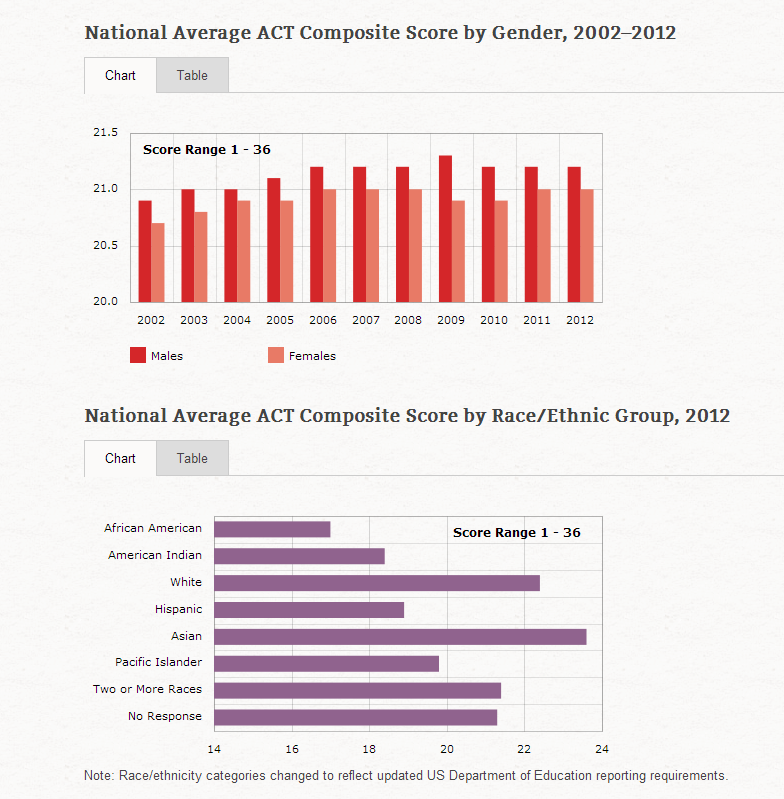
First, consider American College Testing (ACT) scores for the last two decades.

Um…average reading scores for the 2012 graduating class were no higher than scores for the class of 1995. In science the class of 2012 did no better than the class of 1994. The average English score in 1999, three years before passage of No Child Left Behind, was the same as today. Only math scores are up in any statistically significant way.

How about writing? Writing ability seems to be plunging, perhaps because “standardized writing” is hard even to imagine.


(CLICK ON TABLE BELOW TO EXPAND.)


Maybe testing helped close the gender gap. Nope it hasn’t. The gender gap has been consistent for years, hovering just around .2 annually. Males had an average composite score of 21.2 in 2012, females 21.0.

What about a secondary promise of No Child Left Behind? That a focus on testing would eliminate the racial gap?

Also not working!

The average score by race in 2012—which correlates almost perfectly with average poverty rates by racial group—is as follows:

African-American:                            17.0
American-Indian:                              18.4
White                                               22.4
Hispanic                                           18.9
Asian                                                23.6
Pacific Islander                                 19.8
Two or More Races                         21.4
No Response                                   21.3


(CLICK ON TABLE BELOW TO EXPAND.)


What do the figures for the Scholastic Aptitude Tests (SAT’s) show? Huge gains you figure. All these great reforms! Let’s check those gains out.

(CLICK TO EXPAND.)


Well, isn’t that depressing! You almost get the feeling reformers who push standardized testing don’t know what learning is really about.

Math scores for seniors interested in attending colleges and universities are down 9 points since NCLB was made law. Reading scores are down 5. Writing scores again seem to be falling fastest. The writing test was new in 200d and scores are down 9 in six years.

How about the “racial and gender gaps” that No Child Left Behind was supposed to fix? What does the latest evidence show? Good news, I guess.

Male and female students are getting worse scores, but doing it equally. Total scores for both sexes are down 20 points.

With the exception of one racial group, all are performing equally. That is:  scores are in decline.White kids are down (-6 points). So are African-American kids (-13), Mexican American kids (-16), Puerto Rican kids (-9) and Other Hispanic kids (-17).

It’s a debacle.

Only Asian, Asian-American and Pacific Islander kids (all one category for SAT) are doing better. Oddly enough, their scores have increased, in the three tested areas, by a combined 45 points.


(PLEASE CLICK TABLE TO EXPAND.)


How are all the reforms working? Well, terrible, I think you might say. The National Center for Fair and Open Testing adds this note of warning: “Doubling down on unsuccessful policies with more high-stakes K-12 testing, as Common Core exam proponents propose, is an exercise in futility, not meaningful school improvement.”

See also:

http://www.act.org/newsroom/data/1998/tsum.html

http://www.act.org/newsroom/data/2002/pdf/tsum.pdf

http://www.act.org/newsroom/data/2012/trends.html

Tuesday, September 25, 2012

Education Experts Baffled: SAT Scores Decline Again

OH, THE HUMANITY! All those poor education reformers. It's true! SAT scores fell once again last year.

It's a little dip. True. Still, wasn't No Child Left Behind supposed to fix this mess? Didn't President George W. Bush and a bipartisan coalition in Congress promise that NCLB was going to eliminate racial gaps in education? Didn't politicians guarantee this massive new law would insure that every child was proficient in reading and math by 2014?

States were going to raise all kinds of standards--you're darn tootin'--and if test scores didn't go up they were going to get busy and fire a whole bunch of teachers.

So, it's fair to ask, "How are we doing?" If you're a teacher, and you've been getting your brains beat out by the media for most of the last decade, you see this item in the New York Times and you have to wonder:
For the high school class of 2012, the average score on the critical reading section of the SAT college entrance exam, 496, was down 1 point from the previous year, as was the average writing score, 488. The average math score, 514, was unchanged. Also unchanged: only 43 percent of the 1.66 million test-takers achieved the benchmark score, 1550, that indicates readiness for college. Among students whose parents have bachelor’s degrees, though, 60 percent were college ready. The College Board, which administers the test, says those with the benchmark score have a 65 percent likelihood of achieving a B- or higher grade average in their first year in college.
Down two points last year? Could be a statistical anomaly.

Or: it could be our "leaders" can't tell the difference between s--- and standardized testing. I'm thinking, "Charge of the Light Brigade" here. (More about that later.) First, let's look at the bigger picture. I blogged on this same topic in 2011, when scores also fell. Today, all I have to do is quote myself:

[The] weeks and months are ticking by; and we're now less than three years [two today] removed from a time when reformers promise they can take us to a state of absolute academic perfection, when every child in America will be proficient in reading and math.

By now don't you...have to assume the first sweet fruits of success are finally ripe for picking?

So how is the BIG REFORM PUSH going?

I was heading out the door to run a few errands last week--catch up on chores that went untended while I was pedaling [across the United States on a bike]--when I passed the TV and heard Andrea Mitchell on CNN mention declining SAT scores. Mitchell went on to say that Michelle Rhee would be on after a commercial break to explain.

I was in a hurry that day and didn't get to hear Rhee spout. But I'm sure it was fun. Remember her? The woman with the PLAN to save education? The lady who blames teachers for all the nation's academic failings? 

Anyway, SAT scores fell for high school seniors in 2011. It seemed like that might make reformers weep.

Or, weep again this week. Unless you're Rhee. As head of a school reform organization known as Students First, she's had a good year. At the time of my last post on the SAT's, she was busy putting the final touches on a speech about education to be delivered at Kent State and deciding how much to charge for her wisdom. Hmmm...$35,000 sounded about right...

Maybe Rhee should call her organization "Rhee First," if you think about it.

AFTER ALMOST A DECADE OF "REFORM" under No Child Left Behind, after all the preaching of Rhee and Secretary of Education Arne Duncan and a host of others, here's where we land. Since NCLB became law SAT scores are down from 504 to 496 in reading. They're down in math from 516 to 514. Despite billions of dollars spent on all the kinds of reforms reformers have insisted will work, we still don't have one point of gain. And in six short years, since a writing test was instituted, seniors have lost nine points, down from 497 to 488.

I said it last year, I'll say it again today:

Since 2002, when the standardized-testing craze swept America's schools and education experts began acting like zombies in an old science fiction movie--all promising improvement if only we followed them, followed them, followed them--we have been in slow decline.

Rhee, Duncan, Mayor Michael Bloomberg, Joel Klein (his long-time chancellor) in New York, Chester Finn Jr., Steven Brill, the producer of Waiting for Superman and various know-it-all governors will, of course, continue to blame America's "school crisis" on classroom teachers and push their own solutions.

We already have way more charter schools, just as they wanted.

We have more vouchers too.

We have way, way more standardized testing.

And when students fail to meet "standards" we "evaluate" teachers, place the entire burden on their shoulders, and fire them by the thousands.

So why isn't this working? We've listened to experts and we're going nowhere fast, unless you count backwards.

I tried to explain it last fall:

Here's the first problem: We allow school reform to be driven by people like Rhee and governors like John Kasich [in Ohio], Scott Walker (Wisconsin) and Chris Christie (New Jersey), who either went to private schools, send their children to private schools, or both. These are people who want to fix the schools they didn't care to attend.

Secondly, we listen to people like Rhee and Duncan who have only the briefest classroom experience, or like Klein, none at all, and lack insight. It's an odd trend, really. If you placed the top ten names in education reform today and all U. S. Secretaries of Education end to end...their classroom service would not equal ONE thirty-year elementary school veteran in Peoria, Pocatello, or Pompano Beach.

...This idea that if only we get better teachers into classrooms then every student can be a success is shallow and simplistic. It's like saying, "If only ministers gave better sermons sin in the United States would disappear."

A year ago, I feared America's education generals were blind. Today, I'm more worried than ever. I'm beginning to think they're not blind. They're arrogant fools. They're like the Earl of Lucan, Lord Cardigan and Lord Raglan, British officers at the Battle of Balaclava (1854), who confused their own orders and sent six hundred cavalrymen of the famed Light Brigade charging down the wrong valley, with Russians on both sides and Russian cannon bottling them up at the end. Every man in the ranks could look down that valley and tell the attack was doomed and at least one junior officer, a Captain Nolan, tried to redirect the attack. But down the valley they thundered and horses and men were cut down by the hundreds. It was bravery wasted and slaughter without gain.

If you read what Wikipedia says about Cardigan's leadership style, you can substitute "Duncan" or "Bloomberg" or "Klein" (except that they compound problems by leading from the rear) and know where we stand in U. S. education in 2012:
Cardigan survived the battle. Although stories circulated afterwards that he was not actually present, he led the charge from the front and, never looking back, did not see what was happening to the troops behind him. He reached the Russian guns, took part in the fight, and then returned alone up the valley without bothering to rally or even find out what had happened to the survivors...After riding back up the valley, he considered he had done all that he could and then, with considerable sang-froid, left the field and went on board his yacht in Balaclava harbour, where he ate a champagne dinner.
Our leaders in education aren't blind. They see where we're going; but they're too arrogant to realize they're "leading" good troops the wrong way. Like Lord Cardigan they have no interest in looking back and even though their policies continue to fail they keep right on giving advice and then go off and drink their champagne.

Or charge $35,000 to give a speech.


I noticed something odd when I pedaled up Tioga Pass into Yosemite on a bicycle.
It's a rise in elevation of 3100 feet in ten miles and I had to do some very serious sweating.
So far: when experts talk about education reform 
the only people they call on to pedal harder are America's teachers.

WHEN DO WE ASK MORE FROM OUR STUDENTS AND THEIR PARENTS?
 

Thursday, May 26, 2011

Governor Kasich: Clueless on Senate Bill 5


WHY AM I NOT SURPRISED our good Governor Kasich sends his children to a Christian school? Why am I not surprised he doesn’t know what it’s like to work in a public school system that takes every child, not just those who are lucky and rich, or lucky and not handicapped?
Why do I think the Governor doesn't know what it was like for Loveland Middle School teachers when we had the young man in class with the longest criminal record of any juvenile in Hamilton County? 

Why do I think the private schools, vouchers or not, wouldn’t take that kind of young man? 

Why do I think standardized testing won’t help the nine-year-old boy a friend of mine has in class, whose mother is 24, whose father is long gone and probably sexually abused him, who is supposed to wear a diaper every day to school, but doesn’t, and has “bowel issues?” Why do I think when this boy shits his pants in class and denies it when my friend asks—the poor child who sits stewing in filth—why do I think the private Christian school Kasich’s children attend wouldn’t take him? 

Why do I think, Governor Kasich’s promise of merit pay will turn out to be a bait-and-switch move in the end? Probably because the state promised several years back to give any teacher who could go through a rigorous process and win National Board Certification a $25,000 bonus, paid out in ten annual installments. Does the Governor—do all the senators and representatives who voted for Senate Bill 5—even know this program was canceled due to a shortage of funds and many, many teachers never got paid? 

Why do I think a man who made $600,000 in one year at Lehman Brothers doesn’t care in the end about merit pay for regular workers? 

Why do I think all the poor devils who believe standardized testing will save us are deluded? Is it because we’ve been pushing standardized testing for almost ten years and SAT scores are still in decline?

Check it out at collegeboard.com if you don't believe me:

National average in 2002           2010               Gain/Loss in the Age of the Testing Fix

Reading       504                         501                 -3                                         
Math            516                         516                 even
Writing*      497                         492                 -5


Oh, and why do I think, that Kasich doesn’t know that in 2010, when the national average was 1509, Ohio students averaged 1608? 

Why do I think Senate Bill 5 is a bad idea? These are just a few of my favorite educational things.

*The Writing Subtest was first given in 2006