Friday, November 4, 2011

Issue 2, the Business Model, and Ohio Schools


Pedal across Nevada
and you have plenty of time to think.
 This summer I took a solo bicycle trip across the United States to raise money for research on juvenile diabetes. 

When you pedal 4,615 miles alone, you have plenty of time to think about all kinds of political issues.  This is especially true when you're crossing the barren stretches in Nevada.

At one point, after I reached Reno, I passed a billboard advertisement for some private school.  And that got me thinking about Issue 2, here in Ohio. 

By now, you probably know that our Republican governor and our Republican-controlled legislature want to introduce "business efficiency" to Ohio schools.

Well, really, how can opponents of Issue 2 argue against that?  Efficiency!  That's always good.  And business is all about profit, right?  You can't make a case against "profit," can you?  That's capitalism at it's finest.  Right?

Look at the record of for-profit colleges, however, and you may start to wonder.  If Issue 2 passes, is the key word, at the K-12 level in Ohio, going to be "profit" or "education?"

If you haven't been following the news, you may not realize that in recent years enrollment at for-profit colleges, in Ohio and elsewhere, has ballooned to 2,000,000, with much of that growth fueled by $25 billion in federal student loans. 

So:  with all that money dangling in front of your for-profit nose, what's a for-profit school to do?  Well, advertise, of course.  Make it look like going to the University of Phoenix, for example, is a sure-fire path to success.

Only--in too many cases--it's not.  For-profit colleges, which account for 12% of U. S. students in "higher education," rake in more than a quarter of federal student aid money, and end up with an abysmal record when it comes to preparing "graduates" for gainful employment.  As a result, for-profit colleges account for half of all student loan defaults. 

Consider the "business efficiencies" introduced by the Education Management Company (EDMC), based in Pittsburgh and 41% owned by Goldman Sachs.  (With his Lehman Brothers background, Mr. Kasich must salivate when he sees the piles of dollar businesses can make running the state schools.)  The company, which made 89% of its net revenue on student loans, runs Argosy University and Brown Mackie College, among others.

If you want to educate the young--and turn a tidy profit--well, you have to rely on "business efficiencies."  So EDMC developed a system to reward the most successful recruiters, creating what is know in the bowels of  Wall Street as a "boiler-room culture."  Really, it was a telemarketing scheme:  recruiters, and phone banks, and the hard sell, no matter what.  Get those students IN THE DOOR--and bonus pay for solictors who bring in the most business every day.  Take that student loan check, cash it, and put the money in the EDMC account. 

It doesn't matter if EDMC employees enroll students who can't write simple essays.  It doesn't matter if they prey on the desperate unemployed during hard times.  It doesn't matter if they promise to turn marginal students into doctors, lawyers, teachers, computer programmers and nurses.  Students who were clearly on drugs were encouraged to sign up--even students without computers--to take online classes.

So what, if you "hijack the American Dream," as one observer put it?  Sign up those poor suckers, with no chance of graduating, and stick them with hefty federal loans.

Capitalism is about profit--first, second and last. 

Governor Kasich knows that.  He, better than any public sector worker, knows that in the end the free enterprise system has a cash register for a heart and a bank balance where a conscience should go.

I understand if someone wants to vote for Issue 2, if all they care about is keeping their taxes low. 

But don't be fooled by the rhetoric.  There are several provisions buried deep inside Senate Bill 5, that spell disaster for our schools.

Wednesday, November 2, 2011

NAEP Reading Scores Flat-Line in 2011.


ANOTHER DAY in a typical American school, this one in Loveland, Ohio. Time to take attendance. This is a smart class, first period. 

I start my day easy.

“Bloomberg, Michael,” I call out, not looking up from my grade book. “Here.” “George W.?” He’s here, too. “Arne? Arne Duncan?” “Present.” “Klein? Joel Klein?” He’s busy flirting with Michelle Rhee, one row over and doesn’t answer until I call him again.  

“Obama?”

I run down my roster and they’re all here.


In my real class, I asked students to read more books.


“Today,” I explain, “we’re going to discuss reading scores in the United States. Can anyone tell me where this country ranks in reading compared to other nations?”

Hands shoot up all around.

“Michelle?”

“Mr. Viall, in 2003, we ranked 15th out of twenty-nine countries. I think it’s because teachers are in unions....”

“Thank you, Ms. Rhee.”

“I’d like to add that teacher tenure is a major problem,” she continued. 

I have tenure, myself, but I decide not to comment. Little Arne is waving his hand from the back of the room. I call on him for a comment. “Mr. Viall,” he said, “I think the problem is in how No Child Left Behind is being implemented. We need to create national standards...”

“Alright, Arne, I feel your pain. Does anyone know what the latest report from the National Assessment of Education Progress shows?”

The Bush kid raised his hand, seemed unsure, and lowered it again. Nice boy. Not necessarily the brightest boy in the bunch. The new student (born in Kenya one of my colleagues recently said), waved his left hand to get my attention.

“Barack?”
 
“According to recent testing data, U.S. 12th graders had an average score of 286, down one point since 2002. Eighth graders were up one point, to 265, over the same period. Fourth grade scores rose two points over a nine-year stretch, from 219 to 221. According to experts these gains were statistically insignificant.”

“How do you explain this trend, class? If the U.S. is spending billions to implement all kinds of reforms in education, why aren’t scores rising dramatically?”

Michelle has her hand up. I try not to grimace and call on her once more. “I think it’s because we don’t tie teacher pay to test scores.”

The Bloomberg boy, and the Klein kid, both want to speak. “I think we need more charter schools,” Michael says. Joel, his buddy, agrees. “Vouchers, too,” says Joel. “We need vouchers and charter schools.”

“Okay,” I respond. “Let’s say we wanted kids to improve their reading scores – but we didn’t have one additional dime to spend to design new standardized tests and we couldn’t afford to hire one more bureaucrat to draw up all kinds of national standards? What else might work?

The Chisman girl, probably the most logical thinker in the room, put up her hand, and I called on her to respond.

“Well, it’s not like libraries don’t exist. Maybe you could raise scores, without spending a dime, if parents took their kids to the library more often.”

Michelle and Arne and George W. and most of the other kids seemed dumbfounded. “Good point, Lori,” I reply, and shoot her a wink.

Andrea Dubell, the hardest worker in the entire class, waves her hand to get my attention and adds, when called upon, “I think we could raise reading scores in this country without doing anything differently in schools. I don’t think we need more standardized tests, or vouchers, or charter schools. I think if parents read more to their little children and set a good example by reading more themselves, test scores would rise. You know...don’t let kids watch six hours of TV every day.” 

“I think I can improve my own reading score, no matter what you do, Mr. Viall, by reading more for pleasure,” she adds.

A hint of a smile passes over my face, and I tap the side of my skull with an index finger, to indicate that I believe her thinking is sound.

Except for Andrea and Lori, the rest of the class appears stunned.


(For real: I used to give students a list of several hundred books from which they could use to read for my class. See this link.) 


UPDATE (March 2025): As you may realize, most of these fictitious students are named after real “school reformers” from the previous decade. Most of those reformers have moved on to other pursuits – only to be replaced by fresh battalions of reformers with fresh ideas on how teachers can raise test scores. 

Yet, as of March 2025, standardized test scores have stubbornly failed to rise.

Monday, October 31, 2011

Bullies in Middle School and Junior High


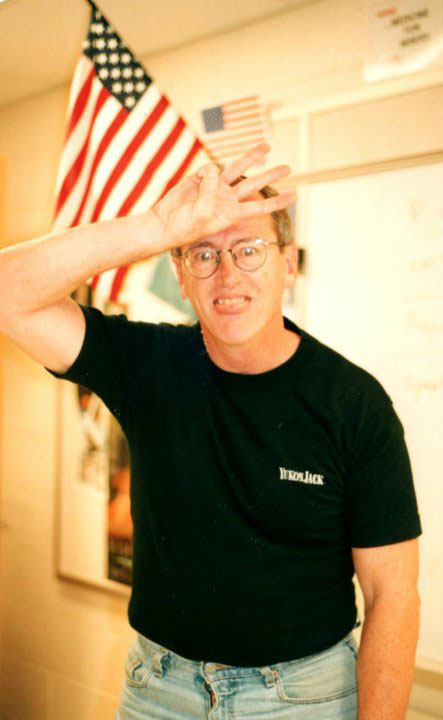
The famous sign of the weenie.

EVERY YEAR, AT THE MIDDLE AND JUNIOR HIGH SCHOOL LEVEL, I knew I’d have one or two students who couldn’t find their niche. I always did what I could to help.

One year it was Phillip, a seventh grader so immature, when asking permission to go to the bathroom, he said he had “a poo poo problem.”

Another year it was Michelle, a sweet-tempered girl, inept in matters of personal grooming. She’d come to class after lunch with a red ring of Hawaiian Punch round her mouth. I had to make sure to tell her to wipe her face before classmates came flooding in. Sometimes during lunch she asked to sit in my room as I graded papers. She didn’t have many friends and only wanted someone to talk to while she ate her sandwich and drank her Punch.

I remember when the “L” sign (for “loser”) came into vogue in the 90s, and remained popular with students for a number of years. I found it offensive.

When I couldn’t break kids of the habit—forming the “L” with thumb and forefinger and placing it to the forehead—I tried indirection. Now and then, for fun, or depending on what we might be talking about in class (we talked about empathy often) I started raising three fingers to form a “W” for “weenie” and stuck them to my head. It was a stupid “insult” but made it hard for teens to focus on their own disagreements when their teacher was standing there with three fingers stuck to his forehead and telling them, “Yeah, you’re a weenie.”

Almost all teens are kind-hearted if they stop to think about what they’re doing and my kids caught on quickly. We began elaborating. A “weenie,” as I explained, was anyone who zoned out during my class or disparaged my absolutely, positively, fantastic jokes. According to students, I was the biggest “weenie” of all.

I can’t argue with that.

We began inventing new forms. If a kid complained about homework I scratched my head in distracted fashion, using three fingers, giving the “Inadvertent Weenie.” Kids invented the “Armpit Weenie” (three fingers and a tickling motion), the “Quadruple Weenie” (two students at once) and the politically-incorrect “Indian Weenie” (three fingers behind the head). Erin Morrison, one of my strongest students, made everyone laugh by demonstrating with various leg kicks and appropriate sound effects the “Karate Kid Weenie.”

A few days later Erin spoke up: “Mr. Viall, make Chelsea show you the ‘Sammy Sosa Weenie!’”

When I called on her to demonstrate, Chelsea McCarty grinned. At the time steroid use was still unproven and Sosa, the Chicago Cubs slugger, was widely admired. Chelsea tapped her heart three times as Sosa did with his index finger whenever he came to bat, only using the three-fingered “W.” Then she touched her lips with the “W,” just as Sosa touched his with an index finger. Then she pointed to the sky like Sosa, using the “W” instead of an index finger. The class applauded and laughed and so did I.

UNFORTUNATELY, THERE’S NOTHING FUNNY about being victimized by bullies. So I interceded to protect targets any time I could. Near the end of my career I had to step in to shield one of my favorite students. Ross was a thoughtful young man, serious-minded, never a problem. There were times when I could see he was down. We talked. He revealed his problems, but only in part. A group of tough kids, none in my classes, had lined up against him.

I offered the usual advice to young men dealing with tormentors: Keep a poker face. Don’t ever give bullies the pleasure of knowing they’re getting to you. Learn to poke a little fun at yourself, leaving no room for others to deliver a true insult of their own. I told Ross about how I suffered in seventh grade when a group of boys picked on me for being skinny.

This seemed to make him feel better, knowing that there was hope in surviving adolescence.

Most kids liked Ross. But outside my classroom walls the bullying was far worse than I understood. One evening Ross’ father (one of my former students) called me at home. He said his son had great respect for what I said. Would it be possible for dad and I to meet? I said yes and suggested he bring Ross, a tactic that usually proved beneficial in dealing with teens.

The three of us sat down together after school a few days later and the story came pouring out. The problem had started in sixth grade, the year before, when a group of poor students singled Ross out for abuse. They never let up, with summer vacation his only respite. Mr. ----- brought up an incident that left me shocked and angry. One of Ross’s tormentors, who towered over him by a foot, had seen him coming down the hall. Ross was carrying an armload of books, his less-scholarly nemesis none. As they passed the bigger boy spat in his face.

“Nobody deserves that, Ross,” I said with outrage, “I don’t care what you have ever said or done. No one deserves that.”

Dad spoke of his love for his son. His eyes brimmed. He reached out and patted Ross on the shoulder. I felt a lump in my throat. This was even more serious than usual.

“Don’t tell anyone I said this,” I continued, “but if they’re going to keep picking on you then you might have to fight.” I described my experience in seventh grade when one of the bullies and I tangled after gym—and after that how he and his friends left me alone. “I don’t think your dad would blame you and it might be worth the three-day suspension to win a little respect.” A hint of a smile finally showed on Ross’s face. I added that he might not want to take on the biggest kid; but at some point he might have to defend himself in a confontration with another member of the gang.

Finally, I promised to speak to the biggest boy, the leader of the wolf pack, the following day. And I won’t deny it. I was pissed.

During my conference period next morning I looked the young man up and asked him to step out in the hall. He was tall enough to look me in the eye. So I looked him in the eye. I told him that while I had not been witness to any incidents “other students” informed me that he was bullying classmates. I didn’t mention names. I didn’t bring up spitting.

I said a parent had also called.

Anatole France once said, “The more you talk, the less people remember.” And that’s the best advice I ever heard when it comes to talking with teens. Keep your points simple and be decisive and precise.

So, I didn’t threaten or lecture. “I don’t know you personally, young man,” I noted. “You don’t know me, do you?”

He said he knew who I was, but no, he didn’t know me.

“I’ll tell you what,” I explained, “I hate to see anyone bullied. You’re a big guy. You look like you can take care of yourself. I doubt you get bullied. But if someone told me you were getting picked on by two high school kids, I’d stand up for you, even though I don’t know you.”

He nodded and, I think, saw my point.

“People who bully others pick on the weak. That’s a form of cowardice,” I added with a touch of scorn. I wanted to call his manhood into question. “Cowardice,” I repeated with a hiss.

Before I let him go, I said again: “If I heard you were being picked on I would come to your defense. If I hear that you are picking on others from now on, I will consider it a personal insult. A personal insult. Do you understand?” I leaned in close and gave him the kind of look my drill instructor at Parris Island sometimes gave us.

He had nothing to add and I let him go in peace. After that he left Ross alone.


Dehumanization of entire groups or individuals should never be tolerated.


POSTSCRIPT: We often talked in history class about how similar all individuals really are. We started the first day of each new school year with this quote from Terrance, a Roman playwright:

“Nothing human is alien to me.” 


I suspect that every teacher knows how difficult it can be to stop bullying. In fact, it usually occurs out of sight of any adult.

In my class we often talked about what I called “labeling” and how “dehumanization” then results. Hitler and his followers referred to Jews as “kikes” and “vermin.” The yellow star they required Jews to wear was labeling made law.

One saw a “Jew” not a human being.

The trouble is the same with all labels: “fag,” “nigger,” “gook,” “retard,” “nerd” to name a few. In my school the “preps” and the “grits” were enemies. The “preps” were well-dressed, richer kids. The “grits” were poorer, tougher kids. As part of a discussion about Nazis, I used to tell students every year, “Next time you see someone you don’t like, say, ‘I hate that…human being.’ It just doesn’t work.”

I couldn’t protect every kid from being bullied, and my approach was never foolproof. Still, in this case it seemed to work. Both Ross and his father sent me kind notes at the end of the year. First, his father:
Your positive influence and words of encouragement made all the difference. Ross looked to you for guidance and without a doubt held you in the highest esteem. You took the time to care that he was struggling and offered him the hand of friendship…Ross is a great kid full of potential. He is also going through a very impressionable time in his life, one full of confusion and self-doubt. We took great comfort in knowing he had you watching over him at school…Your kindness and compassion will always hold a special place in our hearts, but more importantly in Ross’s heart! Thank you for helping Ross through a rough time and helping us get him back on the right path.

Then from Ross:
You always seem to find the funnest ways to get kids to participate frequently and still learn. This is the first year I have actually had fun in social studies/history. You also got me back into reading and I appreciate that. You are always calm (except when we get interrupted in seventh bell…) and I have never personally seen you yell at someone, but I’ve heard stories. You are the best teacher I have probably ever had. When I walk into your classroom I know I am going to have fun, but also pick up a little knowledge at the same time. For the first time in my schooling experience I actually found a class I actually look forward to. Your class really made my 7th grade year enjoyable and less stressful, and I truly appreciate your teachings.

I’m glad I was able to do my part to help.

If your child is being bullied let the adults in his school know; expect them to do whatever they can. Most teachers will help, if they realize what is going on.

Sunday, October 30, 2011

Michelle Rhee: Reformer with a Broom

Is the knife more powerful than the broom?
I'm sorry.  But there are times when the sight of Michelle Rhee makes me gag.  She's an attractive young lady.  That's not it.  She probably looks good in a bikini.

It's what she's been saying, and repeating for years now, and the pathetic way pundits and politicians lap up her "wisdom" that makes me reach for the closest wastebasket. 

You probably don't recall, but Rhee first attracted national attention when Time magazine ran a December 8, 2008 story about her “dynamic leadership” of the troubled Washington, D. C. schools. The cover showed her dressed in black, a broom clutched firmly in one hand.  A caption to the left:  “How to Fix America’s Schools.”  And a caption to the right:  “Michelle Rhee is head of Washington, D. C., schools.  Her battle against bad teachers has earned her admirers and enemies—and could transform public education.”

The title of the story inside was: “Can She Save Our Schools?”  

I taught for 33 years--eleven times longer than the Lady with the Broom--and figured I already knew the answer, but I read the article anyway.           

According to reporters, it was an incident involving Allante Rhodes, a junior at Anacostia High, one of the worst schools in Rhee’s district, that typified the bold leadership the chancellor brought to the task of transforming American education. Rhodes discovered one day that more than half the computers in the school lab were broken. Frustrated, he e-mailed Rhee for help and she answered immediately. (Rhee does everything immediately, and claims to respond to 95,000 e-mails a year.) Soon after, the two sat down for a chat. Rhodes came away impressed. A group of Anacostia kids began meeting with the chancellor to discuss ways to improve the school.

And who could possibly doubt that improvements were needed? 

According to Time students in D. C. were less likely to graduate in 2008 than parents a generation ago. “This is an issue that is warping the nation’s economy and security, and the causes are not as mysterious as they seem. The biggest problem with   U. S. public schools is ineffective teaching, according to decades of research.”  

Rhee promised then (and promises now) to address the problem head on, with a “relentless focus on finding—and rewarding—strong teachers, purging incompetent ones and weakening the tenure system that keeps bad teachers in the classroom.” 

It was bad enough that Rhee believed everything came down to problems at the front of the class. But it was a surprise reporters didn't notice.

First of all, the idea that we had some growing dropout crisis was nonsense. According to the New York Times (October 30, 2009) the high school graduation rate for Americans, ages 18-24, was 80.7% in 1973, and a quarter of 18-24-year-olds were in college. By 2009 the graduation rate was 84.9% and 39.6% were attending college.

The Department of Education broke the dropout rate numbers down like this:

% of Dropouts (16-24 year olds; all students)[1]:   1980  (14.1); 2008  (8.0)

Whites: 1980  (11.4); by 2008  (4.8)
Blacks:  1980  (19.1), dropping in eighteen years to (9.9)
Hispanics:  1980  (35.2), dropping to (18.3)
Asian/Pacific Islanders:  first categorized in 1990 (4. 9), by 2008 (4.4)
American Indian/Alaskan Native:  1990 (16.4); 2008 (14.6)

Look at those numbers carefully. If it’s all teachers, or tenure, what are the chances that all our worst tenured educators end up on Indian reservations?  Isn't it bad enough we stole all their land?
 
And wait:  Can a teacher MAKE a student drop out? 

Well, no matter. 

The Time article continued:  “In the view of Rhee and reformers like her, the struggle to fix America’s failing school system comes down to a simple question:  How do you get the best teachers and principals to work in the worst schools?” Rhee insisted that the answer was tying teacher pay to test results. “The ability to improve test scores is clearly not the only sign of a good teacher,” reporters noted. “But it is a relatively objective measure in an industry with precious few.”

If you were a teacher you read that line and had the sinking feeling that Rhee was deluding herself—that Time was deluding readers—and that experts then, and now, were too arrogant to see they didn't really offer viable solutions. 

Thanks to Rhee, under a new principal Anacostia High was said to be running smoothly. Kids wore uniforms or ended up getting sent home from school. Reporters noted that halls were clear when classes were in session and now the computers all worked. On closer examination, however, it turned out Rhodes and the rest of the Anacostia student body had to be evacuated only weeks before Time ran the story, after fights erupted in the hall and three young men were stabbed. Rhodes told reporters—bad teachers and broom work aside—that he still didn't use the school restrooms which were filthy and unsafe. He waited until he returned “to his grandmothers’ house, where he lives.”

So, if you were a teacher, you rubbed your eyes and wanted to back up a moment. What was the biggest problem in our schools? Wasn’t it “ineffective teachers?” 

Isn’t that what decades of research show? 

Were “ineffective teachers” vandalizing computers before Rhee stepped in to save the day? 

Were they knifing pupils after she did?

Were bad teachers lurking in bathrooms, making them filthy and unsafe? 

And where were Allante’s parents?

If you’re a teacher you wondered why Rhee didn’t use her broom and whack the knives out of the hands of the criminal element and protect the good kids at Anacostia High. In fact, you wondered how test scores could be “a relatively objective measure” of success when students were spilling their blood in the halls outside the classroom door. 

Some day reformers are going to have to face up to the truth and admit that many problems in American education boil down to the stabber vs. stabbed. It’s never a problem to work with kids like Allante Rhodes. He’s motivated and wants to learn. So, I suspect, are most of his peers. Still, we cannot ignore the truth that students were being stabbed at Anacostia High.

This, then, is one of the unanswered questions in education, a question ignored by Rhee and never addressed by voucher advocates nor in landmark legislation like No Child Left Behind.  You can write all the national standards your little reforming hearts desire.

If the question is REALLY teachers, who's going to educate the stabbers and how? 


[1] This is the “status dropout rate:”   the percentage of young adults, ages 16-24, who are not enrolled in school and have not earned a high school degree.

Friday, October 28, 2011

Tea Party vs. Occupy Wall Street

Back in the day, when I was still teaching American history, I tried to be sure my seventh grade students learned to look for all sides in complex arguments. There are times when I wonder if the Tea Party guys aren't partly right and the Occupy Wall Street folks too.

Colonists protest:
Hanging a dummy
of a British tax collector.
In fact, if you tune in cable news today, the coverage is so biased and ridiculous, it's almost pointless to listen.

I'm a liberal, for example. I'm a union guy, too. So I loathe Fox News, which has been chastizing unions for months.

Now I see a story in the New York Times today about the Long Island Railroad and the corruption of their union. I know Fox will cover this story in great detail and vilify unions in general, as if all are corrupt.

In fact, Gretchen Carlson is going to be so upset she'll probably wet her pants.

So here's the basic story: eleven people have been arrested, including a former union president and two doctors, and a variety of people who are receiving pension and disability benefits. Gregory Noone, 62, for instance, collects $105,000 in retirement and disability payments every year after doctors "found" he suffered from severe pain when bending, crouching or gripping objects.

You have to feel for the guy: especially when he's playing golf or tennis, which is often since his tragic retirement. Investigators have evidence that he plays tennis several times a week and "suffered" through 140 rounds of golf during one recent nine-month period.

You have to admire that man's courage in gripping the golf club, despite the pain.

Total losses to the pension and disability funds are expected to run more than $121 million, possibly much higher.

Can big public sector workers unions be a problem, in other words? Of course, they can. And here we want the government--that is the FBI--to step in and arrest the crooks.

But how does anyone imagine that means we can run to the arms of Big Business for safety? This week the New York Times also reported on drug-maker Amgen's agreement to pay $780 million to settle a variety of state and federal lawsuits, accusing it of illegal sales and marketing tactics.

According to one whistle-blower the company overfilled bottles of Aranesp, an anemia drug. This allowed doctors to use the excess dosage to treat patients, charge Medicare and Medicaid extra, and pump up the bottom line. And it certainly helped convince doctors they should be prescribing Aranesp and not some cheaper generic drug.

Meanwhile, over at Clear Channel News, the very soul of conservative talk radio, the company is  making deep cuts in local programming and going with more nationally syndicated shows, which are cheaper to produce. Several hundred employees, including local DJ's like Tony Lynn and Myles Copeland at KBQI in Albuquerque, are out on their fannies and probably wishing they had union protection or even government-backed health insurance.

Robert W. Pittman, just named this month as Clear Channel's chief executive, insists the move is necessary, for the company to run it's business "like it's 2011, not 1970." 

This will allow Clear Channel talk radio hosts to offer a more coordinated message: bashing unions and blaming them for killing jobs and ruining the economy. On WLW in Cincinnati, for example, I recently heard Doc Thompson going on and on about the filthy Occupy Wall Street protestors, "mutants" as he called them again and again.

It reminded me of a Nazi officer who referred to the Jews as "vermin." There was a time when I wouldn't have let one of my seventh graders get by using such language. Nor would I have allowed them to employ such simplistic logic without challenge.

After all, Bernie Madoff and Ken Lay and all the crooks at Lehman Brothers showered regularly and wore $2,000 suits.

This morning, you wonder if a few of those new unemployed DJ's might not be waking up and thinking about joining the Occupy Wall Street protestors.

Its a complex world and we Americans, liberal, conservative and in the middle, are going to have to think seriously about what we really need to do.

Wednesday, October 26, 2011

Why I Loved (Non-Standardized) Teaching: Stefanie's Astute Observation

I'VE BEEN BITCHING too much lately about strange legislation coming out of Columbus, the work of the Ohio General Assembly. So I think I'll do a few posts on why I always loved teaching.

One of the great joys of a life spent in the classroom—at least in a pre-standardized world—is the chance to get kids excited and lead them in a direction (or even follow) that neither they nor you expected to go.

Standardized education anyone?
Try testing this.
Every year, when the time came to look at Native American cultures, I liked to start with a quick discussion of what we called the “TV Indian” stereotype, the idea that all Indians lived the same way. To make the point clear, students listed features of the “TV Indian” lifestyle.

Answers always looked something like this:

Teepees
Feathers
Skin clothes
Painted faces
Bow and arrows
Ride horses
Hunt buffalo
Talk funny, say "How," and "Ugh."

I explained that Native American civilizations varied. For example, some natives relied on corn, beans and squash as dietary staples. “How come no one ever does movies about farming Indians?” I'd ask.

“Because it would be boring,” the kids agreed.

I liked to break into a soulful rendition of “Old McDonald Had a Farm” and ask students to sing along. No one ever did.

AS PART OF THE UNIT, I always showed a series of slides that I created, including one of a woman with a strange-looking elongated skull (see above). Students gasped when the image filled the screen and I explained that standards of beauty vary. Tribes along the Pacific coast, for example, often used a board-like device to reshape babies’ heads.

The higher forehead was considered attractive.

I liked to ask the kids if they could think of any modern American cultural practices that the natives might have found ridiculous. In one class, a girl named Stefanie King raised her hand a moment, thought better of it, and lowered it again. I called on her anyway. She hesitated, looked down from the high dive, and took the plunge. “Mr. Viall,” she said, “their customs seem dumb to us but it’s no different than American women who pay for boob jobs.”

When the roar of laughter subsided, and after I stopped doubling over myself, I replied, “That’s why I like having you in class, Stefanie. You always know how to think.”

IT'S NOT STANDARDIZED EDUCATION, of course, but in those days, a teacher could still use his best professional judgment.

Emily Cavell, one of my star students,
drew this picture of the TV Indian stereotype.

Thursday, October 13, 2011

Ohio Issue 2 and "Bernie Madoff Merit Pay"

Yeah:  We can all agree with that.
Yesterday the Viall household got a slick political brochure in the mail, supporting a "yes" vote on Issue 2.  That's the referendum vote related to Senate Bill 5.

It was a pretty cool ad:  all about merit pay and "rewarding good teachers" and even threw in a little bit of cleavage--a bid to appeal to the "horny vote," I suppose.

Supporters of Issue 2 and Senate Bill 5, of course, hope to baboozle you with a little boobage.  They want you to believe the law is designed to REWARD Ohio educators for superior performance. 

What they don't want you to do is look past the attractive model--because the history of "merit pay" hasn't been very good.

A decade ago, for example, the State of Ohio began promising "great teachers" bonuses if they went through an arduous process and won "National Board Certification."  Some of the best and the brightest applied; but only a fraction of those who submitted materials won this prestigous award. 

Then they settled back to collect their $25,000 bonuses, paid over ten years.

Unfortunately, the State soon ran into budget problems.  So?  The boys up in Columbus announced that the money wasn't there and the bonus part of the plan would have to be scrapped.  That's what we call "Bernie Madoff Merit Pay."

Think it can't happen again?  Of course it can. 

Texas just gutted it's entire merit pay plan, citing deficit issues.  Funds for "rewarding" the great teachers were slashed from $392 million to $40 million, headed for zero soon.  New York City had a $56 million dollar merit pay plan; but when no one could offer proof that merit pay actually improved schools, that plan was scrapped.  Atlanta and Washington, D. C. public schools bet heavily on merit pay to "improve" test scores and ended up with rampant cheating, instead.

If you vote "yes" on Issue 2, because you don't want to pay higher taxes, that makes sense and if that's your sole focus you have every right.

Don't be a boob.
Vote "No" on Issue 2.
 That still doesn't change the real focus and intent of Senate Bill 5:  to deny bargaining power to every public school teacher in the state--including the very best--and every cop, fireman and social worker, too.

It's not a law Republican legislators passed to help the average worker--and if you vote "yes" because you think it is, you've been badly fooled.  You've been mesmerized by the two boobs and now you've voted like a boob.

Governor Kasich is NO friend to teachers--or probation officers--or highway workers--or any other working stiff in the state.  He might keep taxes low and he's a friend to powerful business interests, for sure.  He's a former former Lehman Brothers executive, after all.

That doesn't mean you can believe him when he promises, "The check is in the mail."