1933-1945: Holocaust
“Naked ruthless force reduced to an exact
science.”
1933
This
item is from Remember the Women, in a
NYT book review (April 12, 2015); a
story of Ravensbruck camp.
Overall,
the Germans set up 980 concentration camps; 30,000 slave labor camps; 1,150
Jewish ghettos and 500 brothels where women served as sex slaves. Ravensbruck
opened in 1939, for women, at first, “asocials,” prostitutes, “race defilers,”
and criminals, including political prisoners and Roma (Gypsies).
At this
camp the killings usually involved workers who could no longer serve, who were
sick or weak from hunger. Polish “rabbits” were subjected to medical
experiments, including breaking their legs to work on repair procedures,
insertion of contaminated material to study treatments for German soldiers.
Russian army women tried to resist – refused to make munitions – tried to hold
onto uniforms. After the war those who survived were sometimes sent to Siberia,
on false charges of having collaborated with the Germans.
At
Ravensbruck, killings became a way to make room for healthier arrivals.
Himmler’s
mistress had a baby at a clinic not far from the camp and he took a special
interest in the camp. Siemens and Daimler-Benz both used slave labor and sent
prisoners back to the camps when they could no longer work. With the Russians
approaching, Dr. Carl Clauberg continued to sterilize prisoners.
Rudolf Hoss,
commandant at Auschwitz and then Ravensbruck, admitted later, in the words of
author Sarah Helm, that the urge to kill “was nurtured for so long in the Nazi
psyche that it eventually ran of its own volition, impossible to extinguish.”
Gandhi once
called Hitler’s regime “naked ruthless force reduced to an exact science.”
*
A deck stacked for death.
1933
Problems for
the Reich family began as soon as the Nazis came to power in Germany. Ely (Dux)
Reich had been a nurse in World War I, and for her service was awarded the Iron
Cross. Wilhelm Reich, her husband, was an engineer; but they were Jews, and he
was forced out of his job.
In 1940, the
family fled to Yugoslavia, where Wilhelm died of natural causes. When Nazis invaded,
Ely sent their two children, Werner, and his sister Renate, into hiding, with
different families. Eventually, Werner was found and arrested. While at the
police station, he looked out a window and saw his mother in the prison yard.
He never saw her again.
After the war,
Werner explained how he managed to survive, when millions of others did not.
First, he was sent to the Theresienstadt concentration camp. That camp was used
by the Nazis to disguise the real fate of most of the Jews they had arrested.
Conditions there were not nearly so harsh as in other camps – and Nazi leaders
could point to Theresienstadt for propaganda purposes. See? These camps aren’t
really so bad.
Rumors of mass
extermination were said to be false.
As The New
York Times explained, “At
the Theresienstadt concentration camp in what is now the Czech Republic,
one of [Werner’s] jobs was to exterminate vermin with the cyanide-based
pesticide Zyklon B, which the Germans used in gas chambers.”
His luck changed eventually, and he was
sent to Auschwitz.
…At Auschwitz, when he and other
prisoners ran naked past Dr. Josef Mengele, who would decide who was fit enough
to work and who went to the gas chambers, they tried to appear robust enough to
avoid being selected for death.
“We were running for our lives,”
Mr. Reich told
The New York Times in 2017 for a profile about him. “We tried to look
bigger, stronger. We’d smile, do anything under the sun to look for work.”
Mengele decided Werner was one of the prisoners who could
still work. Luck again.
Then a deck of cards changed his life. Luck again for Werner,
and an older prisoner, who became his friend:
In the Auschwitz barracks where
starving, emaciated, dying men were crammed six to a bed, Werner Reich’s
closest neighbor was a gentlemanly German Jewish man in his 30s named Herbert
Levin, who had been known before World War II as Nivelli the magician.
One day in early 1944, Mr.
Reich, then 16, returned to the barracks from a work assignment, climbed to the
top of his three-tier bunk and watched Mr. Levin shuffle the dirty deck of
cards that prison guards had given him so that he could entertain them – a bit
of protection against being sent to the extermination camp’s gas chamber.
“And I couldn’t understand it,
you know – having a deck of cards in Auschwitz was like finding a gorilla in
your bathroom,” Mr. Reich recalled in a TEDx Talk in 2020. “And then Mr. Levin
turned to me and offered me the deck and said, ‘Pick a card.’ So I picked a
card, and he performed a card trick for me.”
To a teenager who had never seen
a card trick, he said, it was a “miracle.”
Mr. Levin explained the trick,
and Mr. Reich replayed the instructions in his mind for the rest of his time at
Auschwitz – a distraction that helped him survive its horrors – and then
through a 35-mile death march in snow and ice on the way to the Mauthausen concentration camp in Austria. Only after he was
liberated and found his way to England several years later did he buy a deck of
cards and perform the magic on his own.
“And it worked,” he said. “It
worked beautifully.”
Mr. Reich, who became an
engineer after his immigration to the United States, never lost his love of
magic, performing close-up tricks with cards and coins for small groups of
other magicians, at temples and at his sons’ birthday parties.
Many of the prisoners who were forced to march from Auschwitz
died from beatings, cold and exhaustion. Werner suffered from frostbite and lost
parts of the toes on his right foot. He could easily have died in his final months
of imprisonment at Mauthausen, but luck was still with him – and not with him –
and the U.S. Army liberated the camp on May 5, 1945.
The Times adds: “He was
17. He weighed 64 pounds.”
After the war,
he returned to Yugoslavia for two years. Then he fled to England to escape
Communist rule. There he met his future wife, Eva Schiff, also one of the lucky
ones during the war.
She was among the 669
Czech children, mostly Jews, who were rescued before the outbreak of World War
II in 1939 by Sir
Nicholas Winton, a British stockbroker, who used bribes, forgery and secret
contacts with the Gestapo to bring the children to Britain by train and boat.
[Reich] and Miss Schiff married
in England and emigrated to the United States in 1955. After earning a
bachelor’s degree at City College in New York, he worked as an engineer at
Nabisco and the Hills supermarket chain.
Good luck for
one, here and there. Hideous luck for millions. Werner and Eva had two sons,
David and Mikal, and they had children too. His sister, Renate also survived
and came to America in 1948. She married, and spent the next half century in
the United States.
Werner never
knew what happened to Herbert Levin. He kept practicing magic tricks, and eventually
became quite good. Levin, it turned out, had also survived the war, and also
emigrated to the U.S. He died in 1977, but Werner did not learn of his death
for thirty years. Then he read a story about the magician who probably saved
his life. Werner’s own story became the subject of an autobiography, The
Death Camp Magicians.
In a deck
stacked for death, Werner had always picked the right card.
POSTSCRIPT: A few lines from a poem written in 2014, “Could Have,” by Wislawa
Szymborska, seem appropriate here:
It happened, but not to you.
You were saved because you
were the first.
You were saved because you
were the last.
Alone. With others.
On the right. The left.
*
“I Seek a kind person.”
1938
Robert Borger finds safety in Wales, in October 1938, having been
taken in by a foster family named the Bingleys. Back home, in Vienna, in the
wake of the German takeover of Austria, he had been chased through the streets
by SA Brownshirts and Hitler Youth bullies. In March of that same year, the
Germans had marched into Vienna, to be greeted by ecstatic crowds.
Naturally, the
Borger family feared the worst.
On August 3, his
father placed an “help wanted” ad in the Manchester Guardian: “I Seek a
kind person who will educate my intelligent Boy, aged 11, Viennese of good
family. Borger, 5/12 Hintzerstrasse, Vienna 3.” The family in Wales answered
the request – and Robert was saved – as was his mother – who found work as a
domestic servant in England.
His father was
sent to Dachau, but survived, only to die by suicide in 1983.
When his son began
looking into family history, he contacted Nans Bingley, who had “continued to
be ‘a kind, calm, grandmotherly presence’ in their lives, her response is
stark: ‘Robert was the Nazis’ last victim. They got him in the end.’”
Another ad
read:
“FERVENT
prayer in great distress. Who would give a Home to a grammar school scholar
aged 13: healthy, clever, very musical”
In a book by
Julian Borger, we learn his family history, as well as the fates of other
families who advertised, seeking life-saving help. In one case, research led
him to the story of Jews who found safety in Shanghai, where they created a
“Little Vienna,” loosely governed by the Japanese. Then the Germans arrived and
turned the place into a ghetto.
Another teen,
named Gertrude, was passed from foster family to foster family, only to endure what
she described as “a slow orphan-hood,” first worrying about her parents’ safety back home, and then, at war’s end, finally
receiving notification that they had not survived.
As Gertrude, who later became Yehudith
and moved to Israel, expressed it in a line Borger uses as his epigraph: “I
feel as though half of me is fighting the other half by trying to forget,
rather than remember, and I realize that is probably what I have been doing all
my life.”
*
A special family picture.
1938
On Kristallnacht, a group of Nazis stormed
into the Muller family’s apartment in Nuremberg, and used axes to smash furniture,
featherbeds, a cupboard filled with jars of jam and pickles, and even a piano
and cello. In the wake of that night of great destruction – and murder for
others – Norbert Muller, his sister Susanne, and his parents Sebald and Laura ,
began making plans to leave Germany; but they could only manage to get Norbert
to the Netherlands, and later to Britain, as part of a program that saved
10,000 children from German-occupied countries.
For two years, the boy and his family
were able to exchange letters. Included in one letter was a family picture, with
Norbert spliced in, between his sister and mother. In late 1941, however, his loved
ones were shipped to a concentration camp at Riga, in Latvia. A few months later,
they were taken to a forest with thousands of others, shot down, and buried in
a mass grave.
 |
The family photo. |
In 1944, Norbert – now going by the name
of Norman Miller – joined the British Army, where he put his ability to speak
German to good use interrogating prisoners. On May 7, 1945, Miller was posted
at a checkpoint in Hamburg, when a brown Opel, which had been driving erratically,
was ordered to stop. Inside, there were four men, and a check of papers
revealed to Miller, as he later remembered, that “we have a big Nazi fish here.”
That “fish” was Arthur Seyss-Inquart, a
top German official. Miller recognized his name and face from stories in the
newspaper; and he was placed under arrest. (Seyss-Inquart would be hanged on
October 16, 1946, for his war crimes.) Miller later emigrated to the United
States, where he married and started a family. But it was not until 1999,
during a visit to the United States Holocaust Memorial Museum, that he told his
family about the arrest.
In 2013, he and his son Steven traveled
to Riga, to visit the site of the mass grave, and filled three vials of soil,
including one for Michael, his other son. When Norman died in 2024, at age 99, his relatives
sprinkled the dirt from the three vials onto his coffin.
As The New York Times explained, “In
his eulogy, Steven Miller said that the purpose of sprinkling the coffin with
the Riga soil was ‘so that they, who were torn from him and never had a proper
burial of their own, can finally be prayed over and reunited and laid to rest
with their son.’”
*
Half-Aryan Art.
1938
In November 2025, a painting by Gustav Klimt sells
for $236.4 million. Only a painting by Leonardo da Vinci has ever commanded a
higher price at auction. The work shows Elisabeth Lederer.
Benedict Carpenter van Barthold provides the story behind the painting, one of only two full-length Klimt works to survive
World War II.
The
Lederers were a prominent Jewish family. After the 1938 Anschluss (the
annexation of Austria by Nazi Germany), they faced persecution. The family
scattered. But Elisabeth remained, divorced and isolated, in Vienna.
Classified
as a Volljüdin (“full Jew”) under the Nazi regime’s
antisemitic rule, she faced a likely death. In desperation, she circulated a
rumour that she was the illegitimate child of Klimt, the Austrian and Aryan
painter of her earlier portrait.
To
aid this endeavour, her mother Szerena, who had fled to Budapest, swore an
affidavit that Elisabeth’s biological father was not her Jewish husband,
August, but Klimt, a notorious philanderer. The claim was not without
plausibility. Klimt had a long personal relationship with the Lederer
household. Elisabeth’s portrait is itself a document of this interest and
closeness.
The
Nazis, eager to reclaim Klimt’s genius for the Reich, accepted the fabrication.
If Elisabeth was not a “full Jew” but instead a Mischling (half-Jewish),
then the painting itself could be reclassified as an Aryan work of art. With
Elisabeth’s desperate sleight of hand, both she and the painting were saved.
Aided
by her former brother-in-law, a high-ranking Nazi official, Elisabeth was
legally reclassified as illegitimate and “half-Aryan”. This lie successfully
shielded her from the death camps, uniting art history, gossip and survival in
a single legal document.
*
A train headed for life.
1938
On December 10, 500 Jewish children board
a Kindertransport train in Vienna, bound for England and safety. This train is
headed for life, where so many others will be headed for death. Lore Groszmann,
10, is Child Number 152, and one of the
fortunate who will escape the hells of Auschwitz, Buchenwald and Treblinka.
An only child, she will live with four
different foster families, until her parents also escape, on domestic servant
visas, and join her.
Later, she would emigrate to New York,
and write a novel, Other People’s Houses, based on her real-life
experiences. As The New York Times explains in Segal’s [her married
name] obituary:
One of its
early, artful scenes describes the fallout from a knackwurst rotting in Ms.
Segal’s luggage while aboard the Kindertransport. It was a last-minute treat
from her doting parents that she forgets is there. Its pungent smell becomes a
proxy for Ms. Segal’s sense of herself as human contraband, and also an
opportunity for some humor: When the offending package is finally discovered,
flooding young Lore with shame, she hears another child exclaim, “And it isn’t
even kosher!”
The young girl would go on to a
tumultuous relationship with a much older African American man, then be fixed
up on a date with David Segal, whom she married in 1961. (He would die of a
heart attack just seven years later.) In 1985, she would tackle America’s
racial taboos in another novel based on her experiences, Her First American.
As the Times explains:
The book was
Ms. Segal’s rendering and reckoning of her own five-year relationship with
Horace R. Cayton, a Black sociologist who
died in 1970 at 66. He is Carter Bayoux in her novel, and Ms. Segal’s
stand-in is Ilka Weissnix, a surname that translates to know-nothing, as Ilka
explains to Carter, who disputes her translation and supplies his own:
not-white, because she was Jewish.
Ms. Segal and
Mr. Cayton met in a creative-writing class at the New School for Social
Research in Manhattan; she was in her 20s, and he was in his 50s, and it was a
coup de foudre not destined to last – he was already too far gone in his
alcoholism.
In the novel,
the couple meet at a bar in Nevada; Ilka is searching for “the real” America on
a train trip out West. Carter Bayoux becomes her guide and lover. The cultural
critic Stanley Crouch, writing in the foreword to the book’s 20th-anniversary
edition, called it “a quiet, unassuming, hilarious and bold novel that may or
may not be a masterpiece.” He described Carter Bayoux as the most complex Black
character in American fiction since the unnamed narrator of Ralph Ellison’s
“Invisible Man.”
Segal would later tell a reporter that
the novel took eighteen years to write. Ilka was the character that gave her
most difficulty, so, “I settled on making her a newcomer and a naïf because I
wanted to trace her Americanization and her growing sophistication by the use
of her language.”
In her old age, she will compare her
efforts to describe the human condition, to Robert Frost, who once said of
poetry: “It stays our confusion.”
“Other
People’s Houses” concluded with the author’s wonderment at her own tentative
place in the New World: “But I, now that I have children and am about the age
my mother was when Hitler came, walk gingerly and in astonishment upon this
island of my comforts, knowing that it is surrounded on all sides by calamity.”
She also wrote
children’s books, raised her two children, a son and a daughter, and helped
with three grandchildren, before dying at age 96.
*
A Tour of Hell.
1939
In a NYT book review of KL: A History of the Nazi Concentration Camps, the reviewer cites
the case of Moritz Choinowski, a Polish-born Jew who survived six years in the
camps, 1939 until the end of the war. His tour of Hell included stops at
Buchenwald, Auschwitz, Gross-Rosen and Dachau.
A few details
from the book and review:
Primo Levy:
“Trains heavily laden with human beings went in each day, and all that came out
was the ashes of their bodies, their hair, the gold of their teeth.”
Hans Loritz,
SS, who took over one camp explained, “In regards to discipline, I am a swine.”
Rudolph Hoss
had been wounded in WWI; he rose in the ranks and took over at Auschwitz in
1940. Female prisoners worked as tailors and hairdressers for his wife. “Every
wish of my wife, of my children, was met,” he explained.
The first use
of Zyklon-B, there in 1941, dispatched a group of Russian POW’s. “One could see
that these people had scratched and bitten each other in a fit of madness
before they died,” one witness admitted.
Hoss was
pleased with this new method of killing, sparing his SS soldiers the trauma that
followed mass shooting bloodbaths.
At Auschwitz
some prison doctors decided it was best to kill newborns and therefore spare
the mothers for work. Olga Lengyel arrived at the camp with her son. When asked
by an SS physician, Dr. Fritz Klein, how old the boy was she made sure to tell
him he was under 13, and only looked older. This was her way, she hoped, of
sparing him a life of hard labor. At Auschwitz nearly all prisoners under age
14 were gassed, her son among them.
After the war she
still wondered, “How should I have known?”
*
“We never knew when a friend would die.”
1939
NYT obit, 3/18/18: Kalman Aron was born near
Riga in 1924. His mother, Sonia, was from Lithuania. His father, Chaim, was a
custom women’s shoemaker from Russia. After the German invasion his father was
taken away for a work detail and never seen again. The rest of the family was
herded into the Riga ghetto in 1941. His mother was one of 25,000 Jews taken to
the nearby forests and murdered later that year.
Kalman was
later shipped to a series of camps where he was used for slave labor. “I
survived by disappearing,” he later explained. “In the camps, we never knew
when a friend would die. So one way to protect yourself, to insulate yourself,
was to be alone. A deep stark place of loneliness is where I was.”
Guards soon
discovered he had artistic talent (he had been a prodigy at age seven). He
would sketch their pictures or make renderings of their photographs of loved
ones and girlfriends. They would give him extra food or a blanket. “They
wouldn’t pay me anything, but I would get a piece of bread, something to eat.
Without that,” he later explained, “I wouldn’t be here.” “I made it through the
Holocaust with a pencil,” he once told a filmmaker.
He had a brother
who also survived the war; but they lost touch after the Iron Curtain
descended. After the war an American soldier noticed Aron’s talents. He had
sketched his girlfriend; the soldier brought him to the attention of the
Academy of Fine Arts in Vienna. Aron enrolled on a scholarship. The NYT notes:
“He moved to the United States in 1949, newly married, unable to speak English,
by his account, carrying only $4.” He settled in California, illustrated maps
to make a living, “but also completed a pastel portrait drawn from an
indelible, haunting memory: of a mother clutching her child so tightly to her
face that they are almost fused together.” He later made a larger version which
hangs in the Los Angeles Museum of the Holocaust.
Later he
switched to different themes, “vibrant landscapes and portraits,” with famous
clients. Ronald Reagan and Henry Miller both commissioned works. He was married
four times and had one son. “In the camps, I looked at and studied people,” he
later recalled. “The Holocaust gave me an understanding of people that most
people won’t understand.”
 |
"The Lost Children" by Aron.
 |
"Susan" by Aron, painted long after the war.
|
|
*
“Above all,
we must love God.”
1939
The New York Times reports
on a legal
fight involving records kept by the Kusserow family, members of a
pacifist religion, later purchased by a German museum.
The
archive documents the lives and suffering of the family of Franz and Hilda
Kusserow, devout Jehovah’s Witnesses, who were raising their 11 children in a
large house in Bad Lippspringe in northern Germany when the Nazis came to
power. The Jehovah’s Witnesses were the first religious denomination to be
banned, and the Kusserows’ home was searched for religious materials by the
Gestapo 18 times.
In 1939,
the three youngest children were abducted from their school and sent to a Nazi
training school, where they were denied contact with their family. Franz, Hilda
and the other children were all sentenced to prison terms. Two of the brothers,
Wilhelm and Wolfgang, were executed as conscientious objectors.
On April
26, 1940, the evening before he was executed, Wilhelm sent a letter to his
family.
“All of
you know how much you mean to me, and I am repeatedly reminded of this every
time I look at our family photo,” he wrote. “Nevertheless, above all we must
love God, as our Leader Jesus Christ commanded. If we stand up for him, he will
reward us.”
In the end, 1,600 Jehovah’s
Witnesses died at the hands of the Nazis. Another 4,200 were sent to
concentration camps, where they were identified by purple triangles on their
prison uniforms.
If a member of the faith was
willing to renounce his or her beliefs, they could be freed from the camps.
Very few did.
*
Letters for Sala.
1940
NYT obituary (3/14/18): Sala Kirschner dies
at 94. Born Sala Garncarz in 1924 in Sosnowiec, Poland.
At age 16 she
was sent to a Nazi labor camp and survived, unlike so many, till the war’s end.
What made her story unique was her ability to hide 350 letters, postcards, and
notes – and pass them on many years later to her family. Her parents were
gassed at Auschwitz as were most of 35,000 Jews deported from her hometown
during the war. Four siblings also died during the Holocaust.
For years,
Sala kept her letters from her children. “I wanted to raise them in a normal
way,” she once explained, “and not have them take on the burden of their
mother.”
In the camps,
however, letters from family helped her survive. “If I was lonely, I would take
out these letters and read them over and over again. It was my way of feeling
close to them.”
The young
woman was lucky, in a sense, because in some labor camps workers were granted
limited privileges. At first, the Germans wanted the world (and even other
Jews) to believe such camps were ordinary work sites. Prisoners were allowed to
send and receive mail. (The Times
notes the scope of the destruction: none of Sala’s letters to relatives have
survived, nor did most of those she loved.) Sala was first sent to a labor camp
in Geppersdorf, Germany. Male inmates built a stretch of autobahn; female
inmates peeled potatoes and sewed swastikas on German uniforms.
In one letter,
her sister Raizel talks about life in the ghetto back home, coding the news of
a mass deportation. There had been a “big wedding here to which I wasn’t
invited.”
“Be happy, be
glad and thank God a thousand times every day that you still have somebody to
whom you can write with the way things are going here,” she wrote in May 1942.
Not long after Raizel and her sister Blima were sent to labor camps. (Both
sisters survived and ended up in Sweden after the war.)
“Don’t worry
about us,” Raizel added. “But we’re worried about our dear precious parents. We
don’t know what happened to them. May God give us some great news.”
God did not.
Even under
extreme conditions, love could not entirely be extinguished. Sala kept a diary
for a few months. She speaks of an older “guardian angel,” her friend, Ala
Gartner, back home. Gartner would be sent to Auschwitz and hanged later for
participating in a camp uprising.
On another
occasion a Czech Jew, Harry Haubenstock, passed along a note to the young
Polish girl. “You look very cute in your pajamas,” he wrote. As for his own
appearance, he admitted, “I hardly recognize myself any longer. I have changed
so much, and if someone were to see me now, they would hardly believe that I
should be capable of such a deep and sincere love.”
When the
Germans occupied Poland, Raizel was chosen to go to the labor camps first.
Sala, “shrewd and resourceful,” in the words of the Times, “felt her
older sister was too bookish to weather the camp and volunteered to take her
place.”
Sala survived
the war; later she hitchhiked back to Sosnowiec, discovered her family was
gone. Her future husband, Cpl. Sidney Kirschner, an American G.I. spotted her
in the women’s balcony during a Rosh Hashana service and they married in 1946.
He brought her home not long after and they raised three children in Monsey,
N.Y. In later years he encouraged her to put the past behind her.
Her daughter
Ann would later remember asking her about the war; “her eyes would fill with
tears, and it was clear she wanted that door shut.” It was not until 1991 that
she showed a red box full of the letters to her daughter. They were written in
Yiddish, Polish and German. Many carried Hitler stamps and an inked “Z,”
indicating they had been passed through the censors.
*
“To be remembered for longer than they
lived.”
1940
Unlike most Dutch Jews, Marga Minco
would survive the Holocaust, and live to be 103. Most of the rest of her
family, however, was swept away. In Bitter Herbs, in only 89 pages, she
described the situation in which she and those she loved found themselves trapped
after the Germans invaded.
As The New York Times explained in her obituary,
In one
scene, she depicted an absurdist conversation with family members in which they
discussed the most attractive stitch to use to sew the yellow Star of David
onto their clothes to mark themselves as outcasts.
She used the
real names of her family members but fictionalized other details, including her
age. For a pen name, she dropped her given name, Sara, and chose Marga, one of
the aliases on the false ID she had used when she went into hiding.
Sara
Minco was born on March 31, 1920, in the village of Ginneken. She was the
youngest of three children of Salomon Minco, a traveling salesman, and Grietje
Minco-Van Hoorn. From an early age she dreamed of becoming a writer. At age 18,
as soon as she finished high school, she got a job as an “apprentice reporter”
for a local newspaper. In May 1940, in the wake of the German takeover, she was
fired from her position because of her religion. Her parents, however, were
hopeful that the occupation would not be too dire, and, besides, lacked money
to flee.
Her sister
was the first to be deported, with her husband, followed by Ms. Minco’s brother
and his wife. Forced to relocate to the Jewish ghetto in Amsterdam, her parents
were arrested there in 1943. Ms. Minco, who was with them at the time, managed
to flee through a garden fence and went into hiding for the rest of the war.
After the liberation of the Netherlands in 1945, she learned that she was the
only surviving member of her extended family, except for one uncle.
After
the war ended, she married Bert Voeten, a non-Jew, poet, and wartime boyfriend,
who had joined her in hiding. They had two daughters, Jessica, who became a
journalist, herself, and Bettie, who was born in hiding in 1944.
“She was
always a silent person,” Jessica Voeten said of her mother. “The sparseness of
her written words – that’s her.
She added,
“In many interviews she gave over the years, she always said the reason that
she wrote about her family was that she wanted them to be remembered for longer
than they lived.”
In a
story called “The Address,” originally published in 1957, Minco told the “devastating
tale [of] a young girl who returns home after the war to try to retrieve her
family’s possessions, which her mother had left with a neighbor for
safekeeping.”
She recognizes
her mother’s belongings in the strange house, but the neighbor claims they were
not her family’s possessions, and the girl leaves empty-handed. “I resolved to
forget the address,” the girl says as she walks away from the house. “Of all
the things that I had to forget, that would be the easiest.”
*
A
volunteer for the SS.
1940
This next example comes from the San Francisco Chronicle (April 22, 2015), a story titled: Concentration Camp Guard Testifies at Trial.
SS Sgt. Oskar Groening told a German court he helped guard
thousands of Jews at Auschwitz as they left the cattle cars and headed for the gas
chambers. At age 93, he is charged with 300,000 counts of “accessory to
murder.” He admitted seeing another guard silence a crying baby by bashing its
head against a truck. He says he requested a transfer; when it was not granted
he began drinking vodka heavily. “I share morally in the guilt but whether I am
guilty under criminal law, you will have to decide,” he told the judges. He
volunteered for the SS in 1940; worked at the camp 1942-1944; says his main
task was to “help collect and tally money as part of his job of dealing with
the belongings stolen from people arriving;” the presiding judge asked him what
his opinion of this money being sent back to Berlin.
In his opinion, Groening responded, it belonged to the state.
“They didn’t really need it anymore,” he told the court, to the shock of
Auschwitz survivors watching. He could get 15 years in jail.
*
“Sharing
a roof with an SS officer.”
1940
The New
York Times highlights the story of another victim of the
Holocaust, although a survivor. Elsa Koditschek was living in a prosperous
neighborhood of Vienna when the Nazis took over Austria. Herbert Gerbing, an
officer in the German SS, took over her home in 1940. Elsa, a Jew, was allowed
to remain, moving to an upstairs apartment she shared with a tenant known as
“Aunt Sylvia.”
 |
Koditschek as a young woman. |
Eventually, a deportation order arrived, and she was notified
that she would be sent to Lodz, in Poland. She fled instead, leaving behind
most of her valued possessions, including a landscape painted in 1913 by Egon
Shiele, titled “City in Twilight (The Small City II).” For several years “she
hid in the homes of non-Jewish friends,” writing about her life in letters she
sent to relatives. “Who would think I would find
myself sharing a roof with an SS officer?” she wrote, to her son Paul, who had
moved to New York.
That painting was sold during the war – resold several times
since – but Mrs. Koditschek had mentioned it in several letters. The provenance
of the painting was clear. An agreement was recently worked out. When the piece
sells at auction (estimated value today: $12 to $18 million) her heirs will
receive a share of the proceeds.
Elsa was the widow of a Vienna banker and had sent her son
and daughter away for safety as war clouds gathered. She stayed behind in her
three-story home, which she and her husband had purchased in 1911. Upstairs
lives Sylvia Kosmininski, a longtime tenant known as “Aunt Sylvia,” but not a
real relative. When Gerbing moved in she moved upstairs, her family believes,
taking the painting with her.
The Times notes:
The letters do not indicate that
Mrs. Koditschek was particularly fearful of the Nazi she was living with. He
occasionally summoned her to explain how things in the house worked. She
described his demeanor as civil, even after she received “an ominous card”
directing her to show up at a school to be deported to German-occupied Poland.
When she asked the officer if the trip could be delayed, he replied that it
could not, she wrote. But he painted a glowing portrait of what life would be
like in the Lodz ghetto and offered a word of advice, suggesting she bring a
minimum of belongings.
“This was a kind thing for him
to say,” Mrs. Koditschek wrote, “because the luggage of most Jews was robbed
even before they arrived at their destination. Also of course their lives.”
After she fled she lived for years with non-Jewish friends.
She often spent hours hidden behind a cupboard in the apartment of a family
named Heinz. She practiced her English and played chess against herself to while
away the hours. One day, Mr. Heinz came home “under the escort of some strange
men,” she wrote. They began searching the apartment and she had to slip away
through an open door.
The Times again:
“I must have been wearing a magic cap of
invisibility because the plainclothes men did not notice me,” she wrote, adding
that as she roamed the streets that night, “people stared at me as if I was a
ghost from another time.”
Under cover of darkness Mrs. Koditschek
met Aunt Sylvia, and they returned to her home, rushing inside, she said in a
letter, “when the coast was all clear.” For the next two years she lived a
clandestine life there, sleeping on a makeshift bed and hiding whenever the
doorbell rang.
Mr. Gerbing was not often home, she
wrote. Historians have recorded that he had a role in deportation efforts in
Paris, Slovakia and Thessaloniki. When he was away, Mrs. Koditschek noticed,
Jewish laborers, marked by badges, would carry the plunder of war — furniture,
a piano, clothing — into her home. “Wherever he stays,” Mrs. Koditschek wrote,
“in Greece, in France, in Slovakia, he sends big boxes back with goods from
each country.”
“If there was something that had to be
repaired in the house,” she wrote, “the Jews came again, and they also labored
in the garden.”
Eventually, Aunt Sylvia began to run low on money and came to
ask Mrs. Koditschek’s permission to sell the painting and other items, including
a microscope once owned by her son, perhaps in 1943.
Gerbing was killed by a mob in 1945, as the Germans lost
control of occupied Austria.
Russian troops ransacked her home in 1944.
Otherwise, Mrs. Koditschek was extremely fortunate. Of
250,000 Jews who lived in or were deported to the Lodz Ghetto, less than 1,000
survived the war.
 |
The valuable painting. |
*
Turned back at the Spanish border.
(1940)
The
German-Jewish philosopher, Walter Benjamin, having fled his home country in
1933, to settle in Paris, now flees
again, as France falls to German forces. He is stopped at the Spanish
border and ordered back.
Instead,
he swallows enough morphine the night before he is to be deported and takes his
own life.
His
writings were published, mostly after his death, including his legendary “Theses
on the Philosophy of History.”
Before
he fled from Paris, however, he left behind a prized painting by Paul Klee, “Angelus
Novus,” for which he had paid $30.
Klee,
himself, had been falsely accused of being a Jew, his art was deemed “degenerate”
and he was subsequently persecuted by the Nazis – until he and his wife finally
fled to Switzerland.
Klee’s etching,
“Crawling Man,” from 1933, may reflect his fears of the growing Nazi
oppression.
*
“No more
camp for you.”
1941
Henry Bawnik died at 92. He had avoided death twice – once during
the Holocaust, a second time when a ship he was aboard was bombed and sunk
(NYT, 9/11/18). He was rounded up in 1941, at age 15, as
the Nazis liquidated the Lodz ghetto.
He was loaded aboard a passenger ship in the last days of
World War II; Hitler was already dead. Ten thousand prisoners from different
camps had been gathered and loaded onto three passenger ships, “none…believed to
be seaworthy,” as the Times put it.
On May 3, Bawnik watched warplanes approach. They turned out
to be Royal Air Force aircraft and they bombed the Cap Arcona, thinking SS officers were aboard. “We were just
counting the hours before we were going to be dead,” he told the Holocaust Resource Center of Buffalo in
an interview in 2016. “I couldn’t swim.”
The ships began to burn, but Bawnik hung from a rope over the
side away from the fires. A fellow prisoner pulled him up. After the vessel
sank, Bawnik and others were fished from the water and rescued. “What camp are
we going to now?” he recalled asking his rescuers.
“No more camp for you,” he said he was told. “The British are
in town.”
He worked in construction and the dry-cleaning business later
and spent most of his 73 extra years in the United States.
The Times obituary
reads:
Chaim Hercko Bawnik was born in
Lodz on Nov. 16, 1925. His father, Yakov, was a baker. His mother, Nacha (Baran)
Bawnik, tried to run the bakery after her husband died of diabetes in 1932 but
closed it and started money-lending and dressmaking businesses.
Soon after the German invasion
of Poland in September 1939, the Bawniks split up: Henry, his mother and his
sister Rywka moved first to Warsaw and then to Lublin, while his brother,
David, and his sister Dora fled to Russia. Henry, his mother and Rywka returned
to Lodz in early 1940—shortly before the Nazis established part of it as a
Jewish ghetto and sealed it off.
“They gave you so much bread for
a week,” Mr. Bawnik told the Holocaust Resource Center. “You ate the bread up
the first day because you were starving, hungry.” His mother, he said, “would
hide some bread from her own rations and give us a bite during the week.”
Mr. Bawnik said there were
several thousand people in the roundup that sent him from Lodz.
“We didn’t know where we were
going,” he told the Buffalo News in
2015. “They chose the young people that they could get work out of and put us
in the ware-house.” He assumed that he would soon die.
Bawnik was taken to a series of camps. He helped build
railroad tracks at the first camp. At Auchwitz, he looked at the sign that
said, “Arbeit
Macht Frei” (“Work Sets You Free”) and thought he had come to a better camp. He
did not at first believe the talk of prisoners being gassed to death. He
remained at the main camp only briefly, and then transferred to a subcamp, where
he was assigned to work as a bricklayer, thanks to a cousin
who was a kapo. “Because you were a professional, a bricklayer, you were
treated well,” he told the Buffalo News.
“You weren’t beaten to death.”
He was evacuated in January 1945, as Allied forces closed in
and sent to the Dora-Mittelbau camp in Germany. Crammed into cattle cars, many
prisoners died during the 10-day trip. On arrival survivors dragged the dead
from the cars, piled them on wood pyres and burned their bodies up.
In April, he and about 500 other prisoners were moved again,
marched to the Baltic coast, and placed on board the Cap Arcona. The ship was soon filled with prisoners, hoping to
survive the war, terrified death would be their fate. Bawnik told reporters for
the Jerusalem Post, “I was on the
right end, and the wind was going the other way,” he said, when the ship began
to burn. “It took three, three and a half hours, and I could see the floor was
starting to melt; you could see it smoking, it was wood on top of steel, and not
long after that it started tilting.”
Hanging over the side later, he could look down and seem
others jumping into the cold waters. He remembers thinking, “They’re going
down. “A lot of good friends, my God.”
The ship was slowly capsizing. A friend, Peter Abramowicz,
pulled him up and carried him to a partially submerged part of the ship to
await help. The British ordered the Germans to go out and rescue survivors.
As many as 7,000 prisoners had died in the attacks, just days
before the war ended.
Bawnik told his grandson later that he spent the next four
years in Germany, selling cigarettes on the black market. He also drove a taxi.
Many of the Germans in Ahrensbok, the town where he lived, were friendly and generous.
His grandson said later that his grandfather described those years as “among
the best of his life.” He was reunited with his brother and sister Dora. They
left Germany, settled in Israel, but then moved on to New Jersey.
His mother and sister Rywka probably died in Auschwitz.
Bawnik emigrated to this country in 1949. He soon moved to
Hartford, met his future wife Linda Gordon, and married. He is survived by
three daughters, seven grandchildren and two great-grandchildren. He was not
religious and said he survived the camps and the bombing by luck. “If you really believe in God, how could he
do this to his people?” he told the Buffalo
News. “How can you believe in God? It doesn’t make any sense.”
 |
Bawnik in 1949.
|
*
“Kissed
my mother and took his walking stick with him.”
1941
Bret Stephens, writing in the NYT
(6/9/18) takes offense to the words of a German right-wing politician Alexander
Gauland. “Hitler and the Nazis are just a speck of bird shit in over 1,000
years of successful German history.”
Stephens’ maternal grandmother, born Rachel Westerman was
born in the Latvian port town of Liepaja (or Libau) in 1919. She died 96 years
later in Israel. She left behind a book about her life which he long feared to
read. In it she describes a happy Jewish childhood, he says.
When the Soviets took over in
1940, she was living in Riga, the capital, studying and acting and being wooed
by a journalist and playwright named Grisha, her future husband.
The Russian occupation brought
midnight arrests and deportations. The Nazis, who invaded the following June,
brought mass slaughter and enslavement.
Raya’s father, Shmuel, was
arrested along with the other Jewish men on his street in Liepaja on July 14.
He “kissed my mother and took his walking stick with him to the jail,” Raya
wrote. “Later the men were taken to the lighthouse and shot.”
Raya’s older brother, Abrasha,
was arrested on Oct. 1 and murdered about a week later, most likely by
Germany’s Latvian henchmen. “Bye, my girl, I hope we meet again,” were his last
words to Raya. His wife, Zina, was murdered as well.
Grisha’s entire family – his green-eyed
mother, Bella, his older sister, her three children – were murdered in Riga “in
the first days of the German occupation.”
Raya’s mother, Haya, and two of
her sisters, Becka and Ethel, survived a little longer. On Monday, Dec. 15,
1941, they and thousands of other Jews were taken to the women’s prison in
Liepaja. From there, in the freezing cold, they were marched to a nearby beach
called Skede, forced to strip to their underclothes, taken to the edge of a
trench, made to strip naked, and shot in groups of 10. After three straight
days of methodical slaughter, 2,749 Jews – mostly women and children – had perished.
The victims were photographed in
their final moments….
What about Raya? She and Grisha
had barely escaped Riga under heavy German fire. They wound up in Samarkand, in
what is now Uzbekistan, where he enlisted in the Red Army and was badly wounded
in action. In 1945 they were reunited in Riga, and Raya set about discovering
what had happened to her family.
One of the handful of Jewish
survivors of Liepaja (out of the original population of 6,500) had known Raya’s
mother and had tried to help her. “I brought your mother a work certificate
attesting that she was working and did not need to go with the rest,” the
survivor told Raya.
“I begged here to take the
paper, but she told me, ‘I will not take it. My husband is already gone. My
sister, Becka, is terrified, and we will go together. Just know that I am not afraid.’”
She added this:
“If you meet any of my children,
tell them I was not afraid. Tell them to continue living knowing that I was not
afraid.”
In 1972, Raya emigrated to
Israel, which is where I came to know her. She had taken her mother’s words to
heart and had the steady gaze of a woman who feared nothing because she had
seen the worst.
*
“Splintered” family.
1941
Karen Frostig’s grandparents, German Jews, died in the
Holocaust; but until she started doing research, even the camp where they died
seemed forgotten. It was Jungfernhof, near Riga, Latvia.
The New York Times focused on her work in a story in January 2023:
In a week of record cold in late November to
early December 1941, trainloads of 3,985 Reich Jews like her grandparents, who
had been rounded up across Austria and Germany, left Nuremberg, Hamburg,
Stuttgart and Vienna for Skirotava, where they were marched two miles to the
desolate camp. There was no fence; the remoteness and armed patrols by Latvian
auxiliaries barred escape. Prisoners were executed or worked to death, starved,
or died from disease.
An estimated 60,000 other deported Jews
were shot in the nearby Rumbula and Bikernieki forests. In March 1942, the
Nazis pretended they were relocating some 2,000 Jungfernhof prisoners to a
fictional refuge where they would have jobs and medical care, but instead sent
them to their execution, in forests outside Riga, a massacre known as the
Dünamünde Action.
By the time the approaching Red Army sent
the Germans fleeing in 1944, no more than 28 prisoners at Jungfernhof were left
alive, Ms. Frostig established. They were among the 149 people known to have
once been at the camp who survived. Six are known to be still alive, she said,
including two 93-year-old childhood friends from Würzburg whose video interview
last year is online in an extensive project she
created, called “Locker of Memory.”
Herbert Mai of Boynton Beach, Fla., and
Fred Zielberger of Cedarhurst, N.Y., were 12 when they and their families were
forced aboard a transport from Nuremberg to Riga in November 1941. There they
were marched several kilometers to the camp.
“Anybody that couldn’t walk was shot,”
Mr. Mai said.
Seats on a bus were offered. “My mother
wanted to get on,” he remembered, but he dissuaded her. “We walked.” Everyone
on the bus was taken to be shot.
Frostig’s own
father, and her uncle Herman both managed to escape from Germany. Her father almost
never talked about what had happened, only once admitting that the Holocaust had
“splintered” the family.
*
“As if it happened yesterday.”
1942
David Stoliar
(obituary, NYT 1-24-16): Stoliar was
the only survivor among nearly 800 Jews fleeing Romania aboard a refugee ship,
the Struma, a leaky old cattle boat,
with bunks stacked ten high, which tried to land in Palestine. Romania was then
under the control of the fascist Iron Hand, and allied with Hitler.
The vessel was
turned away by British authorities, later interned by Turkey for 71 days, then
towed out of port and set adrift on the Black Sea. On February 24, 1942, a
Soviet submarine sank it with torpedoes, seven miles from the coast. There were
no life preservers on the ship and only two small lifeboats, and all aboard,
save Stoliar, were lost.
He died in
2014 at his home in Bend, Oregon.
Stoliar
remembered that passengers had paid up to $1,000 to gain a place on the ship,
including a promise of visas, which did not exist. Soon after the Struma left port, the engine failed. The
captain of a passing tugboat agreed to fix it but demanded the passengers give
up their wedding rings in payment, for most, their only remaining valuables.
Briefly, the vessel was allowed to dock at Istanbul. One pregnant woman was
allowed to disembark. Nine others were helped by an American oil executive.
Finally, the Turks cut the anchor, and towed the ship into the Black Sea.
There, SC-213, a Soviet sub torpedoed the Struma
because Stalin had standing orders to sink all neutral ships in the area
and prevent supplies from reaching Germany. Stoliar, 19, had been asleep in a
deckhouse and the explosion sent him flying into the air and into the sea.
“When I came to the surface, there was nothing except a tremendous amount of
debris and many, many people swimming in the water. It was very, very cold, and
we had a hard time moving our feet and our hands.”
Stoliar saw a
number of survivors clinging to a partially submerged section of wooden deck,
tangled with metal cables and with part of a ship’s railing still attached. He
grabbed hold and looked around at all the other terrified faces. People were
shivering and sobbing; but as the hours passed the cries for help faded.
Hypothermia and exhaustion proved too much. Some sank out of view; others lost
their grip and floated away. As more and more people died the wooden deck rose
to the surface and Stoliar was able to crawl aboard. That afternoon another
survivor floated by on a wooden door and Stoliar pulled him onto his perch. The
man died soon after. The next day, a passing ship appeared in the distance and
Stoliar was able to wave for help. He was later sent to a hospital in Istanbul,
with frostbite to hands and feet. Then he was jailed for six weeks, he
believed, to keep him from talking to the press. Of the Turks, he later said,
“I was the only witness to their inhumanity, really, from the beginning to the
end.”
He was born in
Romania in 1922; his parents divorced when he was ten and he lived with his
mother in Paris for several years. He returned to Romania in 1936 and graduated
from high school. He was soon taken for forced labor, digging trenches; so his
father, a textile manufacturer, paid for his passage on Struma, hoping to save his son.
He joined the
British Army in 1943, as part of the Jewish Brigade, later fought with the
Israeli Army and worked in Japan for eighteen years. He married and had one son
before his wife died. He remarried and moved to the United States in 1971. In
2000 explorers photographed the wreckage of the ship and interest in the story
revived. Stoliar told one filmmaker in 2001, “For 58 years, no one asked me
about the Struma and I felt that no
one cared. I carried the memories in my head as if it happened yesterday.”
*
“A showman from an early age.”
1942
On September 23, 1942, Robert Max
Widerman (later known as Robert Clary), and his family, including thirteen siblings,
are arrested. Parisian police officers and Gestapo agents arrive and clear out all
the Jews from their crowded apartment
building.
Robert, the youngest Widerman child, is 16.
The teenager had already carved out a bit
of a role as an entertainer and that would save his life. The New York Times
explains: “‘A showman from an early age,’ he had learned to
dance by watching Fred Astaire’s movies and copying his moves. By age 12, he
was singing in a backup chorus with five other children on a weekly Parisian
radio show.”
For most members of his family, arrest was
followed quickly by death at camps like Auschwitz.
The
young, able-bodied men who were deemed capable of work were separated from the
women and children; Mr. Clary [the name he took later], who was 16 but looked
12, managed to stay behind with the men. He would recall his mother’s last
words that day, before she was sent to Auschwitz to die: “Do what they tell you
to do,” she told him. “Tantrums won’t work anymore. I won’t be there to protect
you.”
After
he had been shipped to a nearby concentration camp…he began to perform in
weekly Sunday revues with other prisoners. “Because I entertained, sometimes I
would receive an extra piece of bread and another bowl of soup.”
As
if poised for stardom, he adopted the stage name Robert Clary, taking his
surname from the 1942 French film “Le Destin Fabuleux de Désirée Clary.”
In the years to come, Clary – as he now called
himself – would be transferred to several different camps. But his ability to
perform his song-and-dance routines gave him some value. “That helped me
tremendously when I was deported, because automatically, even in the first
camp, I started to sing for the people who were there, the prisoners,” he would
say later.
“For the 10 minutes that I worked, or the 15
minutes that I sang,” he once explained to a film maker, “they had forgotten
where they were. And that was the most important thing.”
Even the SS guards sometimes enjoyed the show.
This singing, dancing and clowning around, Clary said,“ was second nature to me.”
In April 1945, with Russian troops closing in, Clary
and 4,000 other prisoners were herded out of one camp and marched, in winter,
to Buchenwald. “If you sat down to rest or were too weak to go on,” during that
long march, “you were shot by one of the guards. Twice during those two weeks,
they gave us a piece of bread.” Fewer than 2,000 made it to their destination.
Not long after, Clary was liberated. He
returned to Paris, hoping to be reunited
with lost family. He found success singing in nightclubs. Records he made
attracted an audience in the United States, and in 1949, he emigrated. He found
success again in American nightclubs, even occasionally on Broadway, or in movies.
Then he heard that a TV producer was looking for an actor to play a French
prisoner in a sitcom, set in a P.O.W. camp, during World War II. Hogan’s
Heroes was a hit and ran for six seasons, from 1965 to 1971.
Week in, and week out, the prisoners of
the fictional Stalag 13, managed to outwit the bumbling German head guard, Sgt.
Shultz, and the vainglorious Nazi commandant, Colonel Klink. (Ironically, both
roles were also played by Jews who had escaped the Holocaust.)
As for Mr. Clary,
he had lost both parents, as well as ten brothers and sisters. For years, he
refused to talk about his experiences, but eventually started speaking to high
school students.
Clary soon found that talking about his
time in the camps turned out to be a kind of therapy. “I used to have nightmares I’m
going to be arrested again,” he once told a reporter, “and this time they’re
not going to catch me. But as soon as I talked, the nightmares disappeared.”
“His point was always: Never hate,” a niece
later remembered. “Despite his experiences in the concentration camps, he
always looked for beauty, and to make life joyful for everyone else.”
*
“I love you so much that I was happy to
be deported with you.”
1943
NYT (1-2-16): Marceline Rozenberg was
arrested in 1943, in France, and deported to Auschwitz in 1944.
She was a teen
at the time and went with her father, Szlhama (Schloime) Froim Rozenberg.
Awaiting transport, he told her, “You will come back, perhaps, because you’re
young, but I will not come back.”
She has since done films about the
Holocaust; in one she has an actor stretch out on a bed and speak the words she
said to her father: “I love you so much that I was happy to be deported with
you.” (Her parents had moved to France in 1919, from Poland, because they
wanted greater freedom. France failed the Jews in many ways, she feels, helped
them in others.)
*
“The Devouring.”
1943
Ceija Stojka
was only nine when her Roma family was sent to the first of several Nazi prison
camps.
As The New
York Times explains,
By the end of World War II, an estimated
500,000 Roma and Sinti people – two historically marginalized ethnic groups in
Europe – had been killed, alongside millions of Jews and other victims of Nazi
persecution. Stojka, her mother and four siblings barely escaped that fate; her
father, younger brother and nearly 200 members of her extended family perished.
In the Romani
language, the Holocaust is known as the “Parajmos,” or “The Devouring.”
Many years
later, Stojka took up painting and set out to leave a record of what she had
seen.
In the
painting below, a prisoner looks down a screaming Nazi guard’s gullet, past his
small but menacing teeth. On the back, the Times notes, the artist wrote, “They
devoured us.”
“I must tell how they lived, how they
live today, and what happened to them,” she once explained, regarding the
disasters and the joys of the lives of her family and her people.
Other works
include “Sad Earth,” which she painted on cardboard more than half a century
later. The viewer can almost feel the gusts of wind that sweep across the camp
and hear the cawing of the crows. Huddled prisoners crowd together, perhaps for
warmth, as guards go goose-stepping by. “Careful interventions,” a reporter for
the Times noted, “including a red figure along the bottom edge of the
picture, perhaps a bloodied corpse but as likely a visionary specter of death –
suggest something poetic and fraught rather than reportage.”
In an “Untitled”
work, but set on April 15, 1945, stick figure prisoners walk lift their hands
in shock, for this is the day they did not know was coming, when they would be
liberated by advancing Allied troops.

Sixty years
after she and her family were taken, Stojka would paint “To the Crematoria,”
using her fingers dipped in black to represent so many doomed human beings
trudging toward their ends.
She painted
happier scenes, as well, including a piece called “The Carpet Market,” based on
her own life, selling carpets after the war, and sunflowers, which are symbols
of Roma life.
But she would
never forget, of course, the horrors she had seen – unleashed by other human
beings. “Auschwitz is only sleeping,” she would later say, as memories of World
War II faded into the past.
And,
sometimes, even the victims wanted
to forget. As Roger Rosenblatt wrote not long ago,
A great-uncle of mine survived Auschwitz.
He had been a lawyer in Germany. After the war, he made his way to America and
Brockton, Mass., where he took a job as a salesman in a shoe store. One day,
the owner, seeing that his salesman had a good deal of education, offered him a
higher position in the store. My great-uncle politely refused it. After
Auschwitz, he was content to be a shoe salesman. He was content not to be
noticed. He was content to be alive.
*
Number
136954.
1943
On May 15, after days crammed in a boxcar,
Salamo Arouch, a Jew from northern Greece, arrives at Auschwitz. With him are
his parents, three younger sisters, and a brother.
Back home,
Salamo, 22, had compiled a 24-0 record as a middleweight boxer, his footwork so
skillful, he was nicknamed “The Ballet Dancer.” But in the Death Ring of
Auschwitz, there was no ballet possible. His mother and sisters were
immediately taken away and gassed.
“My family and I arrived at Auschwitz at 6 in the evening,” Mr.
Arouch told The New York Times in 1989. “I was standing all night until the
next day, naked. The Nazis cleaned us with water, disinfected us, shaved our
heads and put numbers on our forearms.” His number: 136954.
Soon after, a camp commandant drove up in a large car, stepped out
and asked if any of the prisoners were boxers or wrestlers. Mr. Arouch raised
his hand.
“The commander did not believe me because of my height,” Mr. Arouch
recalled.
The commander, he said, drew a ring in the dirt; another prisoner
was brought forth; and in the third round the other prisoner went down for the
count.
It was the first of more than 200 fights that Mr. Arouch would win,
with only two draws, he said.
They were “like cockfights,” he said, staged every Wednesday and
Sunday night in a smoke-filled warehouse, with the guards drinking and placing
their bets.
“The loser would be badly weakened,” Mr. Arouch told People
magazine in 1990, “and the Nazis shot the weak.”
As a winner, Mr. Arouch was spared slave labor; he worked as a
clerk.
His father, a laborer, grew weak and was sent to the gas chamber.
His brother refused to pull gold teeth from the dead and was shot
to death.
So: Boxing skill saved one prisoner, and doomed
so many others, the cruelest imaginable version of “sports.” Russian troops
liberated Auschwitz on January 27, 1945. Arouch began searching for any
surviving relatives – but found none. At Bergen-Belsen, however, he met Marta
Yechiel, a teenager from his hometown. They eventually made a home in
Palestine, married, and had four children, and a dozen grandchildren.
In 1989, a movie,
“Triumph of the Spirit,” was made about his life. Part of the film was shot at
Auschwitz, and Arouch returned as a consultant. “It was a terrible experience,”
he admitted. When he approached the rubble of a crematoria, he said, “In my mind
I saw my parents.”
NOTE TO TEACHERS: Were I teaching today, I would ask students if
they thought Arouch would have felt guilty. What other emotions would have
filled his days and nights, after the war?
What kind of conversations could Salamo and Marta have had on nights,
now safe in Israel, when they recalled their lost families?
*
“Why not 13?”
1943
NYT obituary for Johan van Hulst (4/2/18);
also the British Independent, the Jerusalem
Post, the BBC, and other sources: In the
spring and summer of 1943, van Hulst was part of a daring rescue scheme for
Jewish children in Amsterdam. He worked at a teacher’s college next to a nursery.
Children were taken from their parents at a deportation center, sent to the
nursery, then one-by-one, “erased” from the nursery records. They were handed
over a hedge, often to van Hulst, hidden in a classroom and then smuggled into
the Dutch countryside. In all, more than 600 were saved, from infants to
children aged 12.
Records for
the center no longer exist; but as many as 46,000 Jews may have been deported
from there – most headed to extermination camps like Auschwitz and Sobibor in
Poland.
The horror, for van Hulst, came in
knowing only individuals could be saved. He could not save them all – they could
not all vanish without the scheme being revealed. When the nursery was about to
be shut down in September 1943, more than a hundred children remained. He had
to choose. “Try to imagine 80, 90, perhaps 70 or 100 children standing
there, and you have to decide which children to take with you. That was the
most difficult day of my life. You realize that you cannot possibly take all
the children with you. You know for a fact that the children you leave behind
are going to die. I took 12 with me. Later on I asked myself, ‘Why not
13?’”
In 1972, he was recognized by Israel as one of “the righteous
among nations,” for his role in saving Jews during the Holocaust.
In 2012, Israeli
Prime Minister Benjamin Netanyahu told him, “We say those who save one life
saves [sic] a universe. You saved hundreds of universes.”
Van Hulst died
March 22, age 107.
He had started
teaching at the Reformed Teachers’ Training College in 1938. Two years later he
became deputy principal; and when the school ran into financial difficulties
after the Nazis took over, he came up with ways to keep the operation going and
rose to principal.
The
deportation center was also involved in the scheme. The nursery, run by
Henriette Pimentel, began asking him to allow the use of the college garden for
a play area and for use of a classroom for napping. Walter Suskind, a German-Jewish
refugee, who ran the center, also played a key role. He had to convince parents
it was a good choice—to let their children “disappear” from records. Then
Pimentel convinced them to allow children to be smuggled out. Van Hulst was
aided by students and other resistance members. Sometimes, children were
rescued when a tram stopped in front of the center, briefly blocking the Nazi
guards’ view. Then a young woman, working for the resistance, might board the
tram with a child and disappear. Other times, C.A van Wijngaarden, the school janitor kept watch at the
front door. He would let people coming to fetch the children if and keep watch
to make sure the coast was clear. Then, at his signal, they could leave with a
child, from the front door. But only a few could be rescued. “Everyone understood that if 30 children
were brought, we could not save 30 children,” he explained many years later.
“We had to make a choice anyway, and one of the most horrible things was to
make a choice.”
One day, a government examiner arrived at the school without
warning. Hearing a baby crying in a classroom, she went for a look. Were these
Jewish children she asked van Hulst? He hesitated to answer, but she turned out
to be a member of the Dutch resistance, as well. Having discovered his secret,
she shook his hand, but quietly told him, “In God’s name, be careful.”
During all this time, he never told his wife Anna what he was
doing. He did not want her to possess any information that might be
compromising or might even be revealed under torture. Pimentel, for example,
was arrested in July and sent to Auschwitz, where she was one of millions who
were gassed.
At times, van Hulst’s students would watch as German guards led
Jews away. Van Hulst would shout at his students, “‘Let these people do their
job, it’s none of your business,’ while winking at the SS guards, trying to
gain their trust,” it was remembered later. “He performed an act quite
regularly in order to get their confidence.”
According to the BBC,
One of the children Van Hulst helped
rescue was Lies Caransa, who was smuggled out of the crèche [nursery] aged four
while hiding in a bag. Most of her family was later killed at Sobibor, but she
was later reunited with her mother.
“I was not allowed to say
goodbye or cuddle my mother and grandmother, because that might make a scene.”
“I was just allowed to wave. I
felt alone and lonely.”
Johan van
Hulst was born in 1911, in Amsterdam. He had master’s degrees in psychology and
pedagogy and a Ph.D. in humanities. He was a skilled chess player and chaired a
club in the city. When rules were passed that Jews could no longer play the
game with non-Jews, “we decided to secretly play at their houses instead of at
the club. Later this had to stop as well,” he said.
He was humble
about his role. “I was at the center of a particular activity. It’s not about
me. I don’t want to put myself in the foreground or play Resistance hero. All I
really think about is the things I couldn’t do, the few thousand children I
wasn’t able to save.”
An Italian police officer, Giovanni Palatucci, was executed
by the Germans after it was discovered he had helped 500 Jews escape roundup,
by giving them fake “Aryan” papers.
In Belgium, a lack of reprisals led to the arrest of General
von Falkenhausen, who was sent to Dachau.
*
Breakout at Sobibor.
1943
In 2014
archaeologists working at the site of Sobibor came across a wedding ring. It was
traced back to the family of Regina Zielinski.
Regina Zielinski, now deceased,
was a teenager when she hid the ring and just days after that she was part of
the largest breakout of Jewish inmates from a death camp during World War II.
While captive in Sobibor, Regina
had been forced by Nazi guards to sort through the clothes of people sent to
the gas chambers and found her mother's jacket.
“The jacket had a breast pocket
and she hid her wedding ring there but I didn’t give up the ring,” she
recalled, years later.
*
Two
little girls lost – a painting found
1944
In
January, Rosemarie van den Bergh, age seven, and her little sister, Marianne, four,
two Dutch Jews, are sent to Auschwitz after the Nazis raid a home where they
have been hiding.
They do not survive the war – having been gassed on February
11.
The family story is brought into focus long afterward, when
a claim for a lost painting surfaces.
Their parents, Jaap and Ellen, had gone into hiding
separately, hoping to increase everyone’s chances of escaping capture and were not
found. At one point, however, Mr. van den Bergh sold a painting by Camille
Pissarro, a noted 19th-century Impressionist. With the return of peace, he
filed a request, hoping to find and reclaim the painting. “I was forced to sell
the aforementioned piece to procure currency to survive,” he told Dutch
authorities.
“Been in hiding for four years,” he added.
They had a daughter, Suzan, after the war; but her parents
rarely spoke of the two lost girls, or the painting, or their experiences
during the war. The request was lost in a pile of paperwork and discovered
again only in 2015. A search then turned up Suzan, as an heir, and located the
painting “Les Repos,” or “Girl Lying in the Grass,” in a German art museum.
Lengthy negotiations resulted. Suzan van den Bergh did not
want the painting back, so much as she wanted her family story to be told
(although paintings by Pissarro have sold for as much as $32 million). An agreement was reached, to publish a book, The
Girl in the Grass: The Tragic Fate of the Van den Bergh Family and the Search
for a Painting, with publishing costs partly funded by the German museum.
Suzan van den Bergh was said
to be happy because, “She never knew her sisters, her parents never spoke
about it, and that obviously had a big impact on her life. She’s searched
throughout her life to find out what happened, and what her own place is in
it.”
Suzan is quoted in the book as saying: “It is the tiny bit
of life that I can breathe into Rosemarie and Marianne.”
 |
"Les Repos." |
*
“50
meant death.”
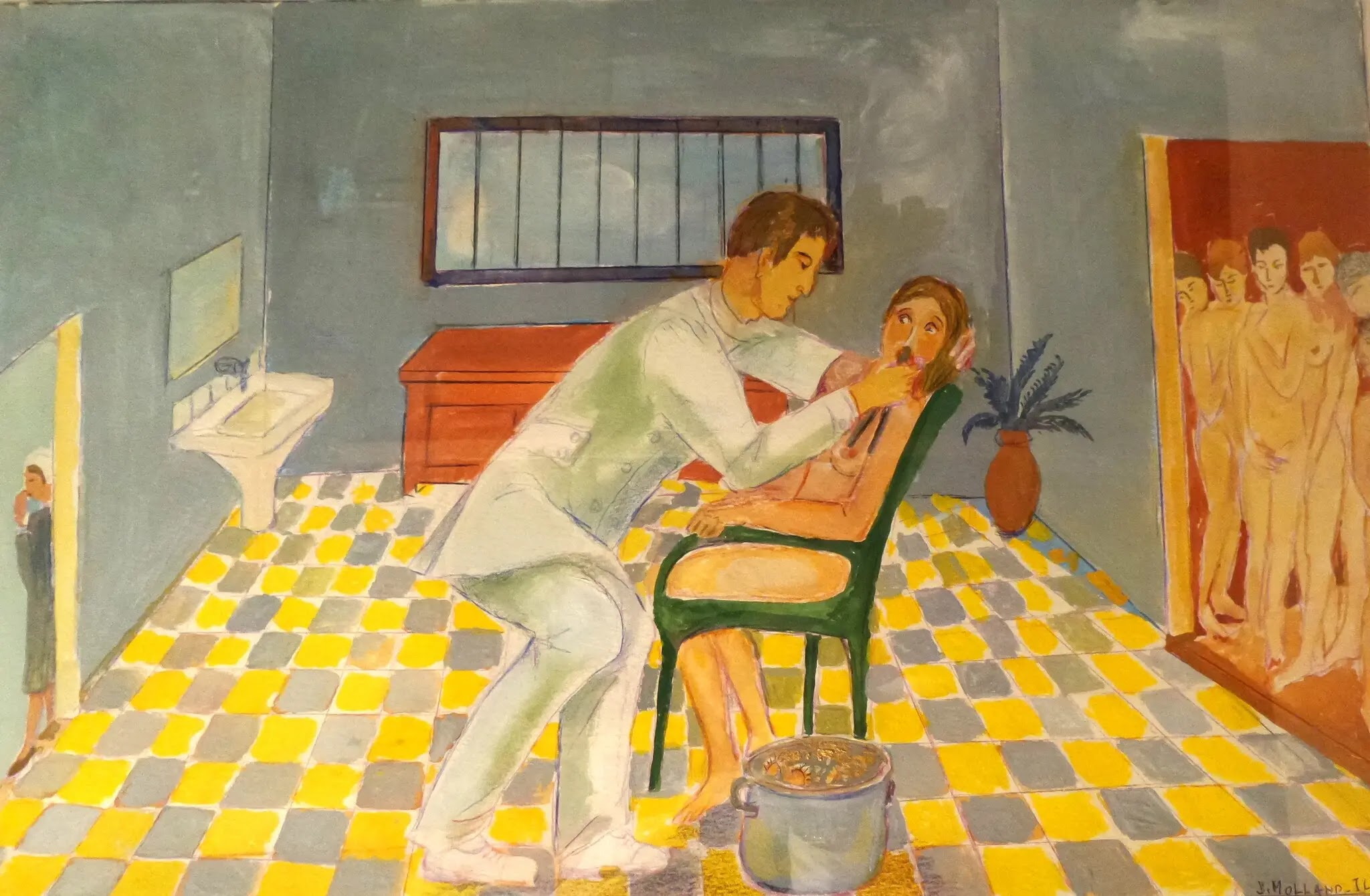
(1944)
Josette Molland, a 20-year-old art student, living in Lyon,
France, is making a good living creating designs for silk weavers in the city,
when the German occupation becomes too unbearable.
Molland joins the Resistance, and put her skills to work,
forging fake Nazi documents. Captured less than a year later, and interrogated
by the Gestapo, she was sent on to various concentration camps, including Ravensbrück.
The
kind of horrors Ms. Molland endured — transported in packed cattle cars,
arriving at the camp at Holleischen to find that a young woman had been hanged
in the courtyard as punishment, sustaining a beating for helping a fellow
prisoner who had collapsed (“Happily I only got 25 blows; 50 meant death”) —
have been recounted before by other camp survivors. And like other victims of
the Nazis, she often gave talks in French schools.
Concerned
that her message wasn’t getting through, she decided to do a series of fifteen
paintings, to better capture her experience. She explained the scenes:
“The Big
Search: In front of the whole camp, a woman, naked on the table, a ‘nurse’
searches her most intimate parts, he finds a gold chain and a medal.”

“Sundays,
these Gentlemen were Bored: They invented a game to distract themselves:
throwing bits of bread from the balcony. A fight ensues. Nothing for the older
women.”
“Collecting the Dead at Night: They are naked, because their clothing
must be used by others. In the autumn of 1944, typhus killed many at the
Holleischen camp.”
“I use them to explain to young
people in the schools what the human race is capable of, hoping that my
testimony awakens their vigilance and encourages them to act, every day, so
they don’t have to live what I did,” she once explained.
Josette’s experience was typical of that terrible time and
place. On arrest, she was tortured by Gestapo agents, but never spoke about what
it was like. When she tried to escape on the way to Ravensbrück, she was
chained by the ankle and thrown onto a pile of charcoal. Soon, she was
transferred to Holleischen, a
slave labor camp, where prisoners worked to make ammunition for the Germans. She
organized a strike – but the guards had a way of breaking the prisoners’
resistance. They were called out at dawn and forced to stand at attention for
hours. If one fell, the guards shot her.
In part, Molland survived by using her artistry to paint a
picture of a guard, and win her good graces. “What I lived in the camps, I can’t even describe it,” she wrote in a memoir.
“Unimaginable. If you haven’t lived it, you can’t understand. Every day we
thought would be our last.”
She went on to
marry, and live fifty good years, she once said.
And when she died at age 100, in March 2024, she was buried – as a brave member
of the Resistance – with full military honors.
 |
A camp dentists looks for gold teeth - full bucket at bottom of scene. |
 |
A prisoner, too weak to continue working is shot in the head. |
*
The “joy” of being tattooed.
1944
In June
1944, Anna Brunn was sent
to Auschwitz, along with other members of her family – arriving by cattle
car, as so many unlucky victims did. She had grown up in a town in Hungary
where 40 families like hers lived separately among a population of 3300.
Anna
had to attend a Jewish high school in a different town – knowing, by 1941, that
Jews were banned from going to college. There, she met Paul Ornstein, a distant
cousin, and they fell in love, only to be separated by war.
At
Auschwitz she would never forget a
last
glimpse of her father and grandmother as they were segregated with other older people
and babies, consigned to the gas chambers.
Anna, who clung to her mother’s hand,
came to believe that they survived because of each other. Her mother shielded
her from the truth about the crematories by telling her that the sweet smell of
smoke hanging in the air at Auschwitz was not, as rumor had it, from burning
flesh. “My blessed ignorance remained relatively undisturbed,” she wrote. “And
blessed it was. It helped me to focus on the day-to-day, moment-by-moment
events, something Mother could not do.”
Anna
would later share her experiences with others. She remembered eating boiled
grass at one point. She and her mother were taken to a stone quarry to work. There,
she wrote, “We carried the stones in silence and dreamed about the thin soup and the
piece of bread we would get at the end of the day.” Only a survivor of these
camps could understand: But when Anna was tattooed on her arm, she felt “joy”
because it meant she had been chosen to perform forced labor and would not be
sent to the gas chambers instead.
In May 1945, she and her mother were liberated
from a forced labor camp at Parschnitz, in Czechoslovakia, when Soviet troops arrived.
She would return to Hungary, to learn that Paul had survived the war, after being
assigned to a forced labor battalion in Ukraine. His mother and brothers had
not been so fortunate and had died at Auschwitz. Anna’s brothers, Paul and
Endre, had also been killed. In 1946, she and Paul Ornstein married, and in
1951 they emigrated to the United States. Both went on to earn doctorates, he as
a psychiatrist, and Anna, now herself “Dr. Ornstein,” built a career in psychotherapy.
Their three children also went on to become
psychiatrists.
As The New York Times emphasized,
despite Anna’s experiences with trauma, “she embraced a school of psychotherapy
that stresses empathy, seeing the world through others’ eyes, and a belief that
all people, even those who seem the most vile, contain a spark of humanity.”
It was her belief, she once said, that everyone
has the capacity to change for the better.
“Self-psychology simply says, ‘Get to know the
other – that the skin color, the religion is not what determines a human
being,’” she said.
*
“Dressing
dolls in a death camp.”
1944
NYT (11/13/18): Archival footage from the documentary
“Shoah” has recently been issued as a new film. The Times notes:
The subject of the segment “The
Merry Flea,” Ada Lichtman, from Poland, recalls how she was forced to clean
dolls taken from Jewish children to prepare them for Germans to give to their
own offspring. “It’s unbelievable, dressing dolls in a death camp,” Lanzmann
says to her. “But everything is unbelievable,” she replies. “It’s unbelievable
being in a death camp.”
Ruth Elias, born in
Czechoslovakia recalls her arrival at Auschwitz, eight months pregnant, and how
she barely avoided selection. But Dr. Josef Mengele controlled the birth and
the fate of her infant.
Hanna Marton tells her story in
a segment called, “Noah’s Ark.” She was part of a convoy of 1,700 Hungarian
Jews that was saved in 1944 by Rezso Kasztner, who negotiated with Adolf
Eichmann.
After the war, Kasztner was
branded a collaborator and faulted for not warning more victims.
Finally, the Times describes the experience of Paula
Biren, who worked for a Jewish women’s police force in the Lodz ghetto. One
night she arrests a peddler and takes him in—almost surely marking him for
deportation. “Did she have a choice but to take part in the ghetto machinery?
She has wrestled with that question for years,” The New York Times explains.
*
“We
were the fuel.”
1944
Lily Engleman, a Hungarian Jew, is 20, when the Nazis finally
come for her family in July 1944. Facing inevitable defeat, as Russian forces batter
German lines in the east, the Nazis still hope to wipe out the last remnants of
the Jewish people; so 440,000 Jews in Hungary are shipped to slave labor camps,
or killing factories, as Lily will describe them, like Auschwitz.
She will later vow to tell the story to the world, write a book,
Lily’s Promise, go on to become a Tik Tok star, and live to 100.
From her New York Times obituary:
Lívia
Engelman was born on Dec. 29, 1923, in Bonyhád, Hungary, to Ahron and Nina
(Bresnitz) Engelman. Her father sold textiles. In her memoir, Ms. Ebert [her married name] described an idyllic childhood, with tender parents and a town that was a
“friendly, bustling kind of place.” One of six siblings – four sisters and two
brothers – she grew up in an Orthodox Jewish family that considered itself
proudly Hungarian. Her father died when she was 18.
In 1944, the Nazis invaded Hungary and
occupied Bonyhád and other towns and cities. First came a curfew – and soldiers
who confiscated family valuables. “Then on May 15, with only an hour’s notice,
Hungarian police officers, guns drawn, forced the town’s Jewish residents into
a ghetto.”
“We thought we were
going for a few days, a few weeks at most,” Ms. Ebert wrote in her memoir. “We
had no idea we’d never come back.”
Weeks passed as Ms.
Ebert and her family lived in cramped quarters and worked weeding fields. Then,
in July 1944, the officers forced all of the Jews in the ghetto onto cattle
cars, squeezed together in fetid air, with two buckets in each car – one for
water, and one to use as a toilet.
When the train arrived at Auschwitz, Lily
watched as soldiers dragged away those too weak to be of any service to their
Nazi captors. Two younger sisters, Bela and Berta, and her mother were sent to the
gas chambers. She and two other sisters were sent to the barracks. In the
distance, she could see smoke pouring from a large chimney where bodies were being
burned in a crematory. As Lily later remembered, when other prisoners told her what
was happening, the reality seemed impossible to comprehend.
“Auschwitz
was really a killing factory – we were the fuel,” Ms. Ebert said in a 2014 interview with the Holocaust Memorial Day
Trust.
In
October 1944, Ms. Ebert and her surviving sisters were sent to Altenburg, in
Germany, a sub-camp of Buchenwald that operated as a munitions factory.
With Germany on the
brink of surrender in April 1945, the Nazis sent Ms. Ebert, her two sisters and
more than 2,000 others from the camp on a death march, but when American forces
began bombing the area, the Nazis fled, enabling Allied troops to rescue them.
Later, in 1956, Ms. Ebert was reunited with her brother, Imi, who had been sent
from the ghetto to a labor camp.
Ms. Ebert would later emigrate to Israel,
where she met her future husband, Shmuel Ebert, like her, a Hungarian Jew. They
married in 1948, and had three children. Esther died of cancer in 2012, Bilha
(later Bilha Weider) and Ahron, both of whom survived their mother. As The New
York Times notes in her obituary, “Ms. Ebert is also survived by her sister
Piri Engelman, 10 grandchildren, 38 great-grandchildren and one
great-great-grandson.”
In 1992, Lily was asked to speak to an
audience about her experiences, and from then on, she worked hard to remind
younger generations about the horrors one set of humans inflicted on another.
“I would talk for my own
sake, and I would also speak for those I loved who hadn’t survived,” she wrote
in her memoir. “And for all the millions of people I never knew who died with
them, all over Europe, I want the world to never forget this terrible crime
against humanity.”
*
“The Bride of Belsen.”
(1945)
On April
15, 1945, British troops liberated the German concentration camp at Bergen-Belsen.
One of the lucky survivors was Gena Goldfinger, 18. She
had spent time in several German camps, including a brief period in Auschwitz.
One of the Brits who took the camp was Sgt. Norman Turgel, and he soon fell in
love with the prisoner, even arranging to take her to dinner at the officers’
mess in the British camp.
She
remembers, “I turned ’round to this Sergeant Norman. “I said: ‘Do we expect any
special visitors? What am I doing here?’ So he says: ‘You are the special
visitor. This is our engagement party.’”
They
married six months later, and Gena became known as the “Bride of Belsen,” a light
of hope in a world shocked by the horrors of war. But she knew the worst of the
worst, once saying, “My story, the story of a survivor, is the story that six
million others cannot tell.”
The
youngest of nine children, her father had died before the war, and she and the
rest of her family were relocated to the Jewish ghetto in Krakow, after the
Germans invaded Poland. The New York Times described her ordeal.
Her other family members were
not so lucky; one, a sister, was subjected to horrible medical experiments.
“I often ask, ‘Why were my
brothers and sister shot? Why was my sister injected with petrol? Was I meant
to be here to tell this story to people who didn’t know?’ Perhaps God guided
me, put me under his wing.”
With her mother, she was moved
to Bergen-Belsen after a brief period at Auschwitz. Another prisoner in her
crowded barracks there was Anne Frank.
“Her bed was around the corner
from me,” Ms. Turgel told the British newspaper The Sun in
2015. “She was delirious, terrible, burning up,” she said, adding that she had
brought Frank water to wash.
Frank…died in March 1945 during
a typhus epidemic at the camp. Ms. Turgel saw the effects of that epidemic up
close: In an effort to ensure her and her mother’s survival, she had talked her
way into a job at the camp hospital.
“The people were dying like
flies – in the hundreds. Reports used to come in – 500 people who died. Three
hundred? We said, ‘Thank God, only 300.’”
After
the British liberated the camp, Gena helped explain the needs of the sick. Her
husband was part of a unit tasked with finding German officers who had
committed atrocities at the camp. He died in 1995. Ms. Turgel was survived by
their three children, as well as by grand- and great-grandchildren.
She once recalled the vows she
had made to herself after her husband took her to England to live.
“I adopted three ambitions,” she
said. “To learn the way of British life, and to learn the English language, and
to write about my memoirs in case I forget. But how can one forget those
atrocities?”
*
“The womb of freedom.”
1945
Samuel Pisar had come a
long way, during the war, to reach the day in April 1945, when he was finally rescued. He was ten years old when Poland was
invaded by both Germans and Russians. He and his family first lived under
Soviet occupation, then, after the Germans invaded Russia, they were sent to a
ghetto. The Germans tortured and executed Samuel’s father, and his mother and
younger sister eventually perished in Hitler’s concentration camps.
In a story about Pisar’s grandson, Antony
Blinken, who later became U.S. Secretary of State, Politico tells the rest
of his story:
Before Pisar was taken away to the camps, his
mother decided he should wear long pants, because it would help him look older.
That, she may have reasoned, might mean he’d be used for labor instead of being
quickly killed. Pisar survived roughly four years in labor and death camps – including
Majdanek, Auschwitz and Dachau – often through sheer instinct. In one instance,
after being chosen for a group marked for the gas chamber, the boy grabbed a
nearby pail and brush and began scrubbing the floor as if that was why he was
there. The ruse worked. He lived.
Pisar
later escaped while on a death march, making a run for it when a squadron of
fighter planes strafed the prisoners, apparently mistaking them for enemy
soldiers. While in hiding, he came across a tank leading an armored convoy.
Instead of the swastika, he saw a five-pointed white star and realized it was
the Americans. “My skull seemed to burst,” he later wrote. “With a wild roar I stormed outside and
darted toward the wondrous vision. I was still running, waving my arms, when
suddenly the hatch of an armored vehicle opened, and a black face, shielded by
helmet and goggles, emerged, swearing at me unintelligibly. … To signal that I
was a friend, and in need of help, I fell at his feet, summoned the few English
words my mother used to sigh while dreaming of our deliverance, and yelled:
‘God Bless America!’ With an unmistakable gesture, the tall American motioned me
to get up, and lifted me through the hatch – into the womb of freedom.”
*
Pemper and Schindler’s List
(1945)
In a New
York Times’ obituary
for Mietek Pemper, we learn about the courage of several key men who saved Jews
from death, by compiling “Schindler’s List.” Mr. Pemper was key. (Spacing is off, for some reason; the next two paragraphs should be indented and are directly quoted from the Times article.)
Mietek Pemper was doing his job as a secretary taking dictation.
One day his boss, Amon Goeth, glanced out the window and saw that a worker did
not have a full load of stones in his wheelbarrow. Mr. Goeth walked outside and
shot the man to death, then returned to his desk and said, “Where were we in
the text?”
Mr. Goeth was commandant of the Plaszow concentration camp just
south of Krakow, Poland, and Mr. Pemper was a Jewish prisoner from Krakow whom
he had forced to be his secretary. Mr. Goeth personally murdered hundreds
during the course of World War II, and Mr. Pemper regarded his assignment as a
death sentence.
“So Mr. Pemper, with
nothing to lose, plotted against Mr. Goeth,” with the help of a second prisoner,
Itzhak Stern. Part of their plotting involved typing the names on what became
known as Schindler’s List, named after Oskar Schindler, a German industrialist.
Schindler was a member of the Nazi Party, and had profited from the slave labor
of prisoners, but turned against the Nazi regime to save nearly 1,200 prisoner’s
lives. (More spacing issues below: next five paragraphs are directly quoted.)
In
his wartime office from hell, Mr. Pemper repeatedly risked his life, using
guile to gain access to classified documents and a photographic memory to
record them. At one point he learned of the Nazis’ plans to exterminate Jews
and others.
He
also learned that many of the labor camps were to be closed and that their
prisoners would most likely be sent to death camps. Only camps making weapons
and other military essentials were to remain open.
Mr.
Pemper passed the information to Mr. Schindler, who had used camp laborers at
his enamelware factory but who by then had become devoted to saving his
workers’ lives. Mr. Pemper encouraged him to expand the operation and offer to
make grenade parts so that the Plaszow camp could remain open. To show that the
factory was up to the task, Mr. Pemper compiled mountains of documentation
crammed with made-up statistics.
The
ruse worked, and the camp stayed open, prolonging the lives of many of its
20,000 inmates. As the massacre of Jews and others accelerated, Mr. Schindler
was able to move his workers to another labor camp and save their lives.
Danger
was constant. Mr. Pemper himself was bitten by one of Mr. Goeth’s two Great
Danes, which he had seen tear an inmate to death. If he misspelled a word, Mr.
Goeth might fly into a rage. The knowledge that the commander had shot an
inmate for serving soup he considered too hot hung in Mr. Pemper’s mind.
In
March 1941, Pemper and other Jews in Krakow were rounded up and sent to a
Jewish ghetto. Pemper had certain clerical skills and could speak several
languages. “The Nazis appointed him to the Judenrat, an administrative liaison
between ghetto residents and the Germans. That experience persuaded Mr. Goeth
to draft him to be his secretary.” (Spacing problems again! Three more paragraphs directly quoted follow.)
In
March 1943 he was ordered to type his first letter to Mr. Schindler, not
knowing that the industrialist had turned against the Nazis. The letter advised
Mr. Schindler that ever stricter regulations meant his workers could no longer
walk the two and a half miles from the camp to his factory. Mr. Schindler, who
had socialized with the Nazi elite, soon lavished his charm on Mr. Goeth to win
permission to build barracks on his factory grounds.
Mr.
Stern, Mr. Pemper’s best friend in the camp office, told Mr. Pemper to trust
Mr. Schindler. Mr. Pemper was staggered by the risks the German entrepreneur
was taking.
“His
courage restored my faith in humanity,” he said. Referring to Mr. Goeth and Mr.
Schindler, Mr. Pemper wrote that it was “like having an angel on one side and a
demon on the other.”
As the Times explains, Pemper
told Schindler as little as possible, so that, if they were discovered, the businessman
could never be accused of knowing classified information. As for Commandant Goeth,
he did not question the fraudulent data that “proved” the camp should remain open.
Pemper eventually came to realize that Goeth
feared being sent to the Eastern Front, where German forces were being chewed
up in endless fighting, if the camp closed.
Mr. Schindler put Pemper’s parents and
brother on the list and saved them. After the war, Pemper testified against Goeth
in a war-crimes trial.
The commandant was convicted and hanged.
*
“You
are free!”
1945
On the morning of April 11, 1945, Rabbi Heschel Schacter
learns that tanks of General George Patton’s Third Army have reached the Buchenwald
Concentration Camp. Realizing the importance of the moment, he gets a jeep and
driver, and races for the spot.
By the time he arrived, tanks had plowed through the
barbed-wire fences, but smoke was still rising from the crematories, and the
smell of burning flesh filled the air. Hundreds of bodies lay all scattered
about. At first, it seemed there were no prisoners alive; but a lieutenant the
rabbi knew took him to a smaller camp, within the complex.
He was led to the
Kleine Lager, or Little Camp, a smaller camp within the larger one. There, in
filthy barracks, men lay on raw wooden planks stacked from floor to ceiling.
They stared down at the rabbi, in his unfamiliar military uniform, with
unmistakable fright.
“Shalom Aleichem, Yidden,” Rabbi Schacter cried
in Yiddish, “ihr zint frei!” – “Peace be upon you, Jews, you are free!” He ran
from barracks to barracks, repeating those words. He was joined by those Jews
who could walk, until a stream of people swelled behind him.
As
he passed a mound of corpses, Rabbi Schacter spied a flicker of movement.
Drawing closer, he saw a small boy, Prisoner 17030, hiding in terror behind the
mound.
“I was afraid of
him,” the child would recall long afterward in an interview with The New
York Times. “I knew all the uniforms of SS and Gestapo and Wehrmacht, and
all of a sudden, a new kind of uniform. I thought, ‘A new kind of enemy.’”
With
tears streaming down his face, Rabbi Schacter picked the boy up. “What’s your
name, my child?” he asked in Yiddish.
“Lulek,” the child replied.
“How old are you?” the rabbi asked.
“What difference does it make?” Lulek,
who was 7, said. “I’m older than you, anyway.”
“Why do you think you’re older?” Rabbi
Schacter asked, smiling.
“Because you cry and
laugh like a child,” Lulek replied. “I haven’t laughed in a long time, and I
don’t even cry anymore. So which one of us is older?”
Rabbi
Schacter discovered nearly a thousand orphaned children in Buchenwald. He and a
colleague, Rabbi Robert Marcus, helped arrange for their transport to France —
a convoy that included Lulek and the teenage Elie Wiesel — as well as to
Switzerland, a group personally conveyed by Rabbi Schacter, and to Palestine.
For decades afterward, Rabbi Schacter
said, he remained haunted by his time in Buchenwald, and by the question
survivors put to him as he raced through the camp that first day.
“They were asking me, over and over,
‘Does the world know what happened to us?’” Rabbi Schacter told The Associated
Press in 1981. “And I was thinking, ‘If my own father had not caught the boat
on time, I would have been there, too.’”
Rabbi Schacter stayed
behind at Buchenwald for many months, doing all he could to help the survivors
recover. At one of his weekly Friday night services, Lulek and his brother were
able to attend, and say the Kaddish for their parents, Polish Jews who had
already been killed by the Nazis.
As for Lulek? The
boy would make it to Palestine after the war and grow up to become Rabbi Yisrael Meir Lau, the chief rabbi of Tel
Aviv.
*
When Franz von
Mendelssohn dies in 1935, he was “a partner at the Mendelssohn Bank in Berlin
and also an instrument collector.”
With the rise
of the Nazis, Jews had increasing difficulty shielding valuable possessions
from Hitler’s greediest followers. A Stradivarius violin, made in 1709, was one
of Franz’s most valuable instruments, and was “in storage at the Mendelssohn
Bank in 1938 when the Nazis forced the bank into liquidation. Its assets were
largely acquired by Deutsche Bank.”
In 1945,
amidst the chaos that attended Germany’s defeat, the violin disappeared. It now
appears that it went through a number of hands, before being sold to its
present owner, a Japanese musician.
The instrument
has an
estimated value of $5,000,000; and the heirs of the Mendelssohn family are
hoping to win it back.
*
Post-War Trials
Fritz
Bauer rose to prominence, after World War II ended. Unlike most Germans, in the
post-war years, he helped force people to
face a reckoning for the crimes of their nation.
The
overarching crime, of course, Bauer described as “the industrialized mass
murder of Europe’s Jews.”
Bauer,
himself, was fortunate to have survived. In a review of a book by Jack Fairweather,
The Prosecutor, we learn:
A bookish judge in Stuttgart
under the Weimar Republic, Bauer was triply anathematized in Nazi Germany: He
was Jewish, a Social Democratic foe of Nazism and a secretly gay man. He and
his fellow Social Democrats were shaken by the readiness of establishment
conservatives who “went along with Hitler’s desire to upend the democratic
order.” Bauer was lucky to survive six terrifying months in the concentration
camps, where he was repeatedly beaten. He emerged to find a police state where
Jewish doctors could not practice and Jewish stores were boycotted, while
Stuttgart’s non-Jewish residents unconcernedly got on with their lives. As
Christmas drew near, Fairweather writes, “girls from the newly renamed Adolf
Hitler School sang carols.” Bauer fled to Denmark in 1936 and then to Sweden in
1943, after a Danish rabbi warned that the occupying Germans were about to
round up all the Jews in the country.
Fairweather’s book makes for an
uncomfortable reminder of how many Germans supported the Third Reich. The legal
ideal of individual criminal justice crumbled before the more than 250,000
Germans who had served in the SS, murdering at Auschwitz and the other death
camps in German-controlled Poland, or as part of the mobile killing squads
called the Einsatzgruppen; the indoctrinated soldiers of the German military
who had backed up the Einsatzgruppen’s massacres, shot Jews themselves or used
Jews as slave labor, as well as killing vast numbers of Soviet prisoners of war
and civilians; the bureaucrats and lawyers who had arranged the logistics of
genocide; and the nearly 14 million Germans who had voted for the Nazis in July
1932, although Hitler’s vicious hatred of Jews had been flaunted in “Mein
Kampf” and his fulminating speeches.
In
1956, Bauer became attorney general for West Germany’s largest state and began
to focus on bringing Nazi criminals and others who made the Holocaust possible,
big and small, to justice. Early on, he issued an arrest warrant for Adolf
Eichmann, known to be alive, but in hiding.
…The
first head of West Germany’s new foreign intelligence agency was Reinhard
Gehlen, previously the Third Reich’s chief of military intelligence for the
eastern front in World War II. He knew where Eichmann had gone to ground in
Argentina, but did not inform Bauer, instead putting the German prosecutor
under surveillance.
When
Bauer unexpectedly got a tip from a Dachau survivor with Eichmann’s address in
Argentina, he did not dare ask the West German police to run it down. Instead
he passed his information to the Israelis and kept exhorting them to grab
Eichmann – leading eventually to his abduction from Buenos Aires and his
dramatic 1961 trial in an Israeli court in Jerusalem.
In the
mid-60s, he put twenty German officers and functionaries, who had operated
Auschwitz on trial.
Bauer
made a point of prosecuting not just senior camp leaders but also lower-ranked
Germans, since every person operating the death camp contributed to mass
murder. The most devastating testimony came from Auschwitz survivors, one of
whom described the mortal terror of people in the gas chambers, some taking 10
or more minutes to die, struggling frantically, their corpses covered in blood
from their noses and ears.
This
blogger wanted to highlight one final detail from The New York Times Review
of Books.
An
Austrian Jewish survivor recalled the words of a little boy who was to be
gassed the next day: “No, I’m not afraid. It’s all so terrible here, it can
only be better up there.”