
IF YOU TOUCH ON THE HOLOCAUST in class here are
a few photos (mostly from the internet), a few ideas I used in class, and a few stories I have encountered since I retired and would try to use if I was still teaching.
(Use whatever you can.)
First, you might be surprised, as I was, if you address
the topic in class. By the time I left the classroom in 2008, I was running
into students occasionally who no longer recognized the man below.
 |
| Hitler fought bravely in World War I and won the Iron Cross. How would history have been altered if a bullet had killed him in 1915 or 1916? (Photo owned by author; feel free to use it.) |
 |
| Hitler walks with Helga Goebbels, the daughter of his propaganda minister. |
IN MY CLASS WE BEGAN a Holocaust unit by focusing
on “dehumanization.” The Nazis, I explained, referred to Jews and others as
“vermin.”
I suggested to students that most people are at
times guilty of “labeling” others, or “seeing all members of a group as
the same.”
I said it was easier to hate people you “labeled”
because you never thought about them as individuals.
For this lesson, I had to be careful. But when I
asked kids if they could think of any “labels” people used examples always came
pouring out: kike, fag, gook, nigger, retard and many, many more.
It made students uneasy to realize that when
they were sometimes guilty of dehumanizing others, for instance, when they
called classmates “nerds” or “losers.”
One of the most powerful moments I ever
experienced in a classroom came when, near the end of this very discussion,
just as my fourth bell class was about to end, a young lady held up her hand. I
called on her; and in an anguished voice she announced, “Mr. Viall, the other
kids label me. They call me a ‘dog.’”
I think her peers were stunned to recognize their
own guilt and I waited for someone to offer explanation.
No one dared utter a word and I had to fight
back tears, myself. Then the bell rang for lunch and the class filed out in complete
silence. I think they had looked in a mirror, as it were, and had not liked the
image they saw reflected.
I stopped the young lady before she could leave
and told her she was one of my favorite students.
 |
| What is the boy in the cap thinking? What is his mother thinking? What are those Nazi soldiers thinking? |
 |
| Pages from the diary of Anne Frank. |
 |
| Trouble for the Jews in Germany began as soon as Hitler came to power. Here party members call for a boycott of this Jewish-owned store in 1933. "Kauft nicht bei Juden" means "Do not buy from Jews." |
 |
| Jews were required to wear yellow stars. In the camps homosexuals wore pink triangles. |
I tried to
point out to my students that the yellow star was just a kind of label. You saw
it, you need not think about the person.
This made
hating easier.
 |
| This Jewish family in the Netherlands was wiped out. |
 |
| Some were lucky. Leo Goldberger (second from right) and his family were helped to escape by boat from Denmark. They found safety in Sweden, a neutral nation. He was 13 at the time. |
His story can be found here.
 |
| Selection: Upon arrival Jews and other prisoners were sorted according to their usefulness. Healthy young men and women might make good slave laborers. Most young children would be taken to the gas chambers immediately. |
TELL THEM I WAS NOT AFRAID
I would use this story for
reasons I think are clear....
Bret
Stephens, writing in
the NYT (6/9/18) takes offense to the words of a German right-wing politician
Alexander Gauland. “Hitler and the Nazis are just a speck of bird shit in over
1,000 years of successful German history.”
Stephens’
maternal grandmother, born Rachel Westerman was born in the Latvian port town
of Liepaja (or Libau) in 1919. She died 96 years later in Israel. She left
behind a book about her life which he long feared to read. In it she describes
a happy Jewish childhood, he says.
“When
the Soviets took over in 1940 she was living in Riga, the capital, studying and
acting and being wooed by a journalist and playwright named Grisha, her future
husband.
“The
Russian occupation brought midnight arrests and deportations. The Nazis, who
invaded the following June, brought mass slaughter and enslavement.
“Raya’s
father, Shmuel, was arrested along with the other Jewish men on his street in
Liepaja on July 14. He ‘kissed my mother and took his walking stick with him to
the jail,’ Raya wrote. ‘Later the men were taken to the lighthouse and shot.’
“Raya’s
older brother, Abrasha, was arrested on Oct. 1 and murdered about a week later,
most likely by Germany’s Latvian henchmen. ‘Bye, my girl, I hope we meet
again,’ were his last words to Raya. His wife, Zina, was murdered as well.
“Grisha’s
entire family—his green-eyed mother, Bella, his older sister, her three
children—were murdered in Riga ‘in the first days of the German occupation.’
“Raya’s
mother, Haya, and two of her sisters, Becka and Ethel, survived a little
longer. On Monday, Dec. 15, 1941, they and thousands of other Jews were taken
to the women’s prison in Liepaja. From there, in the freezing cold, they were
marched to a nearby beach called Skede, forced to strip to their underclothes,
taken to the edge of a trench, made to strip naked, and shot in groups of 10.
After three straight days of methodical slaughter, 2,749 Jews—mostly women and
children—had perished.
“The
victims were photographed in their final moments….
“What
about Raya? She and Grisha had barely escaped Riga under heavy German fire.
They wound up in Samarkand, in what is now Uzbekistan, where he enlisted in the
Red Army and was badly wounded in action. In 1945 they were reunited in Riga,
and Raya set about discovering what had happened to her family.
“One
of the handful of Jewish survivors of Liepaja (out of the original population
of 6,500) had known Raya’s mother and had tried to help her. ‘I brought your
mother a work certificate attesting that she was working and did not need to go
with the rest,’ the survivor told Raya.
“‘I
begged here to take the paper, but she told me, “I will not take it. My husband
is already gone. My sister, Becka, is terrified, and we will go together. Just
know that I am not afraid.”’
“She
added this:
“‘If
you meet any of my children, tell them I was not afraid. Tell them to continue
living knowing that I was not afraid.’
“In
1972, Raya emigrated to Israel, which is where I came to know her. She had
taken her mother’s words to heart and had the steady gaze of a woman who feared
nothing because she had seen the worst.”
 |
| Arriving in a camp. |
EVERY DECISION
DURING SELECTION could make the difference between life and death; notes from
another story:
In a NYT book review of KL: A History of the Nazi Concentration Camps, the reviewer cites
the case of Moritz Choinowski, a Polish-born Jew who survived six years in the
camps, 1939 until the end of the war. His tour of Hell included stops at
Buchenwald, Auschwitz, Gross-Rosen and Dachau.
Primo Levy: “Trains heavily laden
with human beings went in each day, and all that came out was the ashes of
their bodies, their hair, the gold of their teeth.”
Hans Loritz, SS, who took over one
camp explained, “In regards to discipline, I am a swine.”
Rudolph Hoss had been wounded in WWI;
he rose in the ranks and took over at Auschwitz in 1940. Female prisoners
worked as tailors and hairdressers for his wife. “Every wish of my wife, of my
children, was met,” he explained.
The first use of Zyklon-B, there in
1941, dispatched a group of Russian POW’s. “One could see that these people had
scratched and bitten each other in a fit of madness before they died,” one
witness admitted.
Hoss was pleased with this new method
of killing—sparing his SS soldiers the trauma that followed mass shooting
bloodbaths.
At Auschwitz some prison doctors
decided it was best to kill newborns and therefore spare the mothers. Olga
Lengyel arrived at the camp with her son. When asked by an SS physician, Dr.
Fritz Klein, how old the boy was she made sure to tell him he was under 13, and
only looked older. This was her way, she hoped, of sparing him a life of hard
labor. At Auschwitz nearly all prisoners under age 14 were gassed, her son
among them. After the war she still wondered, “How should I have known?”
 |
| What would these prisoners be thinking when they arrived at the camp? |
I CREATED A DETAILED and horrifying reading for
my students. Here I describe how guards lured prisoners to their deaths.
At camps like Auschwitz and Treblinka:
At camps like Auschwitz and Treblinka:
…victims arrived by the trainload, to be gassed
in large chambers disguised as showers. Sometimes guards told new arrivals to
tie their shoes together so they could find them after their “bath.” There were
numbered hooks for hanging clothes and signs in many languages saying:
“Showers.” One guard encouraged victims to move faster. “Hurry,” he
lied. “Coffee is waiting. Coffee is ready in camp.”
At another camp, flowers were planted round the
gas chambers. Meanwhile a band of pretty Jewish girls in white blouses and
navy-blue skirts entertained those about to die. The music they were ordered to
play was always merry.
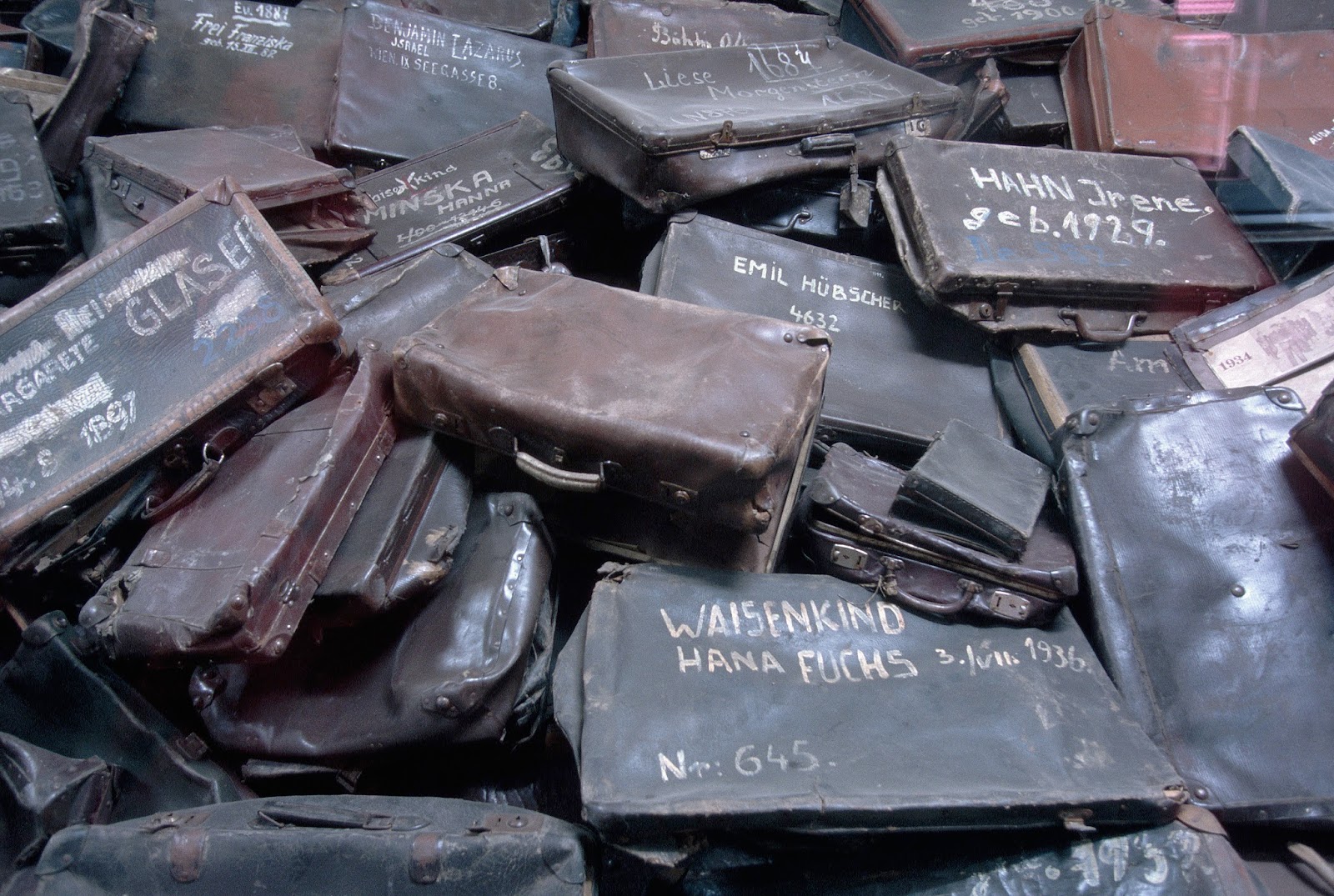 |
| Suitcases at Auschwitz. |
 |
| For more than seventy years this mug kept its secret. Beneath a false bottom a Jewish family, headed for a concentration camp, had hidden a gold ring and necklace. Usually the camp guards looted all valuables. This time they missed them. |
The story is told in more detail here.
 |
| Regina Feldman survived the Holocaust in part because she could knit. She and her family were sent to Sobibor in 1942. Her parents, three brothers and a sister were gassed. |
You can read more about her by clicking this link.
Feldman buried her mother’s wedding ring (shown below )so
guards wouldn’t steal it The ring was found decades later by archaeologists studying
the camp.

 | ||
| Twins Eva and Miriam Mozes. They survived the Holocaust, in part, because Dr. Josef Mengele often chose twins for hideous medical experiments. Mengele became known as "The Angel of Death." |

 |
| Dr. Josef Mengele, center. |
 |
| Hate comes easy if you dehumanize your victims. The Germans referred to prisoners by numbers, not names. |
 |
| In general, it was easier to shoot people in the back of the head. Looking into a victim's eyes was often hard. |
IN THE EARLY DAYS of the war the Germans sent
out special military units to round up and shoot Jews and other “undesirables.”
Thousands of men, women and children were sometimes mowed down in a few hours.
In a letter to his wife, one German soldier
described what it was like to perform such bloody duty. “All we did was
shoot Jews, shoot Jews all the time,” he said. “My arm hurt from
shooting.”
Intent on making sure my students could grasp
the horror, I created a reading for my classes called Hitler’s Black Harvest. I wanted them to feel the Holocaust in
their hearts and souls, not to pass over it in a history book.
The only real problem I had was that the reading
made students cry.
Here’s another sampling:
Here’s another sampling:
Hermann
Graebe [a German officer who did not approve] witnessed one mass killing. Even
though he took no part, what he saw turned his soul to ice. Trucks were
bringing in victims. Guards were hustling them off. Whips cracked in the air as
prisoners undressed: shoes in one pile, coats in another, underwear in a third.
Graebe was surprised by how little crying he heard. People “stood about in
family groups, kissed each other, said farewells and waited for a
sign.” Then they moved to the edge of the pit where they would be
shot.
A family caught his
eye:
An old woman with
snow-white hair was holding a one-year-old child in her arms and singing to it
and tickling it. The child was cooing with delight. The parents were looking on
with tears in their eyes. The father was holding the hand of a boy about ten
years old and speaking to him softly; the boy was fighting his tears. The
father pointed to the sky, stroked his head and seemed to explain something to
him.
Then a guard counted off twenty prisoners,
including the old woman and her family. They stepped closer to the pits and
were cut down in a storm of bullets.
Hitler's Black Harvest is for sale on TpT.
 |
| Czeslawa Kwoka, 14, was sent to Auschwitz in December 1942. |
You can read more about her here.
 |
| Marina Amaral recently colorized the girl's photo to bring her "back to life." |
PRISONERS WHO COULD BE OF USE, even in the death
camps, were sometimes able to survive. Wilhelm Brasse, a photographer, took the
two pictures above. As long as he could do his work he had a chance.
Marcel Nadjari was part of the unit that
disposed of all the bodies at Auschwitz. He left a written account of life in
the camp, stuck it in a thermos, put the thermos in a leather pouch and buried
it in 1944.
It was found many years later.
“We all suffer things here that the human mind
can not imagine,” he explained.
His story is told here.
 |
| Some prisoners were spared to perform slave labor. At Buchenwald prisoners were tied to a cart loaded with stone and sand and forced to pull it, singing as they went. Guards called them "singing horses." |
 |
| Russian prisoners of war were forced to do work for the Nazis or starved and murdered by the hundreds of thousands. |
 |
| Prisoners at Mauthausen had to work in a stone quarry. If you were too weak to work you were sent to the gas chambers. It was hard to survive on a diet of only 1,000 calories a day. Karl Peterik remembered eating oats meant for a horse he was tending. |
 |
| Women chosen for slave labor; some worked in factories or on farms for the Germans. |
HERE ARE A FEW NOTES I took on a
story about women in the camps:
“Remember
the Women,” in NYT book review, 4-12-15; story
of Ravensbruck camp
Germans
had 980 concentration camps; 30,000 camps for slave labor; 1,150 Jewish
ghettos, 500 brothels where women served as sex slaves. Ravensbruck opened in
1939, for women, at first, “asocials,” prostitutes, “race defilers,” and
criminals, including political prisoners and Roma (Gypsies). At this camp the
killings usually involved workers who could no longer serve, who were sick or weak
from hunger. Polish “rabbits” were subjected to medical experiments, including
breaking their legs to work on repair procedures, insertion of contaminated
material to study treatments for German soldiers. Russian army women tried to
resist—refused to make munitions—tried to hold onto uniforms—after, were
sometimes sent to Siberia, on false charges of having collaborated with the
Germans. Killing became a way to make room for healthier arrivals.
Himmler’s
mistress had a baby at a clinic not far from the camp and he took a special
interest in the camp. Siemens and Daimler-Benz both used slave labor and sent
prisoners back to the camps when they could no longer work. With the Russians
approaching, Dr. Carl Clauberg continued to sterilize prisoners. Rudolf Hoss,
commandant at Auschwitz and then Ravensbruck, admitted later, in the words of
author Sarah Helm, that the urge to kill “was nurtured for so long in the Nazi
psyche that it eventually ran of its own volition, impossible to extinguish.”
Gandhi called Hitler’s regime “naked
ruthless force reduced to an exact science.”
 |
| Gypsies were also considered "undesirable" by the Nazis. They were also slaughtered. |
 |
| A serious "problem" for the Germans was disposing of all the bodies of their victims. Mass grave shown at the end of the war. |
 |
| Corpses at Bergen-Belsen |
 |
| The Germans experimented with all kinds of methods to burn bodies. American officers, including General Dwight D. Eisenhower (third from left, front row), examine the evidence. |
 |
| The Hungarian Jews were saved from a train headed for the concentration camps in the spring of 1945. |
 |
| These children survived at Auschwitz. |
 |
| Female survivors. |
A BRIEF NOTE:
NYT (1-2-16) Marceline Rozenberg was arrested in
1943, in France, and deported to Auschwitz in 1944.
She was a teen at the time and went
with her father, Szlhama (Schloime) Froim Rozenberg. Awaiting transport, he told
her, “You will come back, perhaps, because you’re young, but I will not come
back.”
She has since done films about the
Holocaust; in one she has an actor stretch out on a bed and speak the words she
said to her father: “I love you so much that I was happy to be deported with
you.” (Her parents had moved to France in 1919, from Poland, because they
wanted greater freedom. France failed the Jews in many ways, she feels, helped
them in others.)
 |
| A survivor: What is he thinking? What would he say about his experiences in such a hell? |
 |
| Prisoners were never well-fed. Many grown men were reduced in weight to as little as 75 pounds. |

PRISONERS WERE PACKED packed into barracks, three,
four, and even six to a bunk, sleeping on filthy straw.
Many were covered with
lice until “their clothing looked as if it had been sprinkled with poppy
seeds.”
 |
| Having been rescued by Allied troops, two camp survivors help tally the dead. What kind of nightmares would such men and women have? |
 |
| Lucky to be alive. |
 |
| A survivor accuses a Nazi guard of being a murderer. |
I SAW THIS STORY ABOUT A GUARD on trial years later; his story might be worth following up in detail:
San Francisco Chronicle;
4-22-15, “Concentration Camp Guard
Testifies at Trial”
SS
Sgt. Oskar Groening told a German court he helped guard thousands of Jews at
Auschwitz as they left the cattle cars and headed for the gas chambers. At age
93, he is charged with 300,000 counts of “accessory to murder.” He admitted
seeing another guard silence a crying baby by bashing its head against a truck.
He says he requested a transfer; when it was not granted he began drinking
vodka heavily. “I share morally in the guilt but whether I am guilty under
criminal law, you will have to decide,” he told the judges. He volunteered for
the SS in 1940; worked at the camp 1942-1944; says his main task was to “help
collect and tally money as part of his job of dealing with the belongings
stolen from people arriving;” the presiding judge asked him what his opinion of
this money being sent back to Berlin.
In his
opinion, Groening responded, it belonged to the state. “They didn’t really need
it anymore,” he told the court, to the shock of Auschwitz survivors watching.
He could get 15 years in jail.
 |
| Seventy years later, survivors went back to the camps to remember. What would they want to remember? |
 |
| The slogan over the gate reads: "Work shall set you free." |
 |
| A ring owned by Hitler was pocketed by a U.S. soldier in 1945 when Berchtesgaden, his mountain retreat, was captured. Silver, plated in gold, with a large ruby in the center, it was expected to sell for almost $100,000 when it went up for auction in 2013. |
Read more about the ring here.
 |
| Hitler at his mountain retreat. |


