Showing posts with label teaching middle school. Show all posts

Friday, July 1, 2016

A Few Quotes that Still Matter

As a history teacher I always liked to post good quotes around my room. I thought it might make students think. 

One of my favorite moments came one day when Josh hailed me from far across the lunchroom. “Mr. Viall,” he called loudly, “you are not worth the dust the rude wind blows in your face.”

I was pleased to see the young man was quoting Shakespeare, himself, by way of one of my posted quotes.

Here are a few of my favorites.

(I’ve gathered more than 3400 if anyone would like a copy, including Josh, who is actually one of my Facebook friends today. If you’re interested, Josh, or anyone else, particularly teachers, send me an email (vilejjv@yahoo.com) and I will forward my list to you as a document.

Clearly, many still resonate today: 


I wish more political figures kept this in mind.


My teenage students could relate to this one.


Chaucer was talking about war (werre);
but I always thought this applied to school reformers, people who never teach.


I always thought this last quote summed up the trials and tribulations that come along during a stretch of any teen’s life.


Two Legs Suffice: Lessons Learned by Teaching is available at Amazon.com. 

Monday, June 13, 2016

"Snowballs" Fly in History Class and Other Mistakes

I said when I wrote a book about teaching that my focus was on what worked in an ordinary classroom, with an ordinary teacher, in an ordinary American school. I wanted to focus on what real teachers do and why what they do can be infernally hard. I wanted to focus on how to improve what happens in any classroom.

So I skipped over most of my mistakes. 

Naturally, I made plenty, as all human beings do.

In my class, I’m sure former students would admit, we did all kinds of skits. Eventually, I realized how good they could be at performing what I called “plays without scripts” and we set skits up to last for entire periods. 

Early in my career I set up a role-playing activity based on the Boston Massacre, which seemed like a good idea at the time. 

I expected it to last ten minutes—and since snowballs were thrown at British guards in the winter of 1770—I decided we needed “snowballs” to enhance the show. Part of my plan, involved members of the audience throwing a few paper wads.

I was young then; but I should have known!

Once you allowed teens to throw a few snowballs, their enthusiasm for history knew no bounds. (If you remember the Christmastime incident in Philadelphia, years back, where drunken Eagles fans pelted Santa Claus at halftime of  an NFL game, you have some idea.) The snowballs were a mistake from the start; but the debacle was complete when the student in the role of commander of the redcoat guard decided to wave his sword—my blackboard pointer—at the leader of the rebellious colonists. Before I could warn him to be careful, he brought down his weapon squarely on the head of one “dirty rebel,” a student named Darryl.

The blow split his scalp neatly and Darryl did what any dirty rebel might do.

He bled profusely.

(Perhaps it is needless to say we never tried that skit again.)

Before I ever set foot in a classroom I spent two years with the United States Marines. Like my drill instructor at Parris Island and several basketball or football coaches I had admired, I felt there was a place for ass-chewing when it came to motivating people and considered ass-chewing a kind of art. So I worked in the medium whenever I thought it would help; and by “help” I mean help get students going or cut off the kinds of misbehavior that led to far more serious troubles in the end. (I explain this all in my book.)

On at least one occasion, however, ass chewing backfired and that meant it was a mistake. (Some educators might argue it always is. I leave that for wiser heads to debate.)

In the case of F. G., a student in one of my gifted classes, it was definitely a mistake. Like many gifted children, he appeared unmotivated at first glance, at second, and at third. He and I talked repeatedly about getting his work done. I liked F. G., too, but the work he did turn in was incredibly sloppy and incomplete. At some point I questioned him sternly about lack of effort. 

I found out later he took offense. 

Not realizing, I soon got on him again. Finally, I called home. His step mother answered. She liked the boy, she said (he was mild-mannered and capable of hysterical comments at any time), but she couldn’t believe how disorganized he was. His room was “filthy,” “just unbelievable,” she explained. “It looks like he’s a barbarian or something.” 

The boy’s father had blown up repeatedly, she continued. You couldn’t see the furniture in the room under heaps of dirty clothes and toys and junk. Finally, they took away his bed and dresser and chair till he agreed to clean up his room. 

He didn’t clean up, though. Passive aggression was more his style. 

He slept in a sleeping bag and kept piling up junk. 

I realized then that chewing him out wasn’t doing any good. In fact, this approach was exacerbating the problem. In later years, as I became more adept in the subtleties of working with teens, I might have recognized the problem earlier and adopted a fresh approach.

Again: I was young.

Still, in working with a 150 kids ever year, you can’t avoid making mistakes. A third example—this one near the end of my career—involved a project turned in by one of my better students. (I mean “better” in terms of work. I liked or loved all but half a dozen of the 5,000 teens I taught. In fact, I think that’s the only mindset a teacher should have. I think you have to work on it; I think you have to try to like all the kids.) 

The project in this case, a game of some sort, was terrible. Even a brief perusal made it clear the work was rushed and the results incredibly sloppy. I took the young man gently aside and told him he’d have to fix it or start over. 

This questioning of the quality was not my mistake. The project was terrible. But the next day, after he told me he planned to start over, and thinking no one would know whose work it was, I showed his game to a class later in the day, as an example of what not to do. As always, my message was simple. We must all work hard to produce quality work. 

The project, in my mind, was a prop, to make my point to this particular class. I knew it was going into the garbage, regardless. So I bent it double and stuck it in the trash. 

It turned out some of game maker’s friends were seated before me and had seen his project on the bus to school. They knew whose it was and told him about the fate of his work on the ride home that day. The game-maker was humiliated. 

I had held his project up as an example of what not to do.

The boy’s mother contacted me as soon as she found out and told me, perhaps more politely than I really deserved, that I had made a mistake. She could have chewed my butt. I knew at once that she was correct.

I offered to apologize in front of her son’s class. 

I offered to apologize in front of his class and the class where I trashed the game. 

I said I’d be happy to apologize directly to him. 

I offered to apologize to all of my classes. 

Mom felt this might compound the boy’s embarrassment. And she said he would be angry if he knew she called me to intercede. 

I told her I’d say I heard about the problem from one of his friends and promised to take him aside the next day and apologize in that way. 

And I did.

A fourth example of the kind of blunders I committed—and I think it’s safe to say all teachers make their own brand of mistakes—should suffice. Generally speaking, I got huge mileage out of a humorous approach in the classroom. This included using comical essays when it came to minor matters of discipline (also explained in my book). I also used to tease students, particularly ones I liked, and especially those who could give it right back.

I never once meant to offend.

I don’t believe a teacher ever has a right to insult a child. I don’t believe sarcasm directed at students has any place in a classroom. So, if I teased a kid I liked, I was watchful for any expression or hint my jokes struck the wrong spot. 

One year, I fell into the habit of teasing Kate whenever the subject of women’s rights came up. Kate was one of my most talented students, possessor of a superior intellect, \a thoroughly likeable young lady in ever respect.

So I used her as an example—employing what I thought was obvious sarcasm, in regard to the historical mistreatment of women. Talking about the endless battles Susan B. Anthony fought to win the right to vote for women, I might say in effect: “Oh course, Kate, you realize women do belong in the kitchen.”

I suspected Kate was going to end up in medical school—and had no doubt she could do whatever she set heart and hand to do in the future.

I thought the juxtaposition of ideas—the absurdity that women should have been limited in any way—that Kate, herself, was so talented—was clear. Certainly, Kate never complained. 

Her manners were probably too good. 

At the end of the year, however, when she filled out an anonymous survey I always used, she let me know how she truly felt. I wanted teens to answer questions about my class honestly, to tell me what they thought, and set it up, as best I could, so I wouldn’t know whose answers were whose. But seated at my desk, trying not to look over anyone’s shoulder or see their responses, I noticed Kate was using a green marker and writing on a yellow legal pad when she marked down A, B, C or D answers.

Students were allowed to add any comments they might care at the end. So Kate wrote a paragraph, saying her feelings had been hurt.


How did I know it was her?

Only one sheet of yellow legal paper with green responses was turned in that year.

My inclination was to apologize as soon as I read her comments, after her class went to lunch. I would have hunted her up and apologized on the spot.

Still, I always encouraged students to be honest about my class and promised never to question anyone who complained.

I was afraid she might feel I was putting her on the spot.

I gave the survey as close as possible to the end of the year. So, for the next two or three days, before summer vacation, I gave her the space I thought she might need; and I can only say I made damn sure in years to follow I was careful in discussing women’s rights.

Finally, after Kate had gone on to high school, I wrote her a note of apology—which was the least I could do.

If she’s not a doctor today or using her impressive talents in some challenging career, I’d be very much surprised.

Kate: again, I apologize to you.

In the "good old days" this kind of statement could actually fly.
In my mind it was always ludicrous that this was true.

Tuesday, September 22, 2015

Two Legs Suffice: What My Book is About

In a way, Two Legs Suffice: Lessons Learned by Teaching is a book about motivation. 

It’s based in part on my years with the United States Marines (1968-70). I enlisted at the height of the Vietnam War but never saw combat. 

That means I don’t know diddly about combat. So I don’t pretend I do. In the same way most school reformers know nothing about teaching. 

The heart and soul of the book flow from my work with two generations of Loveland, Ohio teens (1975-2008). 
I loved teaching. I did. I worked in a strong community. But teaching is never easy. All real teachers know this is true. None of the school-reformers-who-never-taught have a whiff of a clue. 

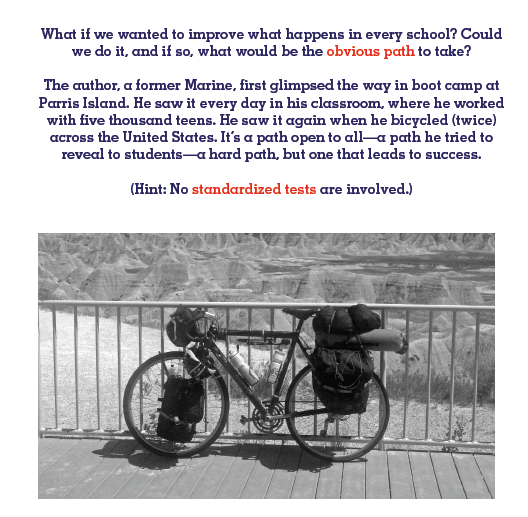
Two Legs Suffice includes a pair of chapters about pedaling a bicycle across the United States (2007; 2011), to raise money for the Juvenile Diabetes Research Foundation. Students and staff at my school helped bring in $13,500 for the 2007 ride and I raised almost $11,000 in 2011, as well. 


Both journeys tie into my basic premise. I believe that effort is paramount in education, just as it is while pedaling up and over Tioga Pass.

That goes for everyone on a seat. 

Near the end of my 2011 ride: pedaling up Tioga Pass into Yosemite National Park.


THE BASIC MESSAGE:

Most teachers are good. We aren’t idiots and slackers, as many critics like to contend. We are not the problem. 

Good teachers can do much to help students succeed. Good teachers cannot solve every problem. Good teachers—even excellent ones—need help.

You can’t keep offering up bold plans to “fix the schools,” like the school-reformers-who-never-taught like to do. You don’t fix families by “fixing the homes.” You work with individuals. You help people.

Motivation is key in any classroom. Tips on motivating students feature prominently in my story. 

Standardized testing is doing great harm and little good. True learning has not been fostered. True learning has been stifled.

More importantly, if we want to follow the surest path to improving learning outcomes, then we must clearly keep in mind that two legs suffice.

(That final premise rests on a lesson I used to share with students about Bruce Jennings, a young man who pedaled a bicycle across the United States in 1976, despite the fact he had one leg.)


NOW AVAILABLE ON AMAZON.COM.

One motivational tool: STAR Awards for students.
Front cover.
Back cover blurb.


Saturday, August 8, 2015

In the Days of Corporal Punishment

Occasionally, I hear someone insist that we must bring back corporal punishment to our schools. I could write an entire chapter on that subject. 

The capsule version would be: I can’t agree.

Early in my career, I did swat, as most teachers did. One day, I gave a young man what I thought was a fairly ordinary swat. But he ended up bruising badly. In days and weeks to follow I heard from other students that other teachers had bruised them, too. I heard from parents that they’d been swatted as kids, bruised, but learned to behave accordingly.

In my case, I had bruised the boy badly. His mother was furious and filed a criminal complaint. I never blamed her for being angry; but I was charged with a felony assault and had to head for court. Lose that case, in 1982, and my teaching career is over. (Some might have said, “And justly so.”)

Someday, I may take the time to tell this story in detail. For now, let’s just say I was found innocent. 

I still don’t blame the mother.

I still understand why mom was angry—and still think I gave the boy only a normal swat. But one detail still amazes me and may prove revelatory to those who don’t know the full story. When the case was decided in my favor I returned to school the next day. My career could continue! That afternoon, Ed Lenney, our wonderful principal, called me into his office during my conference period. He said I had better sit down.

“John,” he explained, “Mrs. ----- [the mother who filed charges] just called.”

My immediate thought was: “She’s going to file a civil complaint [for damages]. I’ll have to go to court and defend myself all over again.”

“You can handle this however you want,” Ed continued, “but she wanted to know if you’d take Carl [the boy; using, here, a fictitious name] back in class.”

(Carl had been removed from my American history class, of course, once charges were filed.)

“WHAT!” I exclaimed. (I don’t recall if I added an expletive. I think I was too surprised.) “WHY?”

“Mrs. ---- says she thinks you’re a good teacher.”

Of all the developments in the story, this was the only one that really surprised me. I thought about it a moment, because I liked almost every kid I ever met, and never had any bad feelings for the boy or his mother. He did bruise badly, after all. That wasn’t a hallucination. Still, I quickly decided that it would be better for all if Carl continued to learn his lessons from another teacher.

I almost never swatted another student again—except in one or two cases where parents actually asked for their child to be given corporal punishment. (Usually, this was chosen in lieu of some kind of suspension.)

And I can assure you that in my experience swatting teens was never enjoyable. You can make the argument, however, that it beats arresting them, which is what schools started doing in the 1980s, and still do today, when school resource officers began to be needed to roam the halls. I am also fully aware that the word “beats” in the previous sentence is loaded with all kinds of different meanings.

(I should also note that today there are 17,000 school resource officers, or cops, to put the matter bluntly, roaming the halls of American schools.

***

Regardless, the argument against corporal punishment is effectively settled in the negative. I never missed using the paddle, myself, and instituted a regimen of Marine Corps pushups as my last line of defense when young men acted up in class. (I explain that whole approach in my book if you’re interested.)

So, on a lighter note, let me share one funny story from the Dark Ages, as some might call it, of corporal punishment. The rule in my class, when I was first teaching, was simple. Skip an after school detention and you earned a swat the next day. 

(Most kids who had detention after school had failed to complete several assignments and I preferred to keep them after rather than give them zeroes and let them waste their talents.) 

Beyond question, the award for creativity in such a situation goes to a young man named Ken 
----.

Ken was a good-old-fashioned boy at a time when Loveland was a country district, not the affluent suburban community it would later become. Ken’s only problem stemmed from lack of motivation. He didn’t complete his work and earned a detention. Unfortunately, he failed to make his cameo appearance. 

As expected, Ken entered Room 207, at the start of sixth bell the next afternoon. “You know the rule, Ken,” I said almost immediately. I put the rest of the class to work and told him to step out in the hall.

He looked worried but made no excuse for skipping.

I asked another teacher to witness, as required, and when Ken bent over as ordered I gave him a moment to collect his thoughts. Then I gave him a swat. 

Normally, a swat made a cracking sound. This time it was more of a thump. Something was wrong.

“Ken, what are you wearing?” I inquired.

He looked embarrassed. But he was quick to admit the truth. “Eleven pairs of underwear, four pairs of gym shorts, two pairs of shorts, and sweat pants,” he explained sheepishly. 

I had to laugh. “Well,” I explained, “you out-foxed me this time. Just don’t skip detention again.”


Ken went back into my room and I followed, tossing my paddle on my desk with a clatter. Then it was back to teaching.

There are other ways to discipline children. This one: for arguing siblings.

Wednesday, August 5, 2015

The Case of the Missing Homework

MANY OF THE BIGGEST NAMES in education reform insist that the only sure way to improve what happens in schools is to “hold teachers accountable.”

I worked with a few bad teachers during my day. Nevertheless, I don’t think I ever looked down the long hallway at school and thought, “You know, the main problem here is all the bad teachers.”
 

There was never any real evidence that educators were the main obstacle in the path of true learning.

Student reluctance to do the work necessary to earn a quality education seemed to be a far more important factor. And I don’t mean my students were all lazy. Not at all. Not at all. I was fortunate to teach thousands of hard-working kids. Still, I also discovered that a significant minority had a tendency to coast along, unless some teacher fired them with a desire to learn that they might not already have. 

            Or gave them a push.

            I knew what that was like when I was young. I knew a push is sometimes required.

Indeed, somewhere around the age of thirteen, my brain ceased functioning in any meaningful fashion and I spent my time in junior high and high school doing the least possible work I could manage. I was oddly proud of myself—to finish in the bottom half of my Revere High School graduating class. 

            I had a perfectly good mind. I just didn’t care to use it. (See proof below.)

At least I was doing well in American history and gym.


Fortunately, I discovered the great powers of motivation in 1968, at Parris Island, after dropping out of college to join the Marines.

When I became a teacher in 1976 I made it a point to make it difficult for kids to loaf in my class and hard for them to fail. I set high standards. But if students failed tests, I called home and asked parents to ensure their children studied and retook the test after school, or before school, or during lunch.

I didn’t average grades, the first F, and say, a B+ on the second try. 

           If a young man or young woman got a 92 B+ on the second test that was the grade that was inked in the book. 

I USED A SIMILAR APPROACH when it came to homework. I used to round up kids who owed me work, at lunch, or during study hall, like a cowboy roping strays. I’d bring in “failing” (i. e. not working) students and put them to work. I would agree to stay after school, or come in early, any time kids fell behind in class.

What I would not tolerate was lack of effort. (See my grades, above.)

In any case, former students might agree, I probably got mad more often if they didn’t use their talents than for all other reasons combined.

In third period one morning I called for everyone to turn in a set of questions that were due. Before I could manage to collect, Mrs. Kemen, one of the best young teachers I ever met, appeared at my classroom door to ask advice on some minor matter. I stepped into the hall to answer her question. Then I returned to class. When I asked again for homework not a single paper came up from the left side of the room. (I had student desks in a horseshoe seating arrangement. (See below.) Even Kyle, the most dependable kid in the class, said he forgot the assignment.
Seating chart used in my class. My post was at the open end of the horseshoe.


The middle section likewise produced zero papers.

“Unbelievable,” I muttered darkly.

When the right side of the room failed to produce a solitary paper, I slammed my grade book to the floor like a football coach who had just watched his defense give up a 99-yard touchdown pass.

“YOU’VE GOT TO BE KIDDING!” I growled.

With that I stomped out the door for effect. (I could always act mad with ease; I rarely was, in truth.) Like an actor considering how to do the next scene, I could reenter angry, or hurt, or adopt my cold, assassin’s voice. The only issue: Which reaction might convince a few teens to move in the desired direction?

To use their talents—not loaf.

I stepped back into the room and for a hundredth time tried to impress on my young charges that they needed to learn as much as they could, for their own good. I insisted that true learning required true effort. I went on in this way for two or three minutes, trying to stir a sense of resolve.

Finally, Kyle could stand no more. He yanked his homework out from under his notebook and waved it in triumph. Papers appeared from all directions and cheers filled the room.

“We love you, Mr. Viall,” Courtney called out merrily.

When everyone stopped laughing, including me, Kyle admitted having masterminded the ruse. 


Almost everyone had their homework; and as was so often the case, I was proud of my kids. 

Tuesday, August 4, 2015

Creative Discipline for Middle School: Angie Collects Belly Button Lint

EARLY IN MY CAREER I came up with a humorous approach for dealing with minor violations of classroom decorum. 

I realized essay punishments could be humorous and effective. 

In most cases, I simply wanted kids to quit goofing around or talking too much. No sense treating breaches of etiquette like criminal infractions. Stick them with a 150-word essay as a simple reminder. Making it comical allowed peers to share a laugh and showed students you wanted to have fun in class, while still expecting everyone to abide by the rules. When Kayla was tardy too often, I had her write about how she became a fashion icon by inventing concrete shoes. On another occasion, Josh seemed to be writing a love note instead of doing his assigned reading. I had him write an essay about falling asleep in class and getting his history book stuck to his face for a week. 

As you might expect, he explained in his essay how his rare affliction made it impossible to flirt with the girl of his dreams.

One day, Angie got in trouble for some minor matter. I had her write: “I Collect Belly Button Lint for a Hobby.” Angie didn’t stop at 150 words. She was a collector in the truest sense. Her essay filled five pages. She had lint from actors, from every president in the last twenty years, and dreamed of finding the Holy Grail of lint—from the belly button of Elvis Presley (assuming Elvis was still alive). 

In most cases punishment fit the “crime.”  One day, Rob came flying through my door, with a friend in hot pursuit. Before I could tell them both to slow down Rob tripped and somersaulted across the linoleum. He dusted himself off without injury, but I made Rob write about his life as “The Human Cannonball.” 

Wendy R. (a straight-A student) had to write an essay after laughing once too often and disturbing class. I forget the title; but she pinpointed her friend Wendy M. as the source of all her difficulties “At times Wendy’s nostrils will go in and out as if they were controlled by a motor.”

That was her reason for laughing.

Max tended to turn around too often and talk to friends. One day I grew tired of viewing the back of his head. 

I HAD HIM WRITE about having a giant tongue. In his essay he called Landon, the friend who had lured him into sin, to inform him of his tragic condition. The essay followed the conventions of a popular Budweiser beer advertisement:

“Hello.” [Landon answers.]

“Wattttttttthhhhhuuuup!!!”

“Hey, man.  I would finish the lines in the commercial but I just gotta ask. What’s wrong with your voice?”

“Miy tung.”

“What?”

“Miy tung iz big,” I said angrily.

“Oh, I see.

“Wat sod I du?”

“Gee, got me.”

“Tanks, yor no hep.”  Then I hung up…..


ONE LAST EXAMPLE deserves mention. One day a young man got in trouble for talking during detention. I asked him to write “The Life of a Cucumber.”

His story began: “I started out the first part of my life in a little cold plastic bag. The bag sat on a shelf in the store, for a long time before some one decided to buy the bag of seeds.”

This essay was not particularly funny, but carried the name of the author, Brian ----.  Only Brian’s handwriting was unusually good.  

Normally, Brian’s handwriting was abominable. 

I still have my notes describing the incident:  “Caught Brian ----lying today because his mother wrote his punishment essay. Brian claimed, in declining order:  

1) he wrote it; she corrected it 
2) okay, no, mom wrote part 
3) well, yes, she wrote it all.

I called Mrs. ---- that evening and she offered lame defense: “I don’t see anything wrong with a mother helping a child.”

“Nor do I,” I responded. “But you weren’t helping. You did the essay for him and let him off his punishment entirely.” 


I told her Brian would have to write a different essay entirely; but if it had been in my power I would have given her a topic all her own to do: “What Happens to a Boy when Mom is an Enabler?” 


For more discipline tips you should buy my book!
Also: I loathe standardized tests and explain why in my work.