
|
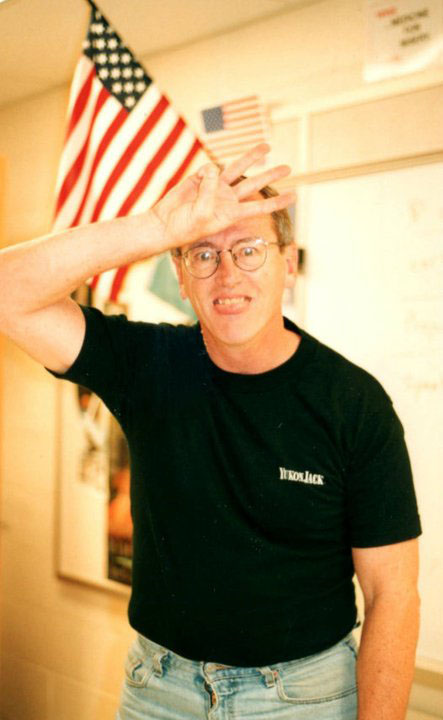 |
| The famous sign of the weenie. |
One year it was Phillip, a seventh grader so immature, when asking permission to go to the bathroom, he said he had “a poo poo problem.”
Another year it was Michelle, a sweet-tempered girl, inept in matters of personal grooming. She’d come to class after lunch with a red ring of Hawaiian Punch round her mouth. I had to make sure to tell her to wipe her face before classmates came flooding in. Sometimes during lunch she asked to sit in my room as I graded papers. She didn’t have many friends and only wanted someone to talk to while she ate her sandwich and drank her Punch.
I remember when the “L” sign (for “loser”) came into vogue in the 90s, and remained popular with students for a number of years. I found it offensive.
When I couldn’t break kids of the habit—forming the “L” with thumb and forefinger and placing it to the forehead—I tried indirection. Now and then, for fun, or depending on what we might be talking about in class (we talked about empathy often) I started raising three fingers to form a “W” for “weenie” and stuck them to my head. It was a stupid “insult” but made it hard for teens to focus on their own disagreements when their teacher was standing there with three fingers stuck to his forehead and telling them, “Yeah, you’re a weenie.”
Almost all teens are kind-hearted if they stop to think about what they’re doing and my kids caught on quickly. We began elaborating. A “weenie,” as I explained, was anyone who zoned out during my class or disparaged my absolutely, positively, fantastic jokes. According to students, I was the biggest “weenie” of all.
I can’t argue with that.
We began inventing new forms. If a kid complained about homework I scratched my head in distracted fashion, using three fingers, giving the “Inadvertent Weenie.” Kids invented the “Armpit Weenie” (three fingers and a tickling motion), the “Quadruple Weenie” (two students at once) and the politically-incorrect “Indian Weenie” (three fingers behind the head). Erin Morrison, one of my strongest students, made everyone laugh by demonstrating with various leg kicks and appropriate sound effects the “Karate Kid Weenie.”
A few days later Erin spoke up: “Mr. Viall, make Chelsea show you the ‘Sammy Sosa Weenie!’”
When I called on her to demonstrate, Chelsea McCarty grinned. At the time steroid use was still unproven and Sosa, the Chicago Cubs slugger, was widely admired. Chelsea tapped her heart three times as Sosa did with his index finger whenever he came to bat, only using the three-fingered “W.” Then she touched her lips with the “W,” just as Sosa touched his with an index finger. Then she pointed to the sky like Sosa, using the “W” instead of an index finger. The class applauded and laughed and so did I.
UNFORTUNATELY, THERE’S NOTHING FUNNY about being victimized by bullies. So I interceded to protect targets any time I could. Near the end of my career I had to step in to shield one of my favorite students. Ross was a thoughtful young man, serious-minded, never a problem. There were times when I could see he was down. We talked. He revealed his problems, but only in part. A group of tough kids, none in my classes, had lined up against him.
I offered the usual advice to young men dealing with tormentors: Keep a poker face. Don’t ever give bullies the pleasure of knowing they’re getting to you. Learn to poke a little fun at yourself, leaving no room for others to deliver a true insult of their own. I told Ross about how I suffered in seventh grade when a group of boys picked on me for being skinny.
This seemed to make him feel better, knowing that there was hope in surviving adolescence.
Most kids liked Ross. But outside my classroom walls the bullying was far worse than I understood. One evening Ross’ father (one of my former students) called me at home. He said his son had great respect for what I said. Would it be possible for dad and I to meet? I said yes and suggested he bring Ross, a tactic that usually proved beneficial in dealing with teens.
The three of us sat down together after school a few days later and the story came pouring out. The problem had started in sixth grade, the year before, when a group of poor students singled Ross out for abuse. They never let up, with summer vacation his only respite. Mr. ----- brought up an incident that left me shocked and angry. One of Ross’s tormentors, who towered over him by a foot, had seen him coming down the hall. Ross was carrying an armload of books, his less-scholarly nemesis none. As they passed the bigger boy spat in his face.
“Nobody deserves that, Ross,” I said with outrage, “I don’t care what you have ever said or done. No one deserves that.”
Dad spoke of his love for his son. His eyes brimmed. He reached out and patted Ross on the shoulder. I felt a lump in my throat. This was even more serious than usual.
“Don’t tell anyone I said this,” I continued, “but if they’re going to keep picking on you then you might have to fight.” I described my experience in seventh grade when one of the bullies and I tangled after gym—and after that how he and his friends left me alone. “I don’t think your dad would blame you and it might be worth the three-day suspension to win a little respect.” A hint of a smile finally showed on Ross’s face. I added that he might not want to take on the biggest kid; but at some point he might have to defend himself in a confontration with another member of the gang.
Finally, I promised to speak to the biggest boy, the leader of the wolf pack, the following day. And I won’t deny it. I was pissed.
During my conference period next morning I looked the young man up and asked him to step out in the hall. He was tall enough to look me in the eye. So I looked him in the eye. I told him that while I had not been witness to any incidents “other students” informed me that he was bullying classmates. I didn’t mention names. I didn’t bring up spitting.
I said a parent had also called.
Anatole France once said, “The more you talk, the less people remember.” And that’s the best advice I ever heard when it comes to talking with teens. Keep your points simple and be decisive and precise.
So, I didn’t threaten or lecture. “I don’t know you personally, young man,” I noted. “You don’t know me, do you?”
He said he knew who I was, but no, he didn’t know me.
“I’ll tell you what,” I explained, “I hate to see anyone bullied. You’re a big guy. You look like you can take care of yourself. I doubt you get bullied. But if someone told me you were getting picked on by two high school kids, I’d stand up for you, even though I don’t know you.”
He nodded and, I think, saw my point.
“People who bully others pick on the weak. That’s a form of cowardice,” I added with a touch of scorn. I wanted to call his manhood into question. “Cowardice,” I repeated with a hiss.
Before I let him go, I said again: “If I heard you were being picked on I would come to your defense. If I hear that you are picking on others from now on, I will consider it a personal insult. A personal insult. Do you understand?” I leaned in close and gave him the kind of look my drill instructor at Parris Island sometimes gave us.
He had nothing to add and I let him go in peace. After that he left Ross alone.
 |
| Dehumanization of entire groups or individuals should never be tolerated. |
POSTSCRIPT: We often talked in history class about how similar all individuals really are. We started the first day of each new school year with this quote from Terrance, a Roman playwright:
“Nothing human is alien to me.”
In my class we often talked about what I called “labeling” and how “dehumanization” then results. Hitler and his followers referred to Jews as “kikes” and “vermin.” The yellow star they required Jews to wear was labeling made law.
One saw a “Jew” not a human being.
The trouble is the same with all labels: “fag,” “nigger,” “gook,” “retard,” “nerd” to name a few. In my school the “preps” and the “grits” were enemies. The “preps” were well-dressed, richer kids. The “grits” were poorer, tougher kids. As part of a discussion about Nazis, I used to tell students every year, “Next time you see someone you don’t like, say, ‘I hate that…human being.’ It just doesn’t work.”
I couldn’t protect every kid from being bullied, and my approach was never foolproof. Still, in this case it seemed to work. Both Ross and his father sent me kind notes at the end of the year. First, his father:
Your positive influence and words of encouragement made all the difference. Ross looked to you for guidance and without a doubt held you in the highest esteem. You took the time to care that he was struggling and offered him the hand of friendship…Ross is a great kid full of potential. He is also going through a very impressionable time in his life, one full of confusion and self-doubt. We took great comfort in knowing he had you watching over him at school…Your kindness and compassion will always hold a special place in our hearts, but more importantly in Ross’s heart! Thank you for helping Ross through a rough time and helping us get him back on the right path.
Then from Ross:
You always seem to find the funnest ways to get kids to participate frequently and still learn. This is the first year I have actually had fun in social studies/history. You also got me back into reading and I appreciate that. You are always calm (except when we get interrupted in seventh bell…) and I have never personally seen you yell at someone, but I’ve heard stories. You are the best teacher I have probably ever had. When I walk into your classroom I know I am going to have fun, but also pick up a little knowledge at the same time. For the first time in my schooling experience I actually found a class I actually look forward to. Your class really made my 7th grade year enjoyable and less stressful, and I truly appreciate your teachings.
I’m glad I was able to do my part to help.
If your child is being bullied let the adults in his school know; expect them to do whatever they can. Most teachers will help, if they realize what is going on.


Crazy! Because I used the EXACT same line last week when I caught some kids calling another kid some really nasty names. They are good kids- and sometimes people forget that kids are just that- kids. They are still learning. And they must be told to stop their behavior if it is bad. Bad behavior doesn't make bad kids- it makes for an opportunity for grown-ups to teach kids not to be jerks. Also- it makes me (as a parent) re-evaluate my own language that I use in the car in front of my own kid. For example- if it is ok for me to call another driver an idiot- why is it not ok for him to call someone at school a mean name? The incident really made me think.
ReplyDeleteLCB
This comment has been removed by the author.
ReplyDelete