Wednesday, September 4, 2013

Christian School Lays Smack Down on Science: Tax Dollars at Work?

If you wonder why the vast majority of Americans believe public schools and religion should not be mixed, a story you likely missed last April may help clarify matters.

The story first broke when a fourth grade teacher at Blue Ridge Christian Academy in South Carolina gave a quiz in science class. You may wonder, if the pictures (below) were part of some left-wing, atheist hoax. That question is easily answered with a check of the website of “Answers in Genesis,” a staunch Christian organization, which holds that the earth is only 6,000 years old.

In a moment, we will turn it over to Ken Ham of “Answers in Genesis” to tell the tale. First, the quiz in question:

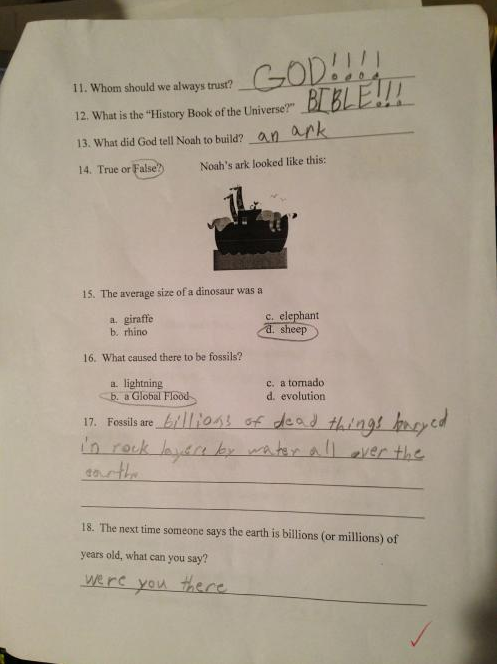


There’s no problem, of course, if a group of parents wants to send their children to a school that teaches dinosaurs roamed the earth alongside Adam and Eve in the Garden of Eden. If that’s what they want their children to believe, so be it.

The real issue is the increasing willingness of states to funnel tax dollars to private schools—with no way for lawmakers to close Pandora’s Bible or Koran once they open it.

Here in Ohio, Governor John Kasich and his friends in the General Assembly are pushing for more money for private schools—including private religious schools. I, for one, am anxiously awaiting the moment when Mr. Kasich or Ohio House Speaker William G. Batchelder has to get up in front of an angry conservative crowd and explain that, yes, freedom of religion does indeed extend to Muslims—and any schools they might like to open, as well.

Conservatives are sure to love that idea.

This summer South Carolina joined a growing list of states which offer at least some tax relief to parents who want to send children to private schools. It came too late to help Blue Ridge Christian Academy, but there are other schools out there ready to pick up the cross and bear it. We know, for example, that in Louisiana a number of Christian schools used taxpayer monies to push a similar type of science.

In fact, in Governor Bobby Jindal’s back yard, the Accelerated Christian Education curriculum favored by several schools went to great pains to explain that the Loch Ness monster was probably real—noting that “Nessie” was likely a plesiosaur. In other words: dinosaurs are not extinct. Darwin is a scumbag. Evolution never happened.

When the story about Blue Ridge first broke “Answers in Genesis” admitted they supplied the science curriculum. They stood by every syllable. Ken Ham of AiG complained about all the attacks on freedom of religion.

Here’s how Mr. Ham saw it:
A Christian K–12 school in South Carolina, with dedicated and highly qualified Christian teachers, has come under vicious attack by atheists. Why? Because one of its instructors, a fourth-grade teacher, tested her children about biblical creation, science, and dinosaurs (using AiG resources), and she has become (in)famous on many atheist websites and blogs.

Only $14.99 if you are interested.

It would be bad enough, Ham warned, if this was an isolated incident; but the demise of Blue Ridge was just one battle in an ongoing war, a small school coming under attack from powerful atheist interests. Like David vs. Goliath. Only this time, Goliath triumphed.

Ham continued: “The atheist buzz about the dinosaur-and-Bible quiz, however, is not really all that surprising. Over the past few years, we have seen atheists becoming more aggressive and intolerant towards Christians…They are attempting to impose their belief system (yes, their religion) on the culture.”

In fact, the “atheists” have been emboldened since the last presidential election. Probably something to do with President Obama and his commie plan to impose good health care on sick Americans. (Really: you wonder. Would Jesus have bothered to raise Lazarus from the dead if he knew he was covered by Obamacare?)

I’m sorry. This isn’t funny.

Ham explained:
In South Carolina [the teacher] showed students a DVD of a children’s program, in which AiG song-writer and dinosaur sculptor Buddy Davis and I are featured. In this DVD, we teach children the history of the universe from the Bible, with a special emphasis on teaching dinosaurs from a biblical perspective (as we do inside our Creation Museum. The teacher handed out a question sheet to the children to test what they learned from the DVD.

The quiz ended up posted on the internet; the school lost enrollment and Blue Ridge folded. You might say the Academy went extinct, if you had a sense of humor.

Ham wasn’t laughing:
Though we praise God for the minority of Christian ‘missionaries’ who work as teachers in the public school system (and who need our prayers), government schools have increasingly become, in essence, churches of atheism. We are aware that the overwhelming majority of children raised in the church attend public schools, and thus it should not be surprising that with all the secularist indoctrination in schools, about two-thirds of our young people brought up in church are walking away from it by the time they reach college age.

Look: Ham and his supporters (good people, probably—albeit not up on the latest science) can stand on their heads if they want to.

It’s a free country, and that freedom should cover all religions and atheists, too.

The problem, when you start mixing public monies and religion, is that you have no idea where to draw the line. If you introduce a class in “The Bible as Literature,” as Texas did recently, you open a door for an atheist teacher to say to students, “I think this is absurd mythology.” You can imagine a situation developing where a Mormon teacher in one school bats some Jewish kid upside the head with the Book of Mormon, or a Catholic educator whips out a Latin Vulgate Bible and starts reading to innocent Presbyterian children. Buddhists berate Baptists. Hindus hector Lutherans. Mennonites menace Methodists.

Public schools end up in the middle of a theological donnybrook.

Better to keep all religion out for the good of all the students.

 Let them think for themselves and with the help of parents and spiritual advisers, let them develop their own belief systems.

Sunday, September 1, 2013

Ohio Charter Schools Suck: GOP Lawmakers Still Love Them

Here in Ohio we are blessed, I tell you, with a governor and lawmaking body that love charter schools. Why? Because our representatives love children? Because charter schools do a better job, measured by standards mandated by that very same lawmaking body?

Nope. Try again.

Here are how regular public schools measured up, with charter schools listed separately, in this year's state report card:


(CHARTERS IN RED, ABOVE.)

Well, then, do our GOP representatives love charters because they devote more resources to helping kids who need help?

Fat chance.


(CHARTERS IN RED, ABOVE.)

As the chart above shows charters tend to pay school founders and school leaders well for their less-than-stellar efforts. And why not? Isn’t education about profits?

What? You say it’s not?

Someone probably needs to break the news to David Brennan. Here in Ohio and elsewhere Brennan operates White Hat, a charter school chain, with almost fifty franchises. No, I mean schools. 

Brennan cares about dollars. No, no, I mean kids. That’s why he has a $6 million mansion down in Naples, Florida. Ha, ha, because Brennan cares about living in lux…no, about kids. In fact, he loves kids so much he is willing to go out of his way and host fund-raising dinners down in Florida for Ohio hard-working GOP politicians.

Another neat White Hat trick, when franchises...no, no, no...control your sarcasm...when schools fail...is to close them down and reopen them with cool new names, in the same buildings, with much the same staff, so that profits for Mr. Brennan are almost impossible to kill, kind of like zombies.

Kids. Sure. Brennan loves ‘em.

How to show this love? According to the Akron Beacon Journal this summer Brennan and his wife Ann contributed more than $3.8 million to fifty-one politicians between 2004 and 2012. Those who gained the most in these transactions?

Ohio’s school children.

Ha, ha! I’m joking!

Actually, the main beneficiaries included Ohio Senate President Keith Faber, Ohio House Speaker William Batchelder, the Republican Party—because no one loves kids more than the GOP (unless they need health insurance)—and, of course, good old Governor John Kasich, who never saw a fund-raising dollar within reach he didn’t want to grab.

It probably comes with his Wall Street background.

So, try again. Why do our leaders love charter schools?

Well, let’s just say they have 3.8 million reasons to love them—even if charter schools really, really, really, really suck.

You can’t say those  bought-and-paid-for legislators haven’t earned their money, though. When Brennan’s chief lobbyist sent lawmakers a list of changes his boss hoped to see in one school funding bill the Ohio General Assembly partially or fully implemented nine of eleven proposals Brennan had deemed “most important.”

As noted in a story by the Columbus Dispatch, Brennan did even more to help lawmakers do right by the children of the state: “Later, [his] lobbyists prepared actual legislative wording to carry out their requests. House staff members frequently checked with the lobbyists to make sure the evolving language and later amendments were acceptable.”

In fact, before you could click your ruby red slippers together three times and say, “Can I have some more campaign cash, please?” Tom Needles, White Hat’s chief lobbyist, was providing pre-written amendments to be included in the proposed legislation. 

Well, did it work—all this helping lawmakers—so that lawmakers could help Brennan—so  Brennan could help kids?

You bet it did. 

The Beacon Journal noted recently that under a new Ohio Senate proposal, charter schools in the state would see a $22 million increase in funding for this school year, even if enrollment did not change. 

Meanwhile most regular public schools—with less effective lobbyists—and less ready cash to dispense—were seeing cuts.

Hey, don’t worry, though. Here in Ohio the operators of charter schools…no, I mean, politicians…no, I mean, the school children...are doing great.


Addendum

A variety of sources can be consulted to verify statistics show in the graphs, including this article from the Columbus Dispatch.

Even better, these grades do not include the 150 Ohio charter schools that have closed in recent years for financial or academic reasons.

See:  Innovation Ohio for original graphs, including the on administrative spending.

Sunday, August 25, 2013

The Theory of Standardized Testing: Let's All Make Plastic Chairs?

(DOUBLE CLICK TO EXPAND.)

Here, in my opinion, is how the theory of standardized testing works:

1. Some people make bad furniture.

2. Some people make great furniture.

3. Therefore, people who have never made any furniture at all must be put in charge of designing new standards of cabinet-making.

Result: Great furniture makers are required to focus their efforts on making more and more plastic chairs.


I AM A RETIRED TEACHER. So, I no longer need to worry about the state of American education.

Still, I do.

It is my belief that reformers, mostly with good intentions, but always with little true understanding of what needs to be done to improve the nation’s schools are taking more and more control.

It is my belief that there are bad teachers—and we should do more to get rid of them.

It is my belief that most of America’s teachers are good; and I believe all good teachers are working extremely hard. (You can’t be good in this profession unless you sweat blood.)

It is my firm belief that standardized testing has done great harm to the process of true learning.

IF I AM RIGHT, IF YOU AGREE, what do we do?

WHAT DO WE DO?


I WOULD BE INTERESTED IN HEARING FROM OTHER TEACHERS; SEND ME AN EMAIL: VILEJJV@YAHOO.COM


(Double click on picture below and you can save it as a picture.)


Friday, August 23, 2013

Rock, Hammer, Common Core Curriculum: What's the Real Key?


What does a common claw hammer have to do with school reform? What does one humble tool have to do with Common Core Curriculum?

We know a student cannot complete a standardized test (and new ones are coming fast, tied to Common Core Curriculum) using a common claw hammer. A hammer is too hard to sharpen.

A hammer is but a tool. You have different kinds of hammers also. You have jack hammers for road construction, rock hammers for geologists, and the humble rock, recommended by nine out of ten satisfied Neanderthals.

A hammer is just a tool. If the hammer owner prefers he or she may let it lie idle in the bottom of the tool box. Or they might use it in some creative fashion. One can crack eggs with a hammer and stir them into pancake batter with the handle.

I don’t recommend it if you are happily married.

A hammer is what you make it. You can pound nails with it, pull them, or employ it as a doorstop. Three hammers would suffice if your hoped to build a stool. Two would be enough if you needed to settle a question of honor in a duel.

What does all of this have to do with education? Patience, please. I am busy with some stupid rhyming. A judge might use a hammer as a gavel. A convict might use it to turn big rocks into gravel. You can stop a burglar with a hammer. You can knock him out and keep an eye on him until the coppers take him to the slammer.

Okay...okay...enough.

Seriously, this is where education experts go wrong, so often, when discussion turns to “fixing schools.”
Experts focus on the tools. They promise, for example, that computers will revolutionize the learning process. They give seminars and advise teachers to swing their hammers in some bold new fashion. Worst of all, they spend their days drawing up blueprints and arguing with one another. One lays out his pet plan and says: “Teachers should build this palatial palace.”

A second insists, “No, they should build a mighty football stadium.”

A third balks and says, “No, teachers should construct a colony on the moon.”

In the end, as always, it’s left to teachers to swing their hammers.

Here, I think, is what every teacher knows. The hammer is not the key. Neither is the blueprint. Ah, the hammerer is the key.

If you have ever spent some time at the front of any classroom you know that you will have to hoist your hammer every day and pound the academic nails. You will pound all day and there will always be more nails to pound, and bent ones to be pulled and straightened. You will hit knots in wood and nails will go shooting off in wild directions. You know that wood will split at inopportune moments and you will often whack your thumb.

You know that you must keep on pounding.

You know, also, that your students must do their own hammering. Again, the hammer is not the key. Neither is the blueprint. And the “basics” of hammering represent only a rudimentary beginning. You understand that the key is instilling in students the desire to use their hammers, often employing them in novel and unexpected ways.

The key is convincing students—if they truly desire to gain a quality education—that they, too, must hammer long and hard and do it every day.

The experts miss this point.

They miss it because they rarely teach. They sit in offices and draw up blueprints for palaces and stadiums and colonies on the moon. They never pound a single nail. Teachers don’t expect much from them at this point. They’ve seen where all their expertise has led in recent years.

At this point, most teachers and their students would be happy if the experts did nothing more than stop getting in the way.

Monday, July 29, 2013

Experts for America: Like Teach for America, only Better!


Project 98.6°.

(Dateline: Washington, D.C.) Today, for the second time in less than a month, the U.S. education establishment was rocked by stunning news (See: NFL Adopts Common Core Playbook.) A secret committee of twenty-five veteran teachers, known as Project 98.6°, and working at the behest of President Barack Obama, today announced results of their deliberations.

Nancy Potts, spokesperson for the group, and a classroom veteran of nineteen years, announced a new federal initiative called “Experts for America.”

The program is meant to mirror “Teach for America.” 

Speaking to a gathering of school reform experts, executives of companies hoping to increase their role in public school education and concerned politicians hoping to extend their tenure in office, Potts noted that the time to solve the nation’s school crisis was now.

“All the big names in school reform will be involved,” she noted. “Bill Gates. Wendy Kopp, CEO of Teach for America. Mayor Michael R. Bloomberg.”

These remarks were met with thunderous applause. America’s children would finally be saved! 

All of them!


“Every expert in this auditorium will play a role,” Potts continued, with just a hint of disdain. “Joel I. Klein, former chancellor of the New York City Public Schools, you will have a chance to teach. Brent Staples, editorial writer for the New York Times, Richard Whitmire, 
acclaimed education author, Davis Guggenheim, producer of Waiting for Superman, yes, all of you will have a real chance to teach. Michelle Rhee – the most experienced expert among you, will be your mentor and colleague.”

Potts had trouble stifling a laugh.  

Quickly, she turned the microphone over to another member of the secret group, Mr. Horace Mann, an Ohio middle school history teacher for the last twenty-four years.

“First, let me tell you what an honor it is to address you all,” Mann began. “Normally, I spend my time in a 25-by-25-foot room, surrounded by hormone-addled teens. Now, here I am, talking to the men and women who do all the talking about fixing America’s schools.

“When our group first met,” he added, “we began by asking, ‘What would be the best way to improve America’s schools?’


“We heard what all of you were saying. What we really needed, you said, was better teachers. Mr. Staples, 
you have no idea how much you helped. When you reviewed Mr. Guggenheim’s movie, you wrote: ‘Public schools generally do a horrendous job of screening and evaluating teachers, which means that they typically end up hiring and granting tenure to any warm body that comes along.’”

“That was when we decided to call ourselves Project 98.6°,” Ms. Potts interjected helpfully, again trying her hardest not to laugh.

Mann continued. “Oh, yes. Mr. Bloomberg, we heard you too. When you said the biggest problem in education was teachers hired “from the bottom 20% of their [college] classes, and not of the best schools” we stood in awe of your epic brilliance. We listened to all of you and suddenly it was perfectly clear. Who better to save the children than you here in this audience today?”

“So we came up with a plan: ‘Experts for America,’” Potts noted happily.

“With the aid of the Selective Service and approval from President Obama,” Mann explained, “a new draft will be instituted. All education experts between the ages of 23-75, all writers of books about education, all executives of companies profiting from ties to public schools, will be subject to call to active duty.”

“We know this may come as a shock for most of you. But you will be committing to work for ten years – minimum – in the toughest public schools. None of that sissy two-year stuff like ‘Teach for America.’” Mrs. Potts smiled.

“Ten years… I mean…you are committed to saving kids? Right?”

“Here are a few assignments we already know,” Mann continued. “Mr. Bill Gates, you will teach students with severe behavior disorders at Marvin Gardens High School in Seattle. You will be replacing a teacher who was assaulted last May and has not recovered from a broken nose and jaw.”

“No, no,” Gates was heard to shout from a front row seat. “You don't understand. My education foundation only dispenses advice...”


Mann’s face hardened. “You will do just fine. As for you, Mr. Klein and Mr. Bloomberg, you favored grading schools in New York City. It seems perfectly fitting, then, that you work with some of the 
200,000 homeless children in your city. You’ll be evaluated on how they perform on standardized tests. Should they fail to make adequate yearly progress, you will be required to devote another year to ‘Experts for America,’ until you finally get it right.

“We need you, too, Mr. Guggenheim. You made a movie about five wonderful families, all of whom wanted the best education for their kids. You made fixing schools seem simple.

“Now you and Mr. Staples will have the chance. You will work at a special charter school, with children of parents who didn’t sign up for any lottery, who did not care about what school their kids attended. We just picked random kids for you to teach. And trust me when I say, parent conferences are going to be great! You will work with the dad who threatened his daughter with an AK-47 when her grades were low. You will be charged with educating the older son of the man who stuck his six-month-old daughter in the freezer to stop her crying. You will teach a disabled boy, born ten years ago addicted to heroin because his single mother was (and still is) a drug abuser.

“You will have the chance to fix it all. And as a bonus, you will work with the son of the mother who chased the principal out of his school last spring. She was wielding a large butcher knife. That happened at my wife’s school,” Mr. Mann noted.

Guggenheim and Staples both looked stunned.

“Ms. Rhee, you are going back to D.C. to straighten out the mess in one of the schools where you handed out big cash rewards when standardized test scores dramatically improved –where cheating was soon shown to be rampant and wrong answers on test after test after test were erased. And you will be issued special pencils.”

“Yep, no erasers,” Potts interjected.


When Mann added that Whitmire would be drafted to work alongside Rhee – that Secretary of Education Arne Duncan would be assigned to a Chicago charter school, working only with teen gang members – that Kopp would be joining him – that executives from Pearson, the money-making, standardized testing-company, would be sent to Florida to teach in a high poverty school – howls for mercy filled the room.

“The time to turn hot air into action…IS NOW!” Ms. Potts shouted into the microphone. “And don’t worry. You’re all so smart!!! Besides, for the rest of us, watching you fix the schools will mean ten years of fabulous fun!”

Mrs. Potts curtsied.

Mr. Mann bowed.

Both smiled broadly and exited the stage. They had other work to do. They had to get back to their home schools and keep helping kids.


Sunday, July 14, 2013

Finland Has Smarter Teachers!

Listen up, America’s public school teachers! It’s time to face facts. Finland has fantastic teachers. Finland’s teachers are great. Finland’s teachers are way smarter than you.

This teacher-intelligence-gap is serious business.

Haven’t you been paying attention! In 2010, in a competition involving fifteen-year-olds from around the world, Finland’s teens ranked first overall. In a test of reading, math and science they stomped our poor kids. By the time the tests ended America’s fifteen-year-olds looked like they had been run over by herds of angry reindeer.

Finland came in second in reading, second in math, first in science, and first in total score. (See chart below.) The United States placed 14th in reading, 25th in math, 17th in science and 14th overall.

Just look at that chilling chart—America’s failing teachers! What a disgrace! Our fifteen-year-olds were clobbered by the Canadians in reading. They were pummeled by the Poles in math. They were slaughtered by the Swiss in science. 

And just how do we explain this whole sordid mess? 


All figures for the 34 member nations of the
Organization for Economic Cooperation and Development. (OECD)

In a recent New York Times editorial, Harvard associate professor Jal Metha set out to use his own giant brain and answer that question and made it clear that despite decades of school reform in the United States we were still missing the point.

What is the point you might well ask? Increasing poverty, maybe? Gangs and school shootings? Drugs? Fathers like the one who recently decided to stop his infant daughter from crying by sticking the baby in the freezer? Nope.

None of that.

According to Metha, high-scoring countries like Finland have smarter teachers—“drawn from the top third of college graduates, rather than the bottom 60 percent as is the case in the United States.” In other words the problems in our schools can be summed up in two words:

“Dumb educators.”

Well, excuse me for being obtuse. As a retired teacher, it may be I am too dimwitted to follow the logic of an esteemed Harvard professor. And for that matter he’s not alone in his criticism of American public school teachers. (See for example: Bloomberg, Michael R.)

Still, I do look at those scores from 2010 and wonder. Even the list is suspicious. No one seems to mention that sixty-five nations were actually tested. So: finishing 14th and 17th and 25th doesn’t seem quite as bad. Technically, it might also be less alarming if we noted that U. S. students tied for 12th in reading and beat the Germans, Spanish and French.

It might also have a calming effect if we asked: “Where are the most populous nations on this list? Where are Brazil and Egypt, Pakistan and Vietnam?

Fifteen of the top-20 most populous countries are absent from the chart.

Well then, what about Finland—with all those smart teachers—and 5.3 million people? Perhaps, comparing Finland and the United States isn’t exactly right. What if we focused on Wisconsin—with 5.7 million people—instead?

If you don’t mind digging into other reports from the OECD (“Education at a Glance: 2011”) a picture begins to form that is not nearly so grim. If we consider a chart showing percentage of students who have attained “upper secondary education” (roughly speaking, those who have graduated from high school), Finland drops to 9th place, with a minuscule lead over the United States.

We finish 12th out of 35 nations.

What happens if we drop some of our worst performing states (Alaska, Georgia and Oregon). If we then compare Finland and top-scoring states in the Union (or Finland and Wisconsin alone), Finland’s teachers suddenly don’t look so great.

Study OECD statistics a little more and a nuanced perspective begins to take form. Students from Australia, Belgium, the Netherlands and New Zealand outscored ours in reading, math and science. Nevertheless, all four nations end up graduating a lower percentage of those who enter their schools than does the United States (Same report, above, p. 32).

It’s a false construct, really, this idea that teachers in this country are so dumb, and critics and college professors need to calm down. Are we really going to say, based on these kinds of comparisons, that Hungarian math teachers are smarter than ours? Because if we do, we should note that Hungarian reading teachers are morons. Does Norway, by comparison with the United States, have smart reading teachers and dumb science instructors? Is that what the results from 2010 prove? Well, then, how about Israel’s pitiful educators? Those poor people must be drooling fools.

Or: the picture may not be as simple as the critics make it seem.


P. S.: The OECD reports that the U. S. has fallen to 16th in attainment of “tertiary education,” or % of students with college degrees. Still, in a ranking of thirty-six advanced nations, we remain ahead of Switzerland (18th), Finland (19th) and Germany (mired in 27th place).

If we follow the kind of logic used by Professor Metha, then we must assume his German counterparts are a pitiful collection of dolts.

*****
According to the OECD, one out of every four college graduates
in the world was produced here in the United States.

Thursday, July 4, 2013

NFL Adopts Common Core Playbook--Copying Education Reforms


(Washington, D. C.) In a surprise news conference today U.S. Secretary of Education Arne Duncan and National Football League Commissioner Roger Goodell announced plans to improve NFL performance in coming seasons. 

Unlike news conferences on education, which draw sparse crowds, representatives from hundreds of newspapers, television and radio networks, and ESPN, ESPN 2, ESPN for Kids and ESPN Tales from the Crypt were in attendance. 


One playbook that will work for every player and every team.


Mr. Duncan spoke first. “We are pleased to announce a partnership involving the U.S. Department of Education and the NFL,” he explained. “We will call this new effort to improve pro football ‘Race to the End Zone.’ All the leading school reform experts insist this approach will dramatically improve the quality of football play.” 

“Frankly,” Commissioner Goodell admitted, “this joint effort developed out of a concern for failing NFL franchises. We have watched the brilliant successes wrought by Mr. Duncan and others like him in recent years. We believe it is time to adopt a variety of sports reforms, similar to school reforms, and introduce them in our league. We believe with such changes in place the Cleveland Browns can finally reach the Super Bowl and win.” 

“We in the NFL love the Common Core Curriculum that Mr. Duncan is pushing on schools here in D.C. and in forty-five states,” Goodell continued. “Just as he believes Common Core Curriculum can save the schools, we believe a Common Core Playbook will save our struggling teams. Beginning with the 2013 season every coach and every team will use the same playbook.” 

A collective gasp went up from the audience. “Does Bill Belichick know about this?” a reporter from ABC wondered. 

An MSNBC reporter shouted from the fifth row: “Do you truly believe if all teams run the same plays, they’ll all have the same success?” 

“Of course,” Mr. Duncan interjected. “It’s going to work in education, too. I promise. And I went to Harvard. So you have to listen to me.” 

“You don’t know anything about NFL football…” a Fox Sports Channel representative pointedly remarked. 

“Yes, well, Mr. Duncan never taught school, either,” Goodell offered in lame defense. “And look at the fantastic job he’s doing fixing U.S. schools. Only $4.35 billion spent on ‘Race to the Top’ and scores on standardized tests are soaring.” 


At this point, reporters could be seen shooting each other strange looks. Frankly, none of them paid the slightest attention to stories about American education. For all they knew, Goodell might be telling the truth. 

“We believe with this system in place every player can succeed,” the Commissioner added. “By 2020 we believe every player in the league will be proficient in blocking, tackling and pass catching.” 

“Are you saying that a new playbook – nothing more than diagrams on paper – will magically change the game?” a representative of local television station WJLA wanted to know. 

“From now on every quarterback will be calling the same plays,” Goodell replied. “In other words, all of them will play like Tom Brady and Peyton Manning.” 

“Even Mark Sanchez?” asked a dubious correspondent from the New York Post. 

“That’s the beauty of the Common Core Playbook,” Duncan explained. “We draw up new standards, kind of like we said we would do under No Child Left Behind. But this time the standards really work, because I promise they will. After all, I’m really smart. Did I mention that I went to Harvard? See: all the running backs run the same plays, and all succeed the same way, because the coaches don’t try to design their own schemes.” 

“Naturally, all defenses will be set up in the same way,” the Commissioner added. 

A young lady standing in the back of the auditorium raised a hand. The Secretary called on her to state her question. 

“I’m sorry. I’m not a sports person. I’m just a third-grade teacher visiting the capital on vacation. Are you saying that if all coaches follow the same plays and all players follow the same offensive and defensive plans this will guarantee success for every player and every team?” 

“Yes…” Duncan began; but the teacher had more to say. 

“Wouldn’t it be wiser to let the coaches design their plays? Aren’t coaches skilled in their field and doesn’t knowledge gathered over many years in the game count for anything? Don’t players have different strengths and weaknesses, so that coaches must tailor plans to meet their needs? Don’t players, themselves, have a dramatic impact on their own success or failure during the games and the success of their teams? No playbook in the world would have saved Aaron Hernandez if he was truly intent on committing murder this past week. And I’ve heard Peyton Manning studies more game film than anyone else…” 

By now, Duncan was shifting nervously from foot to foot at the podium. “Did I mention I went to Harvard? I think we experts can fix the NFL, just like we’re fixing the schools! Pretty soon, we’ll be like Finland, whose students rank #1 in reading and math whenever international competitions are held. Just listen to me and all the other school reformers. By the way, I went to Harvard, in case you’ve forgotten.” 

“I don’t think that guy knows s$%# about football,” a sportscaster from Chicago could be heard telling the teacher. 

“I don’t think he knows anything about education, either,” she nodded glumly. Unlike school reformers, she had learned about helping students by actually helping students for nine years. She already knew a great deal about what worked in a classroom. She understood that writing a bunch of standards had almost nothing to do with real success. 

(Standards in education, she realized, were like diet advice. Losing weight boiled down to motivation in the end.) 


She tried one last question: “Mr. Duncan, I know experts say Finland’s scores are high because they have better teachers. Do you think we should copy their system in other ways? For example, their schools have no sports teams and focus entirely on academics. Might we copy them in that respect? Might we do away with organized sports in our schools?” 

At that point pandemonium ensued, with shouting ESPN reporters and fainting sports columnists, and Goodell looking aghast. A Fox Sports correspondent jumped on stage and tried to wrestle the microphone away before Secretary Duncan could posit an answer. No one in the audience could even fathom the idea. 

Insanity, surely, putting academics first, and right here in America, too! 

The teacher smiled at the irony and exited from the room.


Here’s how Common Core Playbook will work: 
All teams will use identical plays.

Coaches' and players' strengths and weakness 
will no longer be paramount.

Written standards of play are clearly the key –
just as it now is in U. S. education.
 

It’s not “how you play the game.”

It’s a bureaucrat’s dream of how you play the game.


(This is satire only; but real teachers know this is how dumb our leaders in education reform have been.)


*** 

If you liked this post, you might like my book about teaching, Two Legs Suffice. I can send you a free digital copy, if you like. 

(Email me at vilejjv@yahoo.com.)


My work is meant to be a defense of all good teachers and an explanation of what they can do, and what they cannot be expected to do without help. 

Two Legs Suffice is also about what students, parents and others involved in education must also do if we want to truly enhance learning.